UK Nursing Visa 2026: New Rules, ILR & English Changes
The UK immigration landscape changed substantially between November 2025 and April 2026. For most categories of migrant the picture has tightened sharply – longer routes to permanent residency, higher English requirements, higher employer costs. For registered nurses, the picture is more nuanced. The Home Office’s “earned settlement” reforms propose extending the standard 5-year route to Indefinite Leave to Remain to 10 years for most migrants and 15 years for care workers – but with a specific proposed 5-year public-service deduction for NHS doctors and nurses, keeping the effective nurse pathway at 5 years. Combined with the Health and Care Worker visa’s protected salary floor and the 3-week visa processing, registered nursing remains the most workable route into the UK in 2026.
This guide explains exactly what changed, what is proposed but not yet final, what nurses need to do in mid-2026, and where the real risks lie – specifically for nurses currently in the UK on care worker visas and for dependant spouses planning their own careers. Verified against GOV.UK, NHS Employers, the House of Commons Home Affairs Committee, and the November 2025 Earned Settlement consultation document.
🩺 Join FREE WhatsApp Channel for Trusted Guide
Get weekly vacancy alerts, EB-3 visa updates & daily NCLEX prep on WhatsApp — FREE.
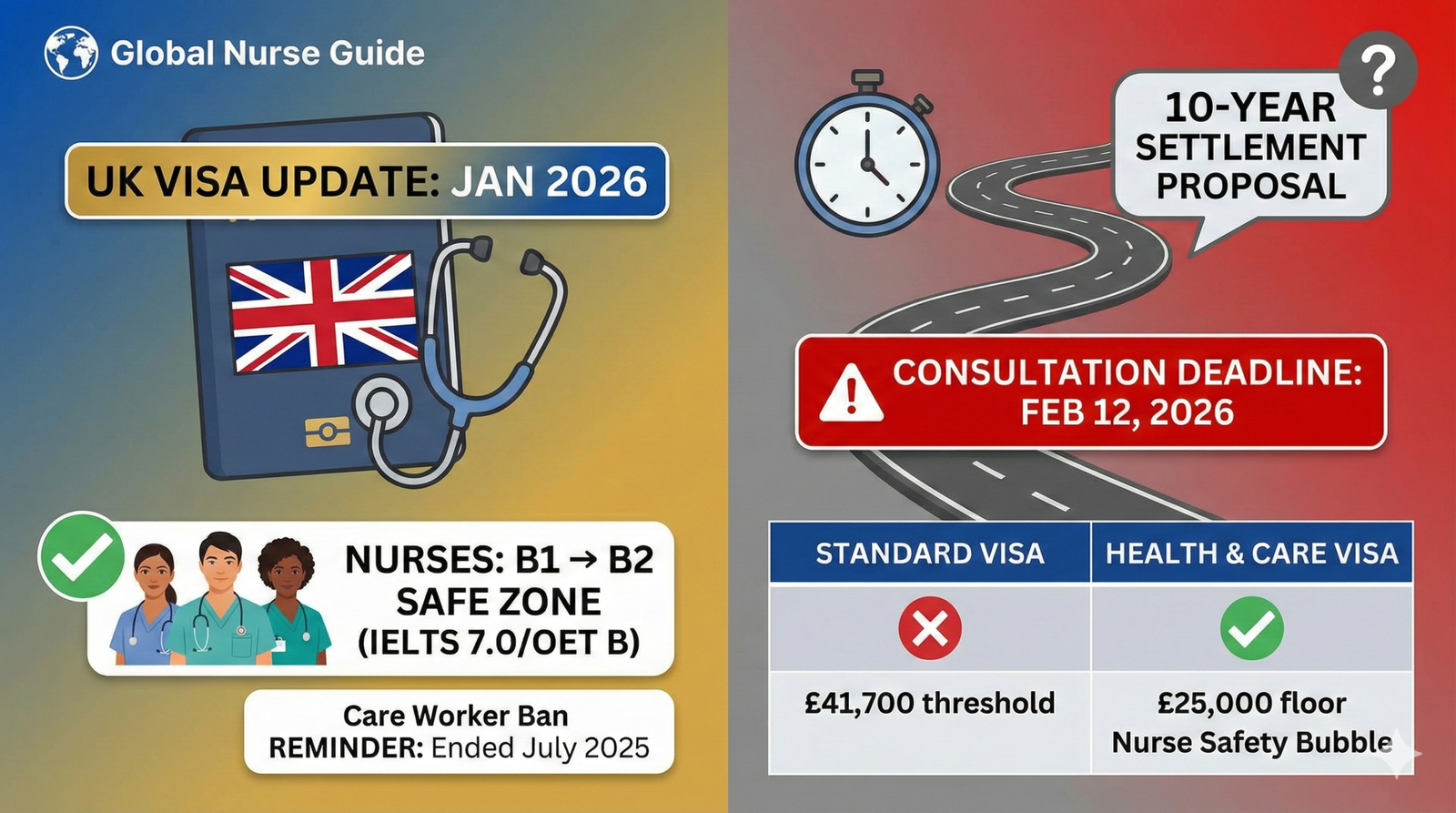
📲 Follow the Channel🇬🇧 UK Visa Rules for Nurses – 2026 Reality Check
B1 → B2 English: Active law, Jan 8, 2026 (Skilled Worker route)
NMC requires: IELTS 7.0 / OET B – already above B2
Earned settlement: 10-year baseline; nurses propose to keep 5-yr route via public-service deduction
General Skilled Worker threshold: £41,700 (from July 22, 2025)
Health and Care Worker threshold: £25,000 (or going rate)
NHS Band 5 entry (April 2026): £32,073
Care Worker overseas recruitment: STOPPED since July 22, 2025
Immigration Skills Charge: £1,320/yr (up 32% from Dec 16, 2025)
1. The B2 English Rule – Active Since January 8, 2026
This change is no longer a proposal. As of January 8, 2026, the English language requirement for new Skilled Worker visa applicants rose from B1 (Intermediate) to B2 (Upper Intermediate) on the CEFR scale. The rule applies to all Certificates of Sponsorship assigned on or after that date.
Why nurses do not need to panic
There has been widespread anxiety in migrant communities about the change. For registered nurses, that anxiety is misplaced. The Home Office and the Nursing and Midwifery Council (NMC) operate on separate English-language standards, and yours is the higher one.
Visa requirement (B2): roughly IELTS 5.5–6.0.
NMC requirement for PIN registration: IELTS 7.0 overall with 6.5 in writing, or OET Grade B.
Because NMC’s standard is materially higher than the new B2 visa requirement, any nurse who meets NMC registration English requirements automatically exceeds what the visa needs. You do not need to take a separate English test for the visa.
The real risk: dependant spouses
The genuine danger sits with partners and spouses. When entering as a dependant, the English standard is lower – many dependants have no test requirement at the visa stage at all. But if your spouse later wants to switch into their own Skilled Worker visa – to take a skilled job, qualify for their own settlement path, or work in a sponsored trade – they will need B2 English at that point.
If your partner intends to work in a skilled role in the UK, the practical advice is straightforward: target IELTS 6.0+ preparation before you leave your home country. The cost of an English test before departure is a fraction of the cost of needing one in a hurry years later, and it preserves your family’s options.
2. The Earned Settlement Reform – What Is and Isn’t Decided
On November 20, 2025, the Home Office launched a consultation titled “A Fairer Pathway to Settlement,” proposing the most significant overhaul of UK Indefinite Leave to Remain in a generation. The consultation closed on February 12, 2026, having received approximately 130,000 responses. Implementation began from April 2026, with the Home Secretary telling MPs that the full set of changes would be phased in. The picture in May 2026 is part-implemented, part-finalising, part-contested.
The headline proposal
The current 5-year route to ILR for most Skilled Workers is being replaced by an “earned settlement” model with longer baseline residence periods:
- 10 years for most migrants (up from 5)
- 15 years for Health and Care visa holders in lower-skilled roles (below RQF level 6)
- 20 years for refugees on the core protection route
Settlement under this model is no longer automatic after time served. It must be “earned” through demonstrated good conduct, contribution, and integration. The traditional 10-year long residence route has been abolished – migrants can no longer aggregate time across mixed visa categories the way they once could. The English requirement at the ILR stage is proposed to be B2.
The proposed nurse exemption
The November 2025 consultation document includes a proposed 5-year public-service deduction for those in specified essential occupations, including NHS doctors and nurses. The arithmetic is meaningful:
10-year baseline − 5-year public-service deduction = 5-year settlement.
If this proposal is adopted as drafted, an NHS-employed registered nurse continues to reach ILR after 5 years, just as before the reform. That is the “Safety Bubble” registered nurses are still inside in 2026.
The two parts of the proposal that are not yet settled
Two specific elements of the proposal remain contested as of mid-May 2026, and nurses planning their futures should monitor both.
First, NHS Employers’ February 2026 consultation response pushed strongly for the public-service deduction to cover all health and care workers regardless of skill level, not just RQF 6+ nursing roles. The current proposed text creates a sharp cliff between registered nurses (5-year route) and lower-skilled care workers (15-year route). Whether the final rules adopt NHS Employers’ broader exemption, the narrower published proposal, or something in between is not yet clear.
Second, the consultation invited views on transitional arrangements – whether migrants already on a 5-year route at the date of implementation should be protected from the new 10-year baseline. The Home Office signalled that transitional arrangements might be considered “for borderline cases” but committed to nothing. NHS Employers argued in their formal response that staff already on a settlement pathway under existing rules should not be disadvantaged. The final position is awaited.
What this means for private-sector nurses
The consultation language specifically refers to “NHS” employment and “specified public service occupations.” If you are working for a private hospital group, a nursing agency, or a private care home, you must monitor the final outcome carefully. The intent of the public-service deduction appears to be linked to the employer (NHS) rather than the profession (nursing). If the final rules adopt that narrower reading, private-sector nurses could face the 10-year baseline despite holding identical clinical credentials.
For a complete picture of how the UK route compares to Canada (6–12 months to PR via Express Entry healthcare draws) and Australia (immediate PR via Subclass 189 when invitations resume), see our UK vs Canada vs Australia for Nurses 2026 guide.
3. Salary Thresholds – Where the Nurse Advantage Is Real
The financial barrier to UK sponsorship rose sharply through 2025, but nursing retained a privileged position. The two key numbers:
| Visa Category | 2026 Salary Threshold | Impact on a Nurse |
|---|---|---|
| General Skilled Worker | £41,700 | Out of reach for new-graduate nurses |
| Health and Care Worker visa | £25,000 (or going rate) | Protected – covers Band 5 onward |
| New entrant rate (general) | £33,400 | For under-26s, students, ISL roles |
The general Skilled Worker threshold rose to £41,700 from July 22, 2025 – meaningfully higher than the £38,700 it replaced. For a junior IT worker, accountant, or general business hire, this threshold is now a real barrier. The Migration Advisory Committee’s January 2026 review of salary requirements explicitly notes this has shifted Skilled Worker sponsorship “towards higher-paid, RQF 6+ roles.”
For nurses, the Health and Care Worker visa retains its separate £25,000 minimum (or £12.82 per hour). The NHS Band 5 starting salary from April 2026 is £32,073 – comfortably above the floor. This is the salary protection that keeps the UK accessible for nurses while it becomes harder for other migrant groups. Combined with the Immigration Health Surcharge (£1,035 per year) being waived for Health and Care Worker visa holders – a substantial multi-year saving – the nurse route remains genuinely viable.
One caution about the Immigration Salary List (ISL): it is scheduled to expire by December 31, 2026. Some healthcare occupations have used the ISL to access discounted salary thresholds. The Migration Advisory Committee’s final report on a replacement Temporary Shortage List was expected in mid-2026. Registered nursing on the standard Health and Care Worker visa is not dependent on the ISL – but anyone relying on an ISL discount should plan for its end.
For full breakdowns of NHS pay bands and take-home pay, see our NHS Pay Calculator 2026/27.
4. The Care Worker Ban – Why the Backdoor Is Closed
One context point is essential to understand. As of July 22, 2025, the UK Home Office stopped overseas recruitment for Care Workers (SOC 6135) and Senior Care Workers (SOC 6136). You can no longer enter the UK as a carer from overseas and “upgrade” later to a nursing role.
That has two practical consequences:
First, if you want to work in UK healthcare from abroad, you must arrive as a Registered Nurse. The care worker route as an entry point is closed.
Second, and more urgently, for the substantial population of care workers already in the UK on a care visa: you sit in a precarious position. The current proposals put care workers in the 15-year ILR baseline (versus the proposed 5-year route for nurses with NHS employment). The gap between a 5-year and a 15-year path to permanent residency is a decade of your working life.
The only realistic survival pathway for care workers in the UK is to complete NMC registration, obtain a PIN, and switch to the registered nursing visa code (SOC 2231) before the new framework fully embeds. Do not delay. Every month spent on the care visa is a month not counting toward a 5-year nurse pathway.
5. Employer Costs in 2026 – Why Some Sponsors Pulled Back
The increased costs of sponsoring overseas workers are mostly borne by the employer, not the visa applicant. But they have a direct effect on how willing different employers are to sponsor at all. The headline 2025-2026 increases:
Certificate of Sponsorship fee rose from £239 to £525 (April 2025 increase).
Immigration Skills Charge rose 32% to £1,320 per sponsored year for large sponsors, with the smaller-sponsor rate at £480, for applications from December 16, 2025.
The combined effect: employer cost per sponsored worker has risen by roughly £18,000–£20,000 over a five-year sponsorship period once National Insurance and pensions are factored in. This has made smaller employers more cautious about sponsorship and pushed concentration toward larger NHS Trusts and established healthcare groups that can absorb the cost.
For nurses, this is mostly a narrowing of who will sponsor you, not whether sponsorship exists. Large NHS Trusts continue to recruit at scale. The risk is more acute for nurses targeting smaller private hospitals or independent care providers.
6. Action Plan for Nurses in Mid-2026
If you have a job offer in hand: push for your Certificate of Sponsorship as soon as possible. The earlier you are in the system, the stronger any argument for transitional protection under the older settlement framework. The Home Office has not committed to broad transitional arrangements, but historical precedent and ongoing NHS Employers advocacy suggest some protection for those already on pathways is plausible.
If your spouse intends to work: prepare for B2 English before leaving home. Plan to take an English test together so both visas are protected. The cost of getting this right early is far smaller than the cost of being stuck later.
If you are an Indian, Filipino, or Nigerian nurse weighing options: compare the UK against Canada and Australia honestly. The UK gives you the fastest start (3-week visa, mature recruitment infrastructure) and the NHS exemption keeps the 5-year ILR path likely. Canada gives you the fastest PR (often 6–12 months after invitation) but a longer licensing timeline. Australia pays the highest salaries but requires AHPRA registration and may take 12–24 months end-to-end. For the side-by-side, see our UK vs Canada vs Australia for Nurses 2026.
If you are already in the UK on a care worker visa: prioritise NMC registration above all else. Pass your OSCE, obtain your PIN, switch to SOC 2231. Every month matters. The proposed 15-year route for care workers is the single most damaging element of the earned settlement reforms.
If you are a private-sector nurse: monitor the final earned settlement rules carefully. The proposed public-service deduction is currently framed around NHS employment. The final position on private-sector clinical nurses is not yet clear.
7. Frequently Asked Questions
Has the 10-year settlement rule been finalised?
Partly. The consultation closed February 12, 2026. Implementation began from April 2026, but full details continue to emerge through 2026. The Home Affairs Committee report (March 2026) called for a clearer implementation timeline. The principle is set; some specifics remain in flux.
Will registered nurses get the 5-year exemption?
The published consultation proposes a 5-year public-service deduction for NHS doctors and nurses. NHS Employers pushed for it to cover all health and care workers regardless of skill level. The final wording is awaited. Best plan: assume the proposed 5-year route holds for NHS-employed registered nurses, but verify when final rules publish.
I’m a private-sector nurse – am I exempt?
Unclear. The consultation language emphasises “NHS employment” and “specified public service occupations.” Whether the deduction applies to the profession (nursing) or the employer (NHS) is the live question. Monitor the final rules.
Do I need to take a new English test for the B2 rule?
For NMC registration, no – the IELTS 7.0/OET B you need for your nursing PIN already exceeds B2. For the visa itself, your NMC English meets the requirement automatically. Dependants are the exception – if your spouse will eventually need their own Skilled Worker visa, they will need B2.
What is the current Band 5 starting salary?
£32,073 from 1 April 2026, after the 3.3% NHS Agenda for Change pay award. This is well above the Health and Care Worker visa’s £25,000 minimum.
Can I still come as a care worker?
No. Overseas recruitment for Care Workers (SOC 6135) and Senior Care Workers (SOC 6136) stopped on July 22, 2025. You must arrive as a Registered Nurse.
What about care workers already in the UK?
Proposed for the 15-year settlement route. The best practical option is to complete NMC registration, get a nursing PIN, and switch to the registered nurse visa code (SOC 2231) to access the proposed 5-year nurse pathway. Do not wait.
Is the UK still worth it compared to Canada or Australia?
Depends on your priorities. UK = fastest start, lowest upfront cost, mature NHS recruitment. Canada = fastest PR (6–12 months after invitation), strongest long-term family settlement. Australia = highest pay, but longer licensing for nurses outside comparable jurisdictions. See our side-by-side comparison.
The Bottom Line
The UK has tightened almost everything about its immigration system in 2025–2026. Higher salary thresholds, higher employer costs, longer routes to permanent residency, stricter English requirements, and the closure of the care-worker entry pathway. Most categories of migrant are genuinely worse off.
Registered nurses sit in an unusual position. The Health and Care Worker visa is still inexpensive and fast. The English requirements were already exceeded by NMC standards. The proposed 5-year public-service deduction preserves the historical settlement timeline. NHS Band 5 entry pay rose to £32,073 in April 2026. The supply-demand picture continues to favour clinical nurses, with NHS Trusts under sustained pressure to recruit internationally.
What this means in practice: the UK remains workable for nurses where it has become much harder for others. The “Safety Bubble” the original advisory described is real – with the caveats that the bubble’s edges (private-sector nurses, transitional arrangements, the precise wording of the final exemption) remain under negotiation. Stay informed, monitor the final earned settlement rules as they finalise through 2026, and act early rather than late.
Related guides on GlobalNurseGuide.com:
UK NHS Nursing Jobs Guide 2026: Pay, Visas & NMC
NHS Pay Calculator 2026/27: Band 5-9 Take-Home
UK vs Canada vs Australia for Nurses 2026
Disclaimer: This article is for informational purposes only and does not constitute immigration or legal advice. UK immigration rules, settlement pathways, salary thresholds, and English language requirements are subject to change. The Earned Settlement reforms are partly implemented and partly in finalisation as of May 2026; final wording on exemptions, transitional arrangements, and private-sector treatment is awaited. Always verify current information directly with the UK Home Office (gov.uk), the Nursing and Midwifery Council (nmc.org.uk), and NHS Employers (nhsemployers.org). Consult a regulated immigration adviser (OISC/SRA) for advice specific to your situation. Information current as of May 14, 2026.
Author

Discover more from Global Nurse Guide
Subscribe to get the latest posts sent to your email.