ICU Nursing Career Guide 2026: CCRN Certification, Salary & How to Enter Critical Care
ICU Nursing Career Guide 2026: CCRN Certification, Salary & How to Enter Critical Care
By Abirami Arumugam, RN, Chief Editor, GlobalNurseGuide.com
The defining fact of intensive care unit nursing is the ratio. Most hospital nurses manage four to six patients per shift. ICU nurses manage one or two. That difference is not a staffing preference. That ratio reflects the clinical intensity of the patients in those beds. Haemodynamically unstable. Mechanically ventilated. Vasopressor-dependent. Post-operative from major surgery with multiple active complications. The nurse-to-patient ratio exists because the assessment and intervention demands of each ICU patient require continuous attention that a higher ratio would make clinically unsafe. Understanding this from the start frames what every other aspect of ICU nursing, the skills, the certification, the career trajectory, is built around.
The types of ICU, and what each means for your career
Critical care nursing is not one environment. Different ICU types draw on overlapping skill sets but carry distinct patient populations and specific clinical expertise.
🩺 Join FREE WhatsApp Channel for Trusted Guide
Get weekly vacancy alerts, EB-3 visa updates & daily NCLEX prep on WhatsApp — FREE.
📲 Follow the ChannelThe Medical ICU, commonly called the MICU, manages adult patients with severe acute medical illness. Septic shock, respiratory failure, decompensated organ failure, and complex medication toxicities are routine presentations. The MICU is where many nurses begin their ICU careers, and it builds the broadest critical care foundation.
The Surgical ICU, or SICU, receives post-operative patients from major abdominal, vascular, and thoracic surgery. The immediate post-surgical period requires rapid assessment of surgical complications, fluid balance management, and recognition of haemodynamic changes that indicate bleeding or anastomotic problems.
The Cardiac ICU and Cardiovascular ICU manage patients after cardiac surgery: coronary artery bypass, valve replacements, and heart transplants. Patients on mechanical circulatory support devices, including intra-aortic balloon pumps and left ventricular assist devices, also land here. These units also manage severe acute coronary syndromes and cardiogenic shock. The CVICU is technically demanding and typically requires the CMC and CSC certifications from AACN. The revised CMC and CSC exams launch on November 19, 2026, per AACN’s published schedule. Nurses preparing for those certifications should verify the current content outline at aacn.org rather than relying on study materials produced before that date.
The Neurological ICU manages patients after stroke, traumatic brain injury, and neurosurgical procedures. Neuro ICU nurses monitor intracranial pressure, manage post-operative cranial drainage systems, and assess neurological status using standardised scales. The frequency and precision of that assessment is specific to this patient population.
Burn ICUs, trauma ICUs, and paediatric ICUs each carry their own subspecialty demands. Paediatric and neonatal ICU nursing was covered in the paediatric nursing career guide on this site. This article addresses adult critical care.
What ICU nurses actually manage on a shift
The clinical task list in an ICU shift is wide and technically specific. A working understanding of it before you apply for the specialty is worth more than any skills checklist.
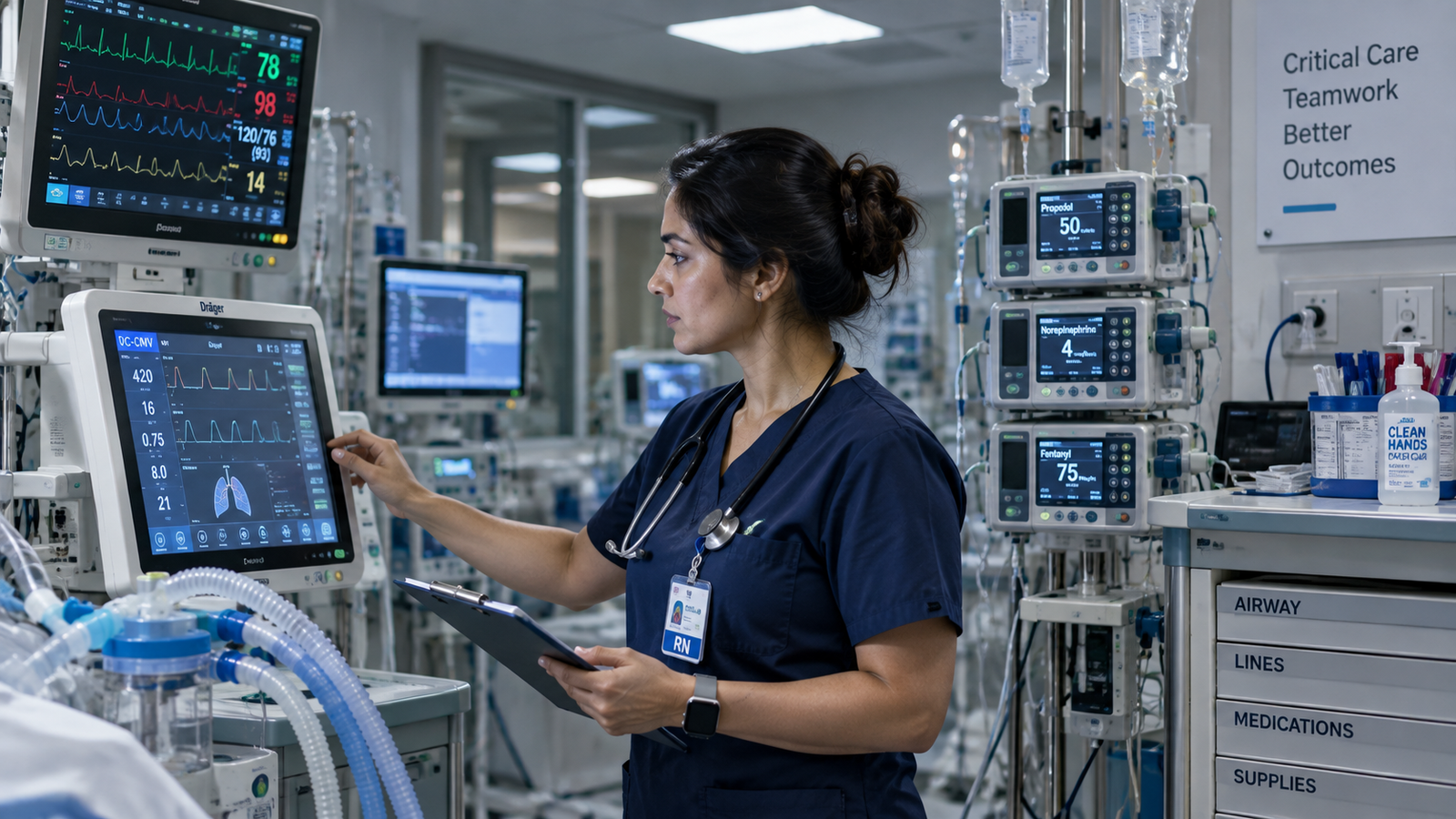
Mechanical ventilation management is central to MICU and most ICU practice. ICU nurses do not set initial ventilator parameters: that is the physician’s role. They assess breath sounds, review waveforms, troubleshoot alarms, identify changes in the patient’s respiratory mechanics, and communicate those changes to the team. A nurse who cannot read a pressure-time waveform or identify a dyssynchrony is not safe in a unit that runs ventilated patients.
Vasopressor infusions are the other clinical constant. Norepinephrine, vasopressin, phenylephrine, and dopamine all require continuous infusion through a central venous catheter, titrated to maintain a target mean arterial pressure. Titrating a vasopressor is not a simple task of turning a dial. It requires understanding the patient’s underlying haemodynamic picture, which comes from continuous monitoring of arterial line waveforms, central venous pressures, and clinical signs of perfusion.
Continuous renal replacement therapy, CRRT, is managed in units where renal failure is part of the patient census. CRRT runs as a continuous dialysis circuit through the patient’s central line. ICU nurses who are CRRT-trained manage the circuit, troubleshoot alarms, document hourly fluid balances, and communicate circuit changes to the nephrologist or intensivist.
Extracorporeal membrane oxygenation, ECMO, is a more specialised circuit that functions as temporary lung or heart-lung support. Not every ICU runs ECMO. Those that do require dedicated ECMO-trained nursing staff, typically certified through a facility-specific training programme and the Extracorporeal Life Support Organization.
ICU delirium is a clinical reality that surprises many nurses entering the specialty. The CAM-ICU, the Confusion Assessment Method for the ICU, is the validated tool used to assess delirium in intubated patients who cannot communicate verbally. Running a CAM-ICU assessment correctly is a daily task. Understanding what a positive result means for the care plan matters. Documenting it accurately matters equally. Nurses who have not been trained on it before entering the specialty encounter it immediately.
Can new graduates go directly to the ICU?
The short answer: sometimes. The longer answer changes what the short answer means in practice.
Most Level I and Level II trauma centre ICUs do not hire new graduate nurses directly. Major academic medical centre intensive care units take the same position. The haemodynamic complexity of the patient population creates a safety requirement that nursing school clinical placements do not meet. Independent clinical assessment from the first unsupervised shift is the expectation, not a goal.
Some hospitals run dedicated critical care new graduate residency programmes. These structured programmes typically run 12 to 18 months. They take nurses from graduation to independent ICU practice through supervised orientation, simulation training, and competency-based milestones. Finding one of these programmes is the fastest route into ICU from nursing school. Not all of them are advertised on standard job boards. Many are posted directly through health system career pages.
Without access to a critical care residency programme, the established route is one to two years in a high-acuity setting before transferring to ICU. Telemetry, step-down or progressive care units, and high-acuity medical-surgical units all build relevant clinical foundations. Emergency nursing experience also transfers strongly. The skill the ICU specifically values is the ability to assess a changing patient and recognise clinical deterioration before the monitoring equipment catches up. That skill builds in settings where you have managed acutely ill patients under time pressure.
CCRN certification: the credential ICU nurses pursue and what it actually requires
The Critical Care Registered Nurse certification, CCRN, is issued by the AACN Certification Corporation, the credentialing body of the American Association of Critical-Care Nurses. It comes in three versions: Adult, Pediatric, and Neonatal. The CCRN (Adult) is the credential most hospital ICU nurses pursue.
AACN offers two eligibility pathways as of 2026.
The two-year pathway requires a current, unencumbered RN licence. At least 1,750 hours of direct bedside care of acutely or critically ill adult patients in the past two years are also required. Of those 1,750 hours, at least 875 must have been earned in the most recent year preceding the application.
The five-year pathway requires at least 2,000 hours of direct care of acutely or critically ill adult patients in the past five years. At least 144 of those hours must fall in the most recent year.
Both pathways accept hours earned in ICU, cardiac care units, trauma units, and critical care transport or flight. The exam consists of 150 multiple-choice questions, computer-administered, covering clinical judgement across major organ systems and evidence-based critical care practice.
The exam application fee is USD 255 for AACN members and USD 370 for non-members. Membership in AACN costs USD 49.50 per year. For a nurse who plans to renew over multiple cycles and access AACN’s CE library, membership pays for itself quickly. The certification is valid for three years. Renewal requires either re-examination or 432 direct bedside care hours in critically ill patient care across the three-year period. At least 144 of those hours must fall in the 12 months before renewal. One hundred continuing education points in clinical content are also required.
Over 138,000 nurses hold active AACN certifications as of 2024. Industry salary survey data from 2026 sources places the CCRN premium at approximately USD 18,000 per year above non-certified ICU nurse compensation. This figure is from nursing workforce surveys, not a BLS primary source, and should be treated as a directional indicator. What the BLS does confirm is that the median annual wage for registered nurses across all settings was USD 93,600 in May 2024. ICU nurses, given the acuity of their setting and the shift differential structures common to 24-hour units, typically earn above that median.
Progressive care and the PCCN as a stepping stone
Nurses working in step-down or progressive care units before transferring to ICU can pursue the PCCN from AACN. It stands for Progressive Care Certified Nurse. The PCCN uses the same eligibility hour structure as the CCRN: 1,750 hours in direct progressive care in the past two years, with 875 in the most recent year. The content covers the less acute patient population of step-down units.
Holding the PCCN before applying for ICU positions demonstrates to hiring managers that you pursued certification during your step-down experience rather than simply waiting. It also builds exam preparation habits that carry directly into CCRN study.
Where an ICU career goes from the bedside
The ICU is one of the most productive launching points for advanced nursing practice.
The Certified Registered Nurse Anesthetist pathway draws heavily from ICU nursing. CRNA programmes require at least one year of ICU experience, and competitive applicants typically have two or more years in a high-acuity adult ICU. The CRNA career guide on this site covers the full educational and certification pathway in detail. The CRNA brings the haemodynamic assessment skills, vasopressor experience, and airway management exposure that ICU nursing builds. These are not coincidental overlaps.
Acute Care Nurse Practitioner programmes, which lead to the ACNPC-AG certification from AACN, also draw directly from ICU experience. AACNPs practice in the inpatient acute and critical care environment, managing the same patient population at the advanced practice level. The educational background required by these programmes is designed specifically for nurses coming from acute care settings.
Flight nursing and critical care transport are natural career extensions from bedside ICU practice. These roles require managing critically ill patients in transport environments with limited equipment and no nearby team. The independent judgement is the same as ICU nursing. The physical demands are greater.
What the unit takes from you over time
An ICU career asks something specific of nurses that is worth stating plainly before you commit to it.
The emotional weight is different from other specialties. ICU nurses build relationships with families during extended admissions, and they are present for deaths that are not always peaceful or expected. They are also present for recoveries that were not expected to occur. Both experiences repeat across a career. Holding those experiences without accumulating a burden that impairs clinical function is what separates nurses who build long ICU careers from those who leave after a few years.
Physiological knowledge requirements in the ICU are higher than in any other bedside nursing setting. A nurse who cannot explain what the arterial line waveform is showing is not functioning at the level the patient’s care requires. Neither is one who cannot track the relationship between CVP trends and fluid responsiveness. That knowledge base is not built in orientation. It builds over months at the bedside, and it keeps building for years. Nurses who remain intellectually curious about the physiology build a different kind of expertise. They come back after a complex shift to read about a mechanism they did not fully understand. Over time, they become the clinical authorities newer nurses rely on. That trajectory takes longer in ICU than in most specialties. The depth of expertise it produces is also greater.
My years in hospital nursing convinced me that the ICU environment tests a specific kind of resilience: the capacity to remain calibrated under sustained pressure. Acute crisis is something most nurses handle. Chronic pressure is different: caring for patients who may not improve, with families watching that trajectory every day. The nurses I respected most in critical care were not the ones who appeared unmoved by difficult outcomes. They were the ones who processed the difficulty honestly and returned the next shift with their clinical judgment intact.
Sources:
American Association of Critical-Care Nurses, aacn.org, CCRN (Adult) certification eligibility, examination structure, fees, and renewal requirements; AACN Certification Corporation certification holder counts, 2024; Bureau of Labor Statistics Occupational Employment and Wage Statistics, May 2024, Registered Nurses (29-1141), bls.gov; Extracorporeal Life Support Organization, elso.org.
BLS OES May 2024 reports a national median of USD 93,600 for registered nurses across all settings and specialties. BLS does not separately track ICU nursing compensation. The USD 18,000 CCRN salary premium figure is drawn from nursing industry workforce surveys from 2026 sources and is not a BLS primary figure; treat it as directional rather than precise. CCRN fees, eligibility requirements, and CMC/CSC exam content are set by AACN and subject to change. Verify current requirements at aacn.org before applying. This article describes ICU nursing clinical responsibilities in informational terms and does not constitute clinical guidance or practice instruction. For clinical decisions, follow your facility’s protocols and your state Board of Nursing’s scope of practice rules.
Author

Discover more from Global Nurse Guide
Subscribe to get the latest posts sent to your email.