Oncology Nursing Career Guide 2026: OCN Certification, Salary & What the Specialty Actually Involves
Oncology Nursing Career Guide 2026: OCN Certification, Salary & What the Specialty Actually Involves
By Abirami Arumugam, RN, Chief Editor, GlobalNurseGuide.com
Oncology nursing is built around long-term patient relationships. A nurse in the emergency department sees a patient for hours. A nurse in a general surgical ward sees a patient for days. An oncology nurse may follow the same patient through diagnosis, treatment, response, recurrence, and end-of-life care over months or years. That continuity draws nurses to the specialty. It is also what makes the emotional weight specific and cumulative in ways most other nursing environments are not. This guide explains what oncology nurses actually do and how to enter the specialty. Which certifications matter and what each requires follow. Career development beyond the bedside comes last.
What oncology nurses do, across settings
Oncology nursing happens in more settings than most nurses realise before they enter the field. The work and the clinical skill set differ substantially by environment.
🩺 Join FREE WhatsApp Channel for Trusted Guide
Get weekly vacancy alerts, EB-3 visa updates & daily NCLEX prep on WhatsApp — FREE.
📲 Follow the ChannelInpatient haematology-oncology units manage patients admitted for chemotherapy cycles needing hospital monitoring. Cancer-related complications including febrile neutropenia, hypercalcaemia, and tumour lysis syndrome are also managed there. Post-procedure recovery from bone marrow biopsies and central venous catheter placements rounds out the census. The inpatient unit sees acute decompensations. It also sees patients admitted for planned treatment who are familiar faces from multiple previous admissions.
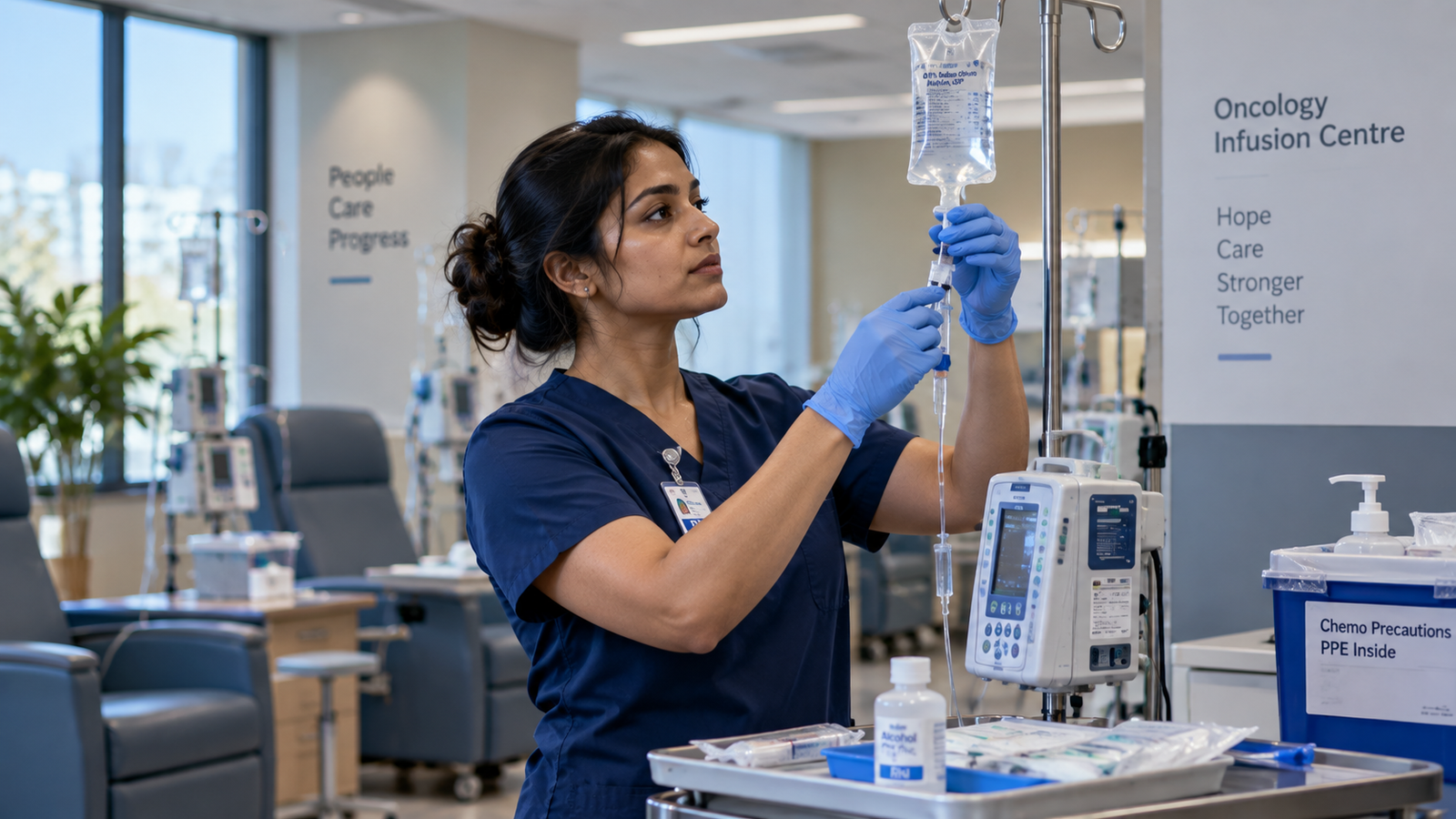
Outpatient infusion centres are the largest and fastest-growing oncology nursing setting. Most patients receiving chemotherapy today receive it in an outpatient chair, not an inpatient bed. A nurse in an outpatient infusion centre manages a full-day caseload. Each patient receives a pre-infusion assessment and lab review. Pre-medications and chemotherapy agents follow. Monitoring for acute reactions continues throughout. Patient education on side effect management between cycles happens at every visit. The pace is different from inpatient oncology. The acuity of individual patients is generally lower. The volume and the coordination demands are higher.
Radiation oncology nursing supports patients through radiation treatment. Radiation nurses assess for radiation-related side effects, educate on skin care, and manage fatigue, mucositis, and other toxicities across a course of radiotherapy lasting weeks. The knowledge specific to radiation effects is a distinct subset of oncology nursing. Nurses who specialise in it often describe it as underrecognised for how specific the expertise actually is.
Bone marrow and stem cell transplant units occupy a separate tier of clinical complexity within oncology. BMT nurses manage patients whose immune systems have been deliberately ablated by high-dose conditioning regimens before transplant. The result is profound immunosuppression lasting weeks. The infection risk, the graft-versus-host disease monitoring, and the prolonged isolation requirements make BMT nursing more technically demanding than most inpatient oncology roles. The BMTCN credential from ONCC reflects that distinct expertise.
Clinical trials nursing is a subspecialty that most career guides barely mention. Research nurses manage protocol adherence, collect and record data, educate patients about trial participation, obtain informed consent, and coordinate between the clinical team and the research sponsor. This role sits at the intersection of nursing, research methodology, and regulatory compliance. Demand for this role has grown as oncology drug development has accelerated. It offers career paths into research coordination and clinical operations that standard clinical nursing tracks do not.
The certifications: OCN, the chemo certificate, and what each one actually is
Many nurses entering oncology confuse two credentials that are entirely different in structure and credential level. Getting this right before you invest time and money matters.
The OCN: board certification from ONCC
The Oncology Certified Nurse, OCN, is a board certification issued by the Oncology Nursing Certification Corporation at oncc.org. It is NCCA-accredited and is the foundational credential for adult oncology registered nurses. It is not a course and does not award continuing education hours. It appears after your RN designation on your credentials line.
Eligibility requires a current, active RN licence in the United States. A minimum of two years of RN experience within the four years prior to application is required. So is at least 2,000 hours of adult oncology nursing practice within the same four-year window. Finally, 10 contact hours of CE in oncology in the three years before application are needed.
The exam has 165 questions, of which 150 are scored, delivered by computer through PSI testing centres and remote proctoring. Six content domains are assessed: the scientific basis of cancer, oncology nursing practice, care of patients on active treatment, side effect management, symptom management, and the psychosocial dimensions of cancer care. ONCC’s 2026 Test Content Outline maintains the same six domains and weighting as the 2025 version. Study materials from 2025 remain current.
The application fee is USD 300 for Oncology Nursing Society members and USD 420 for non-members. ONS membership costs less than the fee difference, so joining before registering for the exam makes financial sense if you plan to maintain membership. Certification is valid for four years. Renewal uses ONCC’s Individual Learning Needs Assessment pathway. It requires completing professional development activities targeted to your identified practice gaps. Re-examination is not always required.
One caution about the exam: the Psychosocial Dimensions of Care domain is weighted at 10%. Nurses who prepare primarily through clinical experience consistently underestimate this section. Candidates who study only the content they administer and observe at the bedside tend to lose points in this domain. Address it specifically in your preparation rather than assuming clinical exposure is sufficient.
The ONS Chemotherapy/Immunotherapy Certificate: a CE course, not a board certification
The Chemotherapy/Immunotherapy Certificate from the Oncology Nursing Society is a continuing education course, not a board certification. It does not appear as a credential after your name. It awards 15 contact hours and demonstrates that you have completed structured training in safe chemotherapy and immunotherapy administration.
Most oncology employers require this certificate before a nurse independently administers chemotherapy. Eligibility requires that you have administered chemotherapy for at least one year and at least once per month before taking the course. The certificate is valid for two years. It is sometimes listed incorrectly in job postings as if it were equivalent to the OCN board certification. It is not.
Entering oncology for the first time, the sequence is straightforward. Begin working in an oncology setting. Complete the ONS course once eligibility is met. Pursue the OCN after reaching the required 2,000 hours and two years of RN experience.
The broader ONCC credential family
ONCC offers eight certifications in total. Beyond the OCN, several credentials address specific career directions. The CPON covers paediatric oncology. The CPHON covers paediatric haematology oncology. The BMTCN addresses bone marrow transplant nursing. The CBCN is for breast care specialists. The AOCN is for experienced nurses pursuing an advanced credential without an NP degree. The AOCNP and AOCNS are for advanced practice nurses. All ONCC certifications share the same four-year renewal cycle and the same requirement for an active, unencumbered RN licence.
What chemotherapy administration specifically requires a nurse to know
Chemotherapy agents are not interchangeable or approximated. The classification of a chemotherapy agent matters clinically in a way that affects how every administration is set up.
Vesicant chemotherapy agents cause tissue destruction if they extravasate from the vein into surrounding tissue. Anthracyclines like doxorubicin, vinca alkaloids like vincristine, and several other agents are vesicants. Administering a vesicant through an IV that is not confirmed patent is a clinical error with permanent consequences for the patient. Oncology nurses develop a specific discipline around assessing IV access before vesicant administration. It becomes second nature after the first year. In the first months, it is deliberate and sometimes nerve-wracking.
Irritant agents are less severe than vesicants but still require attention to site integrity. Non-vesicant agents are more forgiving but still require correct diluent, rate, pre-medication sequence, and patient monitoring.
Central venous access is the norm for patients receiving multiple cycles of chemotherapy. Peripherally inserted central catheters, tunnelled catheters, and implanted ports all require specific nursing knowledge for access, flushing, dressing changes, and trouble-shooting. The port needle insertion procedure, which oncology nurses perform routinely, is a clinical skill taught in orientation and refined through repetition. A nurse who has never accessed a port before entering oncology encounters it in the first week.
Salary and what the data shows
BLS OES May 2024 reports a national median annual wage of USD 93,600 for registered nurses across all specialties and settings. BLS does not publish a separate oncology nursing wage category.
Industry compensation data from Vivian.com, updated August 19, 2026 and based on active job postings, puts the oncology nurse average at USD 49.09 per hour. Annualised to a standard full-time schedule, that is approximately USD 102,107 per year. Vivian notes this is 2% above the general nursing average it tracks. These figures are from an employment platform, not a BLS primary source. Treat them as directional indicators of market positioning, not verified averages.
The OCN certification adds a measurable premium at most institutions that have a formal certification pay programme. ONS surveys of oncology nurses consistently show higher reported compensation among OCN-certified nurses than their non-certified peers. Specific differentials are self-reported and vary by employer.
Can new graduates enter oncology nursing?
Oncology is more accessible to new graduates than critical care or perioperative nursing, and less accessible than some people assume.
Inpatient haematology-oncology units at many hospitals hire new graduates into structured orientation programmes. The clinical complexity is significant but the patient population is generally stable enough that a new graduate nurse with strong mentorship can develop competently. Outpatient infusion centres vary. Some hire new graduates into long orientations. Others require prior clinical experience, because supervision in outpatient settings is less intensive than on inpatient units.
BMT units typically require one to two years of oncology or critical care experience before entry. Radiation oncology is also variable. Clinical trials roles generally require at least one to two years of clinical experience and specific research background or training.
For a nurse who knows oncology is the goal from graduation, the clearest route is an inpatient oncology new graduate residency programme. Complete the ONS chemo certificate as soon as eligibility is met. Pursue the OCN once the 2,000 hours and two years of RN experience are reached.
Where an oncology nursing career goes
Oncology nursing builds a career trajectory that is distinct from most other hospital specialties.
The ONN-CG (Oncology Nurse Navigator Certified Generalist) credential from the AONN+ Foundation for Learning is the most direct adjacent credential. The nurse navigator guide on this site covers this pathway in full. Navigation roles draw directly on oncology clinical experience. The nurse’s role shifts to care coordination, barrier removal, and sustained patient relationship management across the cancer continuum.
Clinical trials research nursing builds on oncology experience into a role that combines clinical assessment with data management, protocol adherence, and regulatory compliance. Senior research nurses and clinical research coordinators often earn above standard staff nurse rates. They also work environments with more regular hours and less shift work than inpatient units.
Advanced practice in oncology leads to the AOCNP credential. This requires completing an MSN or DNP with an NP focus, gaining national NP board certification, and then pursuing the AOCNP through ONCC. Advanced oncology NPs work in cancer centres, manage ongoing treatment regimens, and in full practice authority states practice independently. The scope of the AOCNP role extends to ordering imaging, interpreting labs, adjusting treatment plans, and managing complex symptom presentations across the cancer trajectory.
What the specialty asks of a nurse over time
I have watched oncology nurses work in settings where the patient population carries a diagnosis that, for a significant proportion of them, will become terminal. What I observed in the nurses who sustained long careers in the specialty was not an absence of emotional response to that reality. It was something more specific. A capacity to be genuinely present with a patient whose prognosis was poor. Without requiring the situation to be anything other than what it was.
Oncology nursing attracts nurses who find meaning in sustained relationship. It asks them to hold that relationship through difficult periods without taking refuge in either excessive clinical distance or unsustainable emotional investment. That balance is not taught in orientation. It develops through experience. Sometimes consciously, sometimes not. Through how a team holds each other through difficult losses. Through whether the unit’s culture lets nurses acknowledge the weight of the work without treating acknowledgement as clinical failure.
Nurses who enter oncology expecting to protect themselves from its emotional content by maintaining strict professional separation often leave within two years. Nurses who enter it expecting to handle everything through empathy alone burn out. The nurses who stay longest found a way to care genuinely, grieve appropriately, and return the next shift with the same capacity intact.
Sources:
Oncology Nursing Certification Corporation, oncc.org, OCN eligibility, examination structure, fees, and renewal requirements; Oncology Nursing Society, ons.org, Chemotherapy/Immunotherapy Certificate requirements; AONN+ Foundation for Learning, aonnffl.org, ONN-CG certification; Bureau of Labor Statistics Occupational Employment and Wage Statistics, May 2024, Registered Nurses (29-1141), bls.gov; Vivian.com oncology nurse compensation data, August 19, 2026 (third-party employment platform data, not a BLS primary source).
BLS OES May 2024 reports a national median of USD 93,600 for registered nurses across all settings and specialties. BLS does not separately track oncology nursing compensation. Industry salary data cited above is from third-party employment platforms and is indicative rather than definitive. OCN fees, eligibility criteria, and the Test Content Outline are maintained by ONCC and are subject to update. Verify current requirements directly at oncc.org before applying. This article covers oncology nursing in informational and career-guidance terms only and does not constitute clinical guidance, treatment advice, or professional licensing counsel.
Author

Discover more from Global Nurse Guide
Subscribe to get the latest posts sent to your email.