VA Hospital Nursing Jobs 2026: Salary, Benefits, $200K Loan Forgiveness & How to Apply
There’s a nursing employer in America that offers up to $200,000 in tax-free student loan repayment, a guaranteed federal pension for life, up to 50 paid days off per year, and the ability to work at any of 1,400+ facilities in all 50 states with a single nursing license.
That employer is the U.S. Department of Veterans Affairs (VA) – and it’s also the largest employer of nursing professionals in the entire country, with more than 100,000 nurses on staff.
Whether you’re a new graduate looking for your first job, a mid-career nurse drowning in student debt, or an experienced RN who wants to trade private-sector burnout for mission-driven work with real job security – the VA deserves serious consideration. And in 2026, they’re actively hiring across virtually every specialty and every state.
🩺 Join FREE WhatsApp Channel for Trusted Guide
Get weekly vacancy alerts, EB-3 visa updates & daily NCLEX prep on WhatsApp — FREE.
📲 Follow the ChannelThis guide covers everything: pay, benefits, loan forgiveness, residency programs, how to apply, what it’s really like to work there, and whether the VA is the right move for your career.
🏥 VA Healthcare System – By the Numbers (2026)
100,000+ nursing professionals employed
9 million+ Veterans served
1,400+ healthcare facilities in all 50 states & U.S. territories
171 VA Medical Centers
$200,000 maximum tax-free student loan repayment
Up to 50 paid days off annually (leave + holidays)
3-tier retirement: FERS pension + Social Security + TSP (401k-style)
1. Why Nurses Choose the VA (And Why You Should Consider It)
Let’s address the elephant in the room first. The VA has had its share of headlines – wait-time scandals, bureaucratic frustrations, facility challenges. So why would any nurse choose to work there?
Because beneath the headlines lies something most private hospitals simply cannot match: a benefits package that is, frankly, unrivaled in American healthcare.
Consider this scenario. A nurse with $120,000 in student loans takes a position at a VA hospital. Over five years, the VA’s EDRP program reimburses every dollar of that debt – tax-free, with no mandatory service agreement. That same nurse earns a competitive salary with locality adjustments, accumulates 50 days of paid leave annually, and is building a federal pension that will pay them a monthly annuity for life after retirement. Their employer contributes up to 5% of their salary into a retirement savings account (TSP) on top of everything else.
That’s not hypothetical. That’s what’s on the table right now for nurses willing to serve America’s Veterans.
And then there’s the mission itself. VA nurses serve a patient population unlike any other – men and women who’ve served their country, many carrying physical and psychological wounds that require specialized care. The clinical complexity is extraordinary. The gratitude from patients is genuine. And the sense of purpose is something many VA nurses say they simply couldn’t find in the private sector.
💬 From a VA Nurse
“I started my nursing career at the VA in 1995 – not just a job – as an LPN where the retirement benefits, health benefits and pay have provided me the privilege to work in many capacities while advancing my career. I value the diversity of settings and assignments with opportunities in acute, long-term, mental health, medical/surgical and primary care.”
2. Understanding the VA Healthcare System
The Veterans Health Administration (VHA) is the largest integrated healthcare system in the United States. Understanding its structure helps you navigate where and how to find the right position for you.
The Numbers
The VHA operates 171 VA Medical Centers (these are full hospitals, many with emergency departments, surgical suites, and inpatient beds) plus more than 1,200 outpatient sites including Community-Based Outpatient Clinics (CBOCs), Vet Centers, and domiciliary facilities. Together, these form the 1,400+ sites that serve over 9 million enrolled Veterans annually.
Types of VA Facilities
VA Medical Centers (VAMCs): Full-service hospitals with inpatient, outpatient, surgical, emergency, and specialty care. These are where most acute-care nursing positions are located. Examples include the VA Greater Los Angeles Healthcare System, VA Boston Healthcare System, and Michael E. DeBakey VA Medical Center in Houston.
Community-Based Outpatient Clinics (CBOCs): Smaller clinics that provide primary care and some specialty care closer to where Veterans live. These are ideal for nurses who prefer ambulatory care settings and more predictable schedules.
Community Living Centers (CLCs): VA’s long-term care facilities, providing skilled nursing, rehabilitation, hospice, and palliative care. These offer a different pace of nursing that many nurses find deeply rewarding.
Vet Centers: Community-based counseling centers providing readjustment services including PTSD treatment, military sexual trauma counseling, and bereavement counseling. Mental health nurses play a critical role here.
Home-Based Primary Care (HBPC): VA nurses provide care directly in Veterans’ homes for those who are homebound or have complex chronic conditions. This growing program offers significant autonomy and patient relationship building.
3. VA Nurse Pay: Title 38 Pay Scale Explained
VA nurse compensation operates under Title 38 of the U.S. Code – a pay system specifically designed for healthcare professionals. This is different from the General Schedule (GS) pay system used by most other federal employees, and it offers more flexibility and often higher salaries.
How Title 38 Pay Works
Your salary under Title 38 is determined by three factors working together: your grade (Nurse I, II, or III), your step within that grade (reflecting tenure and performance), and your locality (geographic adjustments based on cost of living and local market competition for nurses).
This means two nurses at the same grade and step can have meaningfully different paychecks depending on where they work. A Nurse II in San Francisco earns significantly more than a Nurse II in rural South Dakota – because the locality adjustment reflects the higher cost of living and competitive nursing market in the Bay Area.
VA Nurse Salary Ranges by Grade (2026 Estimates)
| Grade | Typical Role | Salary Range (With Locality) |
|---|---|---|
| Nurse I | Entry-level RN, new graduate, ADN or BSN | $60,000–$85,000 |
| Nurse II | Experienced RN, BSN preferred, demonstrated competency | $75,000–$115,000 |
| Nurse III | Advanced practice, leadership, master’s degree or above | $95,000–$145,000+ |
Additional Pay Components
Night Differential: 10% additional pay for evening and night shifts (covers both 2nd and 3rd shifts equally).
Weekend Premium: 25% additional pay for hours worked on weekends.
Holiday Pay: Double-time pay for hours worked on any of the 11 federal holidays.
Overtime: Time-and-a-half for hours exceeding the regular work schedule.
Recruitment/Relocation Incentives: For hard-to-fill positions, the VA can offer incentives of up to 25% of base salary.
💡 Look Up Your Exact Pay
You can find the exact salary range for any VA facility by visiting the Title 38 Pay Schedules page on the VA website. Enter your state and facility to see the Nurse Locality Pay Schedule with exact figures for each grade and step.
4. The VA Benefits Package: A Complete Breakdown
The VA benefits package is, in a word, extraordinary. Here’s everything you receive as a VA nurse, organized so you can see the full picture.
| Benefit | Details |
|---|---|
| Health Insurance (FEHB) | Federal Employees Health Benefits – hundreds of plan options nationwide. The government pays the majority of premiums. Coverage can continue into retirement. |
| Dental & Vision | Federal Employees Dental and Vision Insurance Program (FEDVIP). Separate enrollment with competitive group rates. |
| Life Insurance (FEGLI) | Federal Employees Group Life Insurance. Basic coverage at low cost; optional additional coverage for you, spouse, and children. |
| Retirement (FERS) | Three-tier system: defined benefit pension + Social Security + TSP with 5% employer match. Vests after 5 years. See full details in Section 6. |
| Paid Time Off | Up to 26 days annual leave + 13 days sick leave + 11 federal holidays = up to 50 paid days off per year. See full details in Section 7. |
| Student Loan Repayment (EDRP) | Up to $200,000 tax-free over 5 years ($40,000/year). No mandatory service agreement. See full details in Section 5. |
| Tuition Reimbursement | Employee Incentive Scholarship Program (EISP): up to $41,572 tax-free toward continuing education. Service agreement required. |
| Malpractice Coverage | Free – the Federal Tort Claims Act covers VA employees. You do not need personal malpractice insurance. |
| Continuing Education | The VA is the nation’s leading provider of continuing nursing education credits. Free access to extensive training. |
| Flexible Spending Accounts | Tax-free healthcare and dependent care FSAs to reduce your taxable income. |
| Long-Term Care Insurance | Federal Long-Term Care Insurance Program with group rates. |
| Job Security | Federal employees have strong job protections under Title 38 and federal employment law. Layoffs are rare. |
5. Student Loan Forgiveness: EDRP, PSLF & SLRP
If you’re carrying student loan debt, this section alone could be worth hundreds of thousands of dollars to you. The VA offers three separate programs that can dramatically reduce or eliminate your education debt.
Program 1: Education Debt Reduction Program (EDRP)
This is the big one. The EDRP provides up to $200,000 in student loan reimbursement over a 5-year period, at a maximum of $40,000 per year. Here’s what makes it exceptional:
Tax-free: Every dollar you receive through EDRP is completely exempt from federal and state income taxes. This is a massive distinction. If you received $200,000 through a taxable program, you’d owe roughly $50,000–$70,000 in taxes on that money. With EDRP, you owe nothing.
No mandatory service agreement: Unlike many employer loan repayment programs, the EDRP does not require you to commit to a specific length of service. If you leave the VA before your five years are complete, you do not have to repay the funds you’ve already received. This is extraordinarily rare and generous.
Covers broadly: EDRP reimburses payments made toward qualifying education debt, including tuition, fees, books, supplies, equipment, and living expenses incurred during your education. Both federal and private loans qualify.
Who qualifies: You must be a VA employee in a specific, hard-to-fill direct patient care position. Registered nurses, licensed practical nurses, social workers, and psychologists are among the eligible professions. Not every VA position is EDRP-eligible – check job listings on USAJobs.gov for positions that specifically mention EDRP.
Program 2: Public Service Loan Forgiveness (PSLF)
Because the VA is a federal government employer, all VA nurses automatically qualify for the Public Service Loan Forgiveness program. After making 120 qualifying monthly payments (10 years) on federal Direct Loans while working full-time for the VA, your remaining loan balance is forgiven – tax-free.
Here’s the powerful part: EDRP and PSLF can work simultaneously. The EDRP reimburses you for payments you make on your loans, and those same payments count toward your 120 qualifying payments for PSLF. So you’re getting reimbursed for payments that are also counting toward full forgiveness.
Program 3: Student Loan Repayment Program (SLRP)
The VA also offers the SLRP, which provides up to $10,000 per year (with a $60,000 lifetime maximum) in direct loan payments to your lender. Unlike EDRP, this is available to employees across various positions, not just hard-to-fill roles. However, SLRP does require a 3-year service agreement.
💰 The Math: How Much Can You Actually Save?
A nurse with $150,000 in student loans who takes an EDRP-eligible VA position could receive $200,000 in tax-free reimbursements over 5 years – completely eliminating their debt with money to spare. Meanwhile, their loan payments also count toward PSLF. And the money they save on loan payments can go into their TSP retirement account, which the VA matches. The compounding financial advantage is enormous.
6. The FERS Retirement Package: Pension, TSP & Social Security
The Federal Employees Retirement System (FERS) is a three-component retirement package that provides a level of security most private-sector nurses can only dream of.
Component 1: The FERS Pension (Defined Benefit)
This is a guaranteed monthly payment for life based on your years of service and your highest three consecutive years of salary (called your “High-3”).
The formula: For most employees, the pension equals 1% × High-3 salary × years of service. If you retire at age 62 or older with 20+ years of service, the multiplier increases to 1.1%.
Example: A nurse with a High-3 average salary of $95,000 who retires at age 62 with 25 years of service would receive: 1.1% × $95,000 × 25 = $26,125 per year ($2,177/month) – for life, with annual cost-of-living adjustments (COLA).
Vesting: You become vested in the FERS pension after just 5 years of creditable service. That means even if you leave federal service after 5 years, you’ll still receive a pension (albeit smaller) when you reach retirement age.
Unused sick leave: Any sick leave you haven’t used at retirement gets converted into additional service credit – adding to your pension amount. This is a powerful incentive to stay healthy (or at least to use annual leave rather than sick leave for minor absences).
Component 2: Social Security
Unlike some state government retirement systems that replace Social Security, FERS employees pay into and receive Social Security benefits. This provides a second guaranteed income stream in retirement, based on your full career earnings history.
Component 3: Thrift Savings Plan (TSP)
The TSP is the federal government’s version of a 401(k), and it comes with one of the best employer match programs in the country.
Automatic 1% contribution: The VA contributes 1% of your base pay to your TSP account automatically, even if you contribute nothing yourself.
Matching contributions: When you contribute 5% of your salary, the VA matches up to 4% additional. That means for every 5% you put in, the government adds 5% – effectively doubling your contribution. Your total retirement savings rate becomes 10% of your salary before any additional personal contributions.
2026 contribution limits: You can contribute up to $24,500 in 2026 ($32,500 if you’re 50+ with regular catch-up, or $35,750 if you’re aged 60–63 under the new enhanced catch-up provision).
Investment options: The TSP offers five individual funds (G, F, C, S, and I) and Lifecycle (L) funds that automatically adjust their asset allocation as you approach retirement. A new L 2075 fund was recently added for younger employees. Both Traditional (pre-tax) and Roth (after-tax) contributions are available, and starting in 2026, in-plan Roth conversions are also possible.
Retirement Eligibility
| Retirement Type | Age Requirement | Service Requirement |
|---|---|---|
| Standard | Age 62 | 5 years |
| Early (Full Benefits) | Age 60 | 20 years |
| MRA (Full Benefits) | Age 55–57 (varies by birth year) | 30 years |
| MRA (Reduced Benefits) | Age 55–57 | 10 years (5% reduction per year under 62) |
7. Paid Time Off: How 50 Days a Year Is Possible
The VA’s leave policy is one of the most generous in healthcare. Here’s the complete breakdown:
Annual Leave (Vacation)
Years 1–3: 13 days per year (4 hours per biweekly pay period)
Years 3–15: 20 days per year (6 hours per pay period)
After 15 years: 26 days per year (8 hours per pay period)
Sick Leave
All employees: 13 days per year (4 hours per pay period), accumulating without any cap. Unused sick leave rolls over every year and ultimately counts toward your retirement service credit.
Federal Holidays (2026)
VA employees receive 11 paid federal holidays: New Year’s Day, Martin Luther King Jr. Day, Presidents’ Day, Memorial Day, Juneteenth, Independence Day, Labor Day, Columbus Day, Veterans Day, Thanksgiving Day, and Christmas Day.
The 50-Day Calculation
| Category | New Employee | 3+ Years | 15+ Years |
|---|---|---|---|
| Annual Leave | 13 days | 20 days | 26 days |
| Sick Leave | 13 days | 13 days | 13 days |
| Federal Holidays | 11 days | 11 days | 11 days |
| Total Paid Days Off | 37 days | 44 days | 50 days |
Compare that to the private sector, where many nurses start with 10–15 days of PTO and 5–6 holidays. The difference is significant from day one, and it only gets better with tenure.
8. The VA Nurse Career Ladder: Nurse I, II & III
The VA uses a structured career ladder that provides clear advancement pathways, each with defined criteria and compensation increases.
Nurse I
Entry-level grade for new graduates and nurses early in their careers. Divided into three levels based on education and experience:
Level 1: ADN or diploma graduate, newly licensed.
Level 2: BSN or ADN with some experience. New graduates with a BSN typically start here.
Level 3: Demonstrates sustained clinical competency beyond what’s expected at Level 2.
Nurse II
The mid-career grade for RNs who demonstrate competency across multiple dimensions of nursing practice. Promotion to Nurse II typically requires a BSN (or equivalent), demonstrated proficiency in the VA’s five dimensions of nursing practice (Practice, Veteran/Patient-Driven Care, Leadership, Professional Development, and Evidence-Based Practice/Research), and strong performance evaluations.
Nurse III
The advanced grade, typically requiring a master’s degree or higher and demonstrated excellence in leadership, education, research, or specialized clinical practice. Nurse III positions include nurse managers, clinical nurse specialists, nurse educators, and other advanced roles. The pay reflects this distinction significantly.
⚠️ Key Tip: Document Your Experience Thoroughly
Your grade and step are determined partly by how well you present your experience on paper. VA nursing boards want to see specific numbers and outcomes, not generic summaries. Instead of saying “managed patient care,” describe the patient acuity levels, census numbers, specific procedures, and outcomes. The more detailed your documentation, the higher your starting grade and step.
9. New Graduate Programs: RNTTP & PB-RNR Residencies
If you’re a new nursing graduate, the VA has two structured residency programs designed specifically for you.
RN Transition-to-Practice (RNTTP) Residency Program
Since 2011, every VA Medical Center that hires post-graduate RNs has been required to maintain an RNTTP program. This is a comprehensive 12-month residency designed to bridge the gap between nursing school and independent practice.
What’s included: Over 200 hours of didactic instruction covering VA-specific clinical content and Veteran-centric care. Clinical preceptorship with an experienced VA nurse who guides you through your first year. Simulation training, case studies, and evidence-based practice projects. Professional development in leadership, critical thinking, and clinical judgment.
Who qualifies: Any newly licensed RN in their first RN role or any RN with less than one year of professional experience. Open to graduates of ADN, BSN, and MSN entry-level programs accredited by CCNE or ACEN.
The difference: RNTTP residents are paid VA employees from day one. You earn your full salary and benefits while in the program – this is not an unpaid training period.
Post-Baccalaureate Registered Nurse Residency (PB-RNR)
This is a more selective, federally funded trainee program specifically for BSN or MSN graduates with no prior RN experience. It’s administered through the VA’s Office of Academic Affiliations and is modeled after medical internships.
Key features: 12-month intensive curriculum accredited by CCNE. Residents receive a stipend and are eligible for health insurance. Schedules are typically Monday through Friday with no weekends, no off-tour shifts, and no holidays. Residents receive 13 paid sick days and 13 paid vacation days.
Application timelines for 2026: Multiple VA facilities are posting PB-RNR application deadlines for spring and summer 2026. VA Greater Los Angeles opens applications in April 2026 for a September 2026 fall cohort. VA Boston accepts applications through April 1, 2026. VA Maine has a second deadline of May 1, 2026. VA San Francisco opens its next application window in May 2026.
After successfully completing either residency, graduates are strongly encouraged to apply for permanent VA nursing positions – and retention rates are high.
10. VA Travel Nurse Corps
If you’re an experienced nurse who wants flexibility, variety, and the chance to see different parts of the country while maintaining federal employee benefits, the VA Travel Nurse Corps is worth a serious look.
The program offers short-term and long-term clinical assignments at VA facilities nationwide. Travel nurses support facilities during staffing shortages, special projects (including the ongoing Electronic Health Records Modernization rollout), and seasonal demand fluctuations.
How It Works
Travel Nurse Corps positions are posted as open continuous announcements on USAJobs.gov, meaning they accept applications year-round rather than having a single deadline. The current posting remains open through June 30, 2026, with weekly cut-off dates for application review.
Requirements: U.S. citizenship, current and unrestricted RN license from any state, and a willingness to accept at least 3 short-term assignments per year. Prior experience is preferred.
What you get: Federal employee status and benefits, travel reimbursement, per diem allowances for housing and meals, exposure to different VA facilities and patient populations, and the ability to explore new cities and regions while building a diverse clinical resume.
11. Nursing Specialties at the VA
The VA offers nursing positions across an extraordinarily wide range of specialties – including several that are unique to veteran care and unavailable in civilian hospitals.
Standard Hospital Specialties
Acute care (ICU, CCU, MICU, SICU), emergency department, medical-surgical, telemetry, operating room/perioperative, post-anesthesia care, dialysis/nephrology, oncology, cardiology, gastroenterology, pulmonary, orthopedics, neurology, and women’s health.
VA-Specific Specialties
Mental Health & PTSD: This is one of the VA’s signature areas. VA nurses provide care across inpatient psychiatric units, PTSD residential treatment programs, substance abuse programs, and outpatient mental health clinics. The VA has pioneered many evidence-based treatments for PTSD, including Cognitive Processing Therapy and Prolonged Exposure Therapy.
Spinal Cord Injury/Disorder (SCI/D): The VA operates the largest network of SCI/D centers in the world. Nurses in these units develop highly specialized skills in neurogenic bowel and bladder management, autonomic dysreflexia, pressure injury prevention, and rehabilitation nursing.
Polytrauma/Traumatic Brain Injury: VA Polytrauma Centers treat Veterans with multiple complex injuries often resulting from blast exposure. This is cutting-edge rehabilitation nursing with advanced interdisciplinary collaboration.
Home-Based Primary Care (HBPC): VA nurses provide comprehensive care in Veterans’ homes for those with complex chronic conditions. This role offers significant autonomy and deep patient relationships that develop over months and years.
Telehealth/Virtual Care: The VA has been a national leader in telehealth, and nursing roles in virtual care coordination have expanded dramatically. Some positions are even available as remote work.
Research Nursing: The VA’s research enterprise is extensive, and research nurses support clinical trials, contribute to evidence-based practice, and advance nursing science.
12. Licensing & Mobility: One License, Every State
This is one of the VA’s most underappreciated advantages. Because the VA is a federal employer, you need only one active, unrestricted U.S. nursing license to work at any VA facility in any state.
That means if you hold an RN license from Texas, you can work at a VA Medical Center in California, New York, Florida, or any other state without obtaining additional state licenses. When you transfer between VA facilities, your license travels with you.
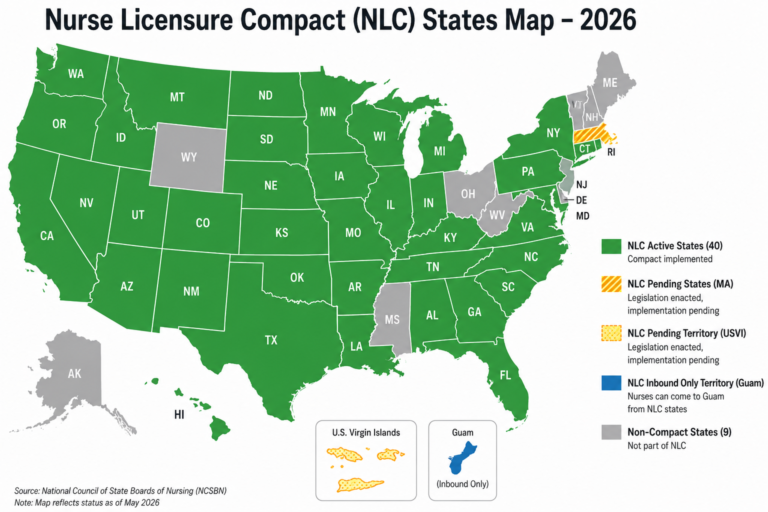
For comparison, nurses in the private sector who want to work across state lines must either hold multiple state licenses or obtain a multistate license through the Nurse Licensure Compact – and even then, the compact only covers member states.
This federal licensing advantage is especially powerful for VA Travel Nurse Corps members and for nurses who want career mobility without the administrative burden of managing multiple state licenses.
13. How to Apply: Step-by-Step USAJobs Guide
Applying for VA nursing jobs is different from applying to private hospitals. The process goes through USAJobs.gov, the federal government’s employment portal, and requires specific documentation. Here’s exactly how to do it.
Step 1: Create Your USAJobs Account
Visit USAJobs.gov and create an account. You’ll need to verify your identity through Login.gov. Set up job alerts for “Registered Nurse” within the “Department of Veterans Affairs” to receive notifications when new positions are posted.
Step 2: Build Your Federal Resume
This is the most critical step, and where many applicants stumble. A federal resume is very different from a private-sector resume. It needs to be significantly longer and more detailed. For each position, include: exact job title, employer name and address, start and end dates (month/year), hours per week, salary, supervisor name and phone number, and a detailed description of your duties, responsibilities, and accomplishments. The VA evaluates your experience across five dimensions: Practice, Veteran/Patient-Driven Care, Leadership, Professional Development, and Evidence-Based Practice/Research.
Step 3: Complete VA Application Forms
For RN positions, you’ll need Form 10-2850a (Application for Nurses and Nurse Anesthetists). For Advanced Practice Nurses (NP, CRNA), the same form applies. For LPNs, use Form 10-2850c. These forms are available on the VA website and must be submitted with your application package.
Step 4: Search and Apply
Search for positions on USAJobs, or contact the Nurse Recruiter at your preferred VA facility directly. Many VA facilities have dedicated nurse recruiters who can tell you about positions that may not yet be posted on USAJobs. Complete the online questionnaire, upload all required documents, and submit before the closing date.
Step 5: Pre-Employment Processing
After selection, expect 1–3 months for pre-employment processing. This includes a background investigation (SF-85 or SF-86), physical examination, drug screening, credential verification, and occupational health screening. Maintain regular contact with HR during this period to prevent delays.
💡 Pro Tip: Contact the Nurse Recruiter
Every VA Medical Center has a dedicated Nurse Recruiter. Reaching out directly is often more effective than relying solely on USAJobs postings. Email your resume, specify the unit/specialty you’re interested in, and ask about both current and upcoming openings. Many positions are filled through direct recruiter contact before they even appear on USAJobs.
14. Citizenship & Eligibility Requirements
This section is especially important for international readers of this guide.
U.S. citizenship is required for the vast majority of VA nursing positions. This includes citizenship by birth or through naturalization. The VA does not sponsor work visas for international nurses.
Additional requirements for all applicants: Current, full, active, and unrestricted RN license from any U.S. state, territory, or commonwealth. Graduation from a nursing program accredited by CCNE or ACEN. Successful completion of a background investigation. Physical fitness for the demands of the position. Proficiency in spoken and written English.
Veterans’ preference: Veterans receive hiring preference under federal law. If you’re a Veteran with a nursing degree, you have a significant advantage in the application process. The VA specifically encourages Veterans to apply, and many VA nurses are themselves former military.
For international nurses: If you are an international nurse who has obtained U.S. citizenship through naturalization, you are fully eligible for VA positions. If you are not yet a U.S. citizen, the VA is not an option until you obtain citizenship. Consider other pathways first (see our Nursing Visa Sponsorship USA 2026 guide) and return to the VA as a career move after naturalization.
15. What It’s Really Like: VA Nursing Culture
No career guide is complete without an honest look at what the day-to-day experience is actually like. Here’s what you should know about VA nursing culture – the good and the challenging.
The Good
Mission-driven culture: There is a genuine sense of purpose in VA nursing that many nurses say is difficult to replicate elsewhere. Caring for Veterans who have served their country creates a unique patient-nurse relationship built on mutual respect.
Interdisciplinary teams: VA healthcare operates with robust interdisciplinary care teams. Nurses regularly collaborate with physicians, social workers, psychologists, pharmacists, and rehabilitation specialists. The team-based approach means you’re not carrying the burden alone.
Work-life balance: While hospital nursing always involves shift work, VA facilities generally offer more predictable scheduling, generous leave policies, and better staffing ratios than many private hospitals. The 8-hour shift model is still common at many VA facilities, though 12-hour shifts are increasingly available.
Professional development: The VA invests heavily in continuing education, leadership development, and career advancement. The structured career ladder (Nurse I through III) provides clear goals and pathways for advancement.
Shared Governance: Many VA facilities use a Shared Governance model that gives bedside nurses a meaningful voice in clinical practice decisions, staffing, professional development, and quality improvement.
The Challenges
Bureaucracy: As a federal agency, the VA involves more administrative processes than private healthcare. Hiring takes longer, procurement is slower, and policy changes can move through layers of approval. Patience with process is essential.
EHR transition: Some VA facilities are in the process of transitioning from VistA/CPRS (the VA’s long-standing electronic health record) to the Oracle Health system. Transitions of this magnitude come with learning curves and temporary workflow disruptions.
Complex patient population: Veterans frequently present with multiple comorbidities, mental health conditions, substance use disorders, and social determinants of health that make clinical care more complex than what many nurses encountered in nursing school. This is clinically challenging but also deeply rewarding for those who rise to it.
Variable facility quality: Like any large system, the VA has facilities that are exceptional and others that are struggling. Research specific facilities before applying – check VA quality ratings, talk to nurses who work there, and visit if possible.
16. Frequently Asked Questions
How much do VA nurses get paid in 2026?
VA nurse salaries are determined by the Title 38 pay system with grades, steps, and locality adjustments. Nurse I (entry-level) typically starts at $60,000–$85,000. Nurse II (mid-career) earns $75,000–$115,000. Nurse III (advanced/leadership) can earn $95,000–$145,000+. Locality adjustments in high-cost areas like San Francisco or New York can increase salaries by 20% or more.
What is the VA EDRP student loan repayment program?
The Education Debt Reduction Program provides up to $200,000 in tax-free student loan repayment over 5 years ($40,000/year) for nurses in hard-to-fill positions. It requires no mandatory service agreement and covers both federal and private student loans. It can be combined with Public Service Loan Forgiveness for maximum benefit.
What retirement benefits do VA nurses receive?
VA nurses receive the FERS three-tier retirement: (1) A defined benefit pension based on your High-3 salary and years of service, vesting after 5 years. (2) Social Security benefits. (3) TSP (like a 401k) with the government contributing 1% automatically plus matching up to 4% when you contribute 5%. You can retire at age 60 with 20 years of service, or age 62 with just 5 years.
How many days off do VA nurses get?
New employees receive 13 days annual leave + 13 days sick leave + 11 federal holidays = 37 paid days off. After 3 years, annual leave increases to 20 days (44 total). After 15 years, annual leave increases to 26 days (50 total). Sick leave accumulates without a cap and converts to retirement service credit.
What is the RNTTP residency program?
The RN Transition-to-Practice Residency is a mandatory 12-month program for all newly hired graduate nurses or RNs with less than one year of experience. It includes 200+ hours of didactic instruction, clinical preceptorship, simulation training, and evidence-based practice projects. You’re a paid VA employee throughout the program.
How do I apply for VA nursing jobs?
Apply through USAJobs.gov by searching for “Registered Nurse” with the Department of Veterans Affairs. You’ll need a detailed federal resume and VA Form 10-2850a. You can also contact the Nurse Recruiter at your preferred VA facility directly. Expect 1–3 months for pre-employment processing after selection.
Do VA nurses need a license for every state?
No. You need only one current, unrestricted RN license from any U.S. state to work at any VA facility nationwide. This is a major advantage of federal employment – your license is recognized across all 50 states and U.S. territories.
What is the VA Travel Nurse Corps?
The VA Travel Nurse Corps offers short-term and long-term assignments at VA facilities nationwide. You maintain federal employee status and benefits while traveling. Positions are posted as open continuous announcements on USAJobs and accept applications year-round through June 30, 2026.
Can international nurses work at VA hospitals?
U.S. citizenship is required for most VA positions. The VA does not sponsor work visas. International nurses who have obtained citizenship through naturalization are fully eligible. If you’re not yet a citizen, explore private-sector visa sponsorship first, then consider the VA after naturalization.
What nursing specialties are available at the VA?
The VA offers an exceptional range including acute care (ICU, ER, med-surg), mental health/PTSD, spinal cord injury, polytrauma/TBI, home-based primary care, telehealth, oncology, cardiology, dialysis, surgical services, geriatrics, research nursing, and nurse education. Several of these specialties involve clinical populations and treatment approaches unique to the VA.
Final Words: Is the VA Right for You?
The VA isn’t for everyone. The federal application process is more cumbersome than walking into a private hospital with your resume. The bureaucracy is real. And the patient population carries complexities that require both clinical skill and emotional resilience.
But if you’re looking for a career – not just a job – the VA offers a combination of benefits, job security, professional development, and purpose that is genuinely difficult to match anywhere else in American healthcare. The numbers speak for themselves: $200,000 in tax-free loan forgiveness, a guaranteed pension for life, up to 50 paid days off, a 5% TSP match, and the ability to practice in any state with a single license.
And let’s not forget the 9 million Veterans who depend on this healthcare system. They deserve the best nurses in the country. If that’s you, the VA has a place for you.
Start here:
USAJobs – VA Registered Nurse Positions
Every statistic, benefit detail, and program description in this article was verified through live research conducted on March 4, 2026, using official VA.gov sources, USAJobs postings, and federal employment resources.
Related Articles:
Nursing Jobs in USA 2026: Ultimate Guide to Salary, Visa & Career Opportunities
Nursing Visa Sponsorship USA 2026: Complete EB-3 Green Card Guide
Disclaimer: This article is for informational purposes only and does not constitute employment, financial, or legal advice. Benefits, pay scales, and program availability are subject to change. Always verify current information directly with VA Human Resources or the official VA.gov website. GlobalNurseGuide.com is not affiliated with the U.S. Department of Veterans Affairs. Salary estimates are based on Title 38 pay schedule data, VA career publications, and publicly available federal employment information current as of March 2026.
© 2026 GlobalNurseGuide.com – Empowering Nurses Worldwide with Real Opportunities
Author

Discover more from Global Nurse Guide
Subscribe to get the latest posts sent to your email.