NCLEX Pass Rates Drop in 2025: Why the ‘Next Gen’ Honeymoon Phase is Over
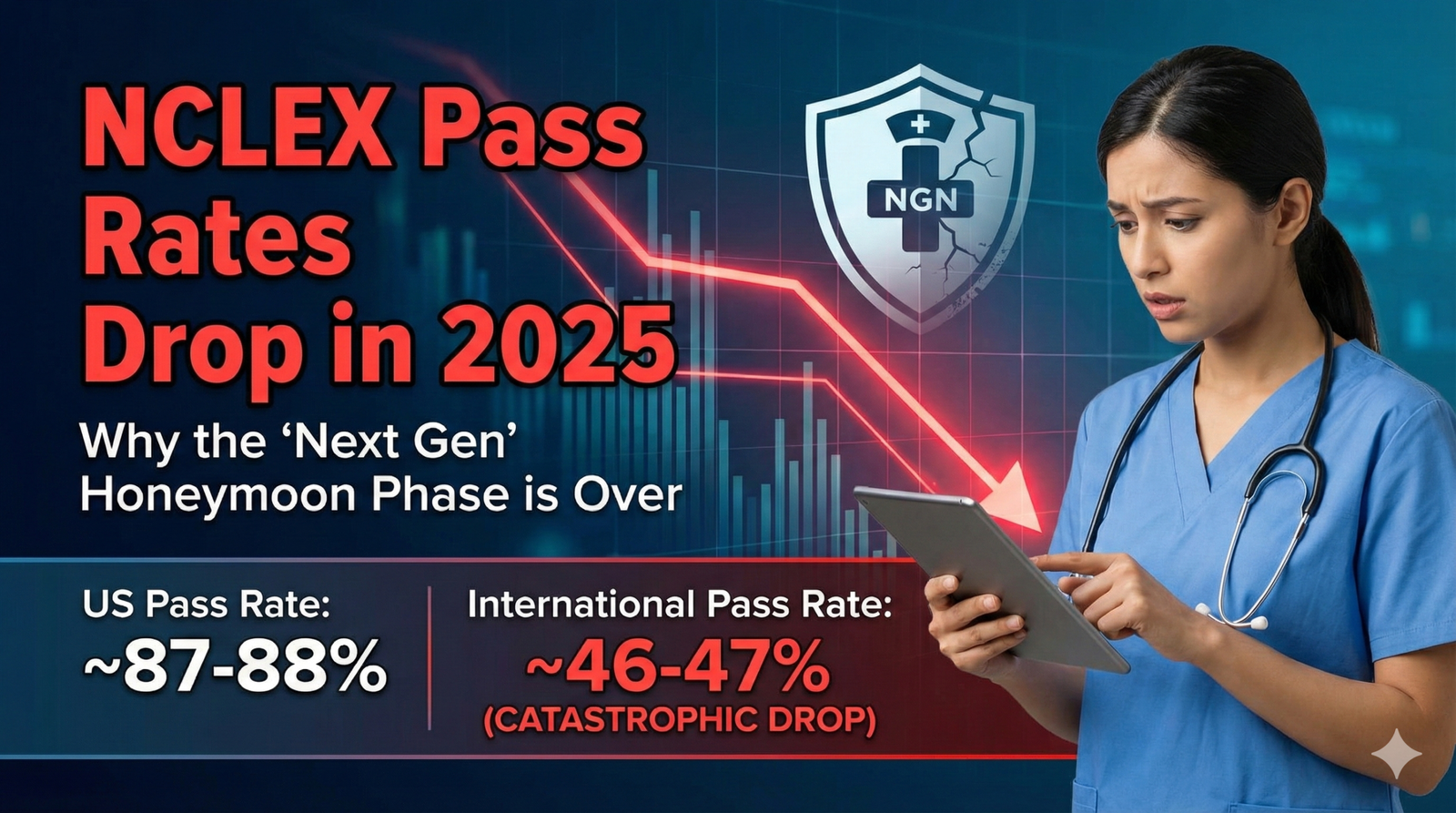
NCLEX-RN pass rates dropped in 2025 for the first time since the Next Generation NCLEX launched in April 2023. The overall pass rate fell to 69.1%, down from 73.3% in 2024. First-time US-educated candidates dropped from 91.2% to 87.1%. The steepest fall was among internationally educated nurses, where first-time pass rates collapsed to roughly 47%. Repeat international candidates fared worst of all, at about 30%. The “easy mode” of 2023–2024 is over – and the April 1, 2026 NCLEX test plan update has reset the rules again.
This article explains what actually happened to NCLEX pass rates in 2025, why the international cohort was hit hardest, what the new April 2026 test plan changed, and how a candidate preparing for the exam right now should respond. The data is from NCSBN’s 2024 official statistics and preliminary 2025 reporting cross-checked against major review provider data through November 2025.
🩺 Join FREE WhatsApp Channel for Trusted Guide
Get weekly vacancy alerts, EB-3 visa updates & daily NCLEX prep on WhatsApp — FREE.
📲 Follow the Channel📉 NCLEX 2025 Pass Rates – Verified Data
Overall NCLEX-RN 2025: 69.1% (down from 73.3% in 2024)
First-time US-educated: 87.1% (down from 91.2% in 2024)
Repeat US-educated: 53.1%
First-time internationally educated: ~47%
Repeat internationally educated: ~30.3%
Source: NCSBN data via Kaplan/Nurse.org reporting, Nov 2025
Passing standard (RN): 0.00 logits, in effect through 31 March 2026
New test plan effective: 1 April 2026
The Hook: The 2023–2024 “Easy Mode” Is Over
For two years the nursing world breathed a collective sigh of relief. The Next Generation NCLEX (NGN), launched in April 2023, brought with it a surge in pass rates that made the exam seem – dare we say it – beatable. The 2024 numbers looked almost euphoric: 91.2% of US-educated first-time test takers passed, up from 88.6% in 2023.
The 2025 data tells a different story. The honeymoon phase is officially over. The drop is not anecdotal – it is statistical, NCSBN-reported, and visible across every candidate category. If you are preparing for the NCLEX in 2026, the strategies that worked for your older people in 2024 will not produce the same results.
The Data: A Stark Reality Check
| Candidate Type | 2024 | 2025 | Change |
|---|---|---|---|
| First-time US-educated | 91.2% | 87.1% | Notable correction |
| First-time internationally educated | Higher | ~47% | Steepest decline |
| Repeat US-educated | ~55% | 53.1% | Roughly a coin flip |
| Repeat internationally educated | ~40% | ~30.3% | Critical failure rate |
| Overall NCLEX-RN (all candidates) | 73.3% | 69.1% | First drop since NGN launch |
If you are an internationally educated nurse, that ~47% figure should be the wake-up call. More than half of the international cohort failed on first attempt in 2025. Repeat IEN candidates were down to roughly one in three. These are not small fluctuations – they are workforce-significant outcomes that will shape US licensure pipelines for the next two years.
Why the Drop? The Real Analysis
Two factors converged to create what nursing educators are calling a perfect storm for 2025 examinees.
1. The algorithm caught up
When the NGN launched in April 2023, the new polytomous scoring rules (partial credit on certain question types) created an initial scoring uplift. Candidates who would have scored zero on complex multi-part questions under the old format were now getting partial credit for partial knowledge. That contributed to the 2024 spike.
The NCLEX is psychometrically calibrated: NCSBN reviews and resets passing standards on a three-year cycle. The current RN passing standard of 0.00 logits has been in effect through 31 March 2026. As the NGN test bank gathered millions of data points and item-difficulty calibrations stabilised, the practical effect was that candidates needed to demonstrate more precise clinical judgment to reach the same passing logit score. The early-NGN buffer was always going to fade. In 2025, it did.
2. The COVID learning-loss cohort
The 2025 graduating cohort completed prerequisite sciences – Anatomy & Physiology, Microbiology, Chemistry – during the peak of pandemic disruption from 2020 to 2022. Many of those courses ran online, with open-book testing, pass/fail grading, and limited lab work.
The NGN measures clinical judgment, which depends on a deep understanding of pathophysiology. If your foundation is shaky – if you completed A&P remotely with an open textbook – the NGN case studies will expose that gap. You cannot reason through kidney failure interventions in real time if you never internalised renal physiology. ATI and other education researchers have flagged this as a real, measurable effect across the 2024 and 2025 cohorts, separate from the test-difficulty calibration.
The “Partial Credit” Myth That’s Hurting Candidates
Stop telling yourself, “I get partial credit now, so I have more margin.” That mindset is dangerous.
Polytomous scoring – awarding points for individually correct responses on multi-part items – was designed to measure ability more precisely, not to make the exam easier. The passing standard did not move. The exam still pulls you toward the 50% probability point on each item; it just measures your ability with finer resolution.
The trap candidates fall into: in the old NCLEX, a Select All That Apply (SATA) question was binary – you either got every option right or scored zero. That created a strong incentive to be selective. Under NGN polytomous scoring, candidates assume there is no penalty for over-selecting, and start treating SATA like a fishing expedition.
The reality is more careful than that. SATA items now use a +/- scoring approach: you earn a point for each correct selection, and you lose a point for each incorrect selection, with the total score on the item unable to drop below zero. So selecting six options where four are correct can produce the same item score as selecting four correct ones. Selecting six where only three are correct produces a worse score than selecting three. The math favours caution on SATA.
That said, this only applies to SATA-style polytomous items. Most other question types – traditional multiple choice, drag-and-drop ordering, hot-spot identification – do not penalise incorrect answers. The right strategy varies by question type. Blanket advice like “never guess on the NCLEX” is wrong. The correct advice is: be conservative on SATA; on most other formats, an educated guess is better than a blank.
The International Crisis: It Is Partly a Language Test Now
Why did international rates fall to roughly 47%? Much of it lives in the case studies.
The NGN case study format is no longer just a nursing test – it is also a high-level English reading comprehension test. A single case study presents tabs of medical records, nurses’ notes, vital signs, and patient history. Then six progressive questions ask you to recognise cues, analyse them, prioritise hypotheses, generate solutions, take action, and evaluate outcomes – the NCSBN Clinical Judgment Measurement Model in action.
For internationally educated nurses, two specific issues compound:
Nuance kills. The difference between a correct action and a fatal one often hangs on a single adjective in the patient’s chart. “Restless” versus “lethargic.” “Diminished” versus “absent.” “Productive” versus “non-productive.” These distinctions are second nature to a native English-speaking nurse. They are a constant cognitive tax on a second-language reader.
Clinical protocol mismatch. International nurses often have substantial clinical experience – in many cases more than their US-educated counterparts. But the NGN tests US-specific clinical judgment frameworks: prioritisation by ABCs and Maslow’s hierarchy, scope of practice differentiated by RN versus LPN, delegation rules, US informed consent procedures, US patient rights. A nurse from India, the Philippines, or Nigeria can know medicine deeply and still miss these test-specific frameworks.
What the April 1, 2026 NCLEX Test Plan Changed
If you are reading this in mid-2026 and beyond, there is one more thing you need to know: the NCLEX is no longer the exam that produced the 2025 numbers above.
The NCSBN releases a new NCLEX-RN test plan every three years. Standard-setting panels met in September 2025 to set new cut scores for the next cycle, and the new test plan took effect on April 1, 2026. The previous passing standard of 0.00 logits (in effect through 31 March 2026) was succeeded by the updated standard under the new plan.
The April 2026 update adjusts content distribution across the four Client Needs categories to reflect current nursing practice, with continued emphasis on pharmacology and deepened weight on the six cognitive skills of the Clinical Judgment Measurement Model: recognising cues, analysing cues, prioritising hypotheses, generating solutions, taking action, and evaluating outcomes. NCLEX prep materials published before late 2025 may not fully reflect the April 2026 content distribution. If you are preparing now, use current-edition materials.
The 2025 pass rates analysed in this article reflect the pre-April-2026 exam. We will only have a clear sense of whether the test plan changes raise, lower, or stabilise pass rates after several quarters of 2026 data are reported.
Strategic Advice: How to Beat the Odds
Panic does not help you pass. Strategy does. Here is the battle plan for the 2026 NGN:
Stop memorising, start processing. You cannot flashcard your way through a case study. Instead of memorising lists of symptoms, train yourself to ask why. Why does this symptom point to this diagnosis? Why does this intervention address this physiology? If you cannot articulate the chain, you do not own the content yet.
Do case studies every day, not just multiple choice. Three to five full NGN case studies daily, under timed conditions. The cognitive stamina to read through tabs of chart data without missing the details is built only through repetition.
Read every rationale – including for questions you got right. The questions you guessed correctly are at least as instructive as the ones you missed. The rationale teaches the reasoning pattern that will apply to similar future questions.
Track your performance by topic. Pharmacology, prioritisation, infection control, lab values, maternal/newborn, paediatrics, mental health. After two weeks of data, the pattern is visible. Concentrate the next week’s content review on whichever topic is consistently below 60%.
For Internationally Educated Nurses Specifically
Train medical English explicitly. General IELTS or TOEFL prep does not transfer to NGN case studies. The OET (Occupational English Test) prep materials are useful even if you are not sitting the OET itself, because they train chart-reading and clinical communication in English. Many candidates also benefit from reading nursing journals and chart-style notes daily for 30 minutes.
Drill US clinical frameworks separately. Memorise ABCs over Maslow’s over the nursing process as a prioritisation hierarchy. Study RN-versus-LPN scope of practice. Practise US-specific informed consent and patient rights scenarios. These frameworks are often light in international curricula.
Allocate extra prep time to maternal/newborn, paediatrics, and mental health. These three areas are routinely under-emphasised in international curricula and over-tested on the NCLEX relative to that exposure.
Be conservative on SATA. As covered above – +/- scoring penalises incorrect selections on SATA items. If you are not confident, do not select. On other item types, educated guesses are still worth taking.
For a complete preparation strategy covering the April 2026 test plan, the question-bank comparison (UWorld vs Archer vs Saunders), and the day-by-day study plan that actually produces first-attempt passes, see our full guide on how to pass the NCLEX on your first attempt in 2026. That article is the strategic response to the diagnostic in this one.
The Retake Reality
If you have already taken the exam and not passed, the retake numbers above are sobering – 53% for repeat US candidates, 30% for repeat IENs. NCSBN’s retake policy allows up to eight attempts per year with a mandatory 45-day wait between attempts. Individual state Boards of Nursing may impose stricter limits.
The reason repeat pass rates are so much lower than first-attempt rates is not random. It is that most repeat candidates use the same failed study strategy with more effort, rather than changing approach. The retake is harder, not easier, because you carry the weight of a previous failure plus 45 days of interrupted momentum. The candidates who pass on the second attempt almost always describe a complete strategy reset – different question bank, different study schedule, targeted remediation of the weak areas identified on their Candidate Performance Report.
The Bottom Line
The 2025 NCLEX pass rate drop was not a one-off blip. It was a return to a harder normal – driven by item-difficulty stabilisation, the lingering effects of pandemic-era foundational science education, and an exam format that increasingly punishes the kind of memorisation that nursing school exams reward. For internationally educated nurses, the language and clinical-framework gap turned a difficult exam into something close to a crisis.
The good news, such as it is: every one of these factors is addressable with the right preparation strategy. The April 2026 test plan introduces another layer of change, but the core skills the NCLEX measures – clinical judgment, reasoning under uncertainty, accurate prioritisation – are trainable. The candidates who pass in 2026 will not be the ones with the best memorisation. They will be the ones who built the right preparation system early and trusted it.
Related articles on GlobalNurseGuide.com:
How to Pass the NCLEX on Your First Attempt in 2026: The Real Strategy Guide
NCLEX-RN Guide for Indian Nurses 2026
NCLEX Guide for Filipino Nurses
Fast-Track US Nursing License for International Nurses
Disclaimer: This article is for informational purposes only and does not constitute educational or professional advice. NCLEX pass rate data is sourced from the National Council of State Boards of Nursing (NCSBN) 2024 official statistics and preliminary 2025 reporting, cross-referenced with Kaplan, Nurse.org, and ATI Testing reporting as of late 2025. Pass rates fluctuate by reporting period and final NCSBN 2025 figures may vary slightly from preliminary data cited here. NCLEX exam structure, passing standards, content distribution, and scoring methods are determined by NCSBN. The April 1, 2026 test plan introduces revised content distribution and standard-setting; verify current details at ncsbn.org. Information current as of May 14, 2026.
Author

Discover more from Global Nurse Guide
Subscribe to get the latest posts sent to your email.