Nursing Jobs in New York 2026: High Salary, High Tax & the BSN-in-10 Law
Updated May 26, 2026 • Reading Time: ~18 Minutes
$105,600 – that is the median registered nurse salary in New York state, the second highest in the country after California. It is also the number that persuades nurses to move here every year without calculating what New York takes back. State income tax runs 4 to 10.9 percent. If you work in New York City, add another 3 to 3.9 percent in city tax. A nurse earning $105,000 in Manhattan can lose $10,000 to $14,000 in combined state and city income tax alone – money that a nurse earning $90,000 in Texas or $85,000 in Florida would keep entirely. New York also requires a BSN within 10 years of licensure, is not a compact state, and uses a licensing pathway for international nurses that no other state shares.
None of that makes New York a bad choice. It makes it a specific choice – one that rewards certain career goals and punishes others. If your ambition is to work at NYU Langone, NewYork-Presbyterian, Memorial Sloan Kettering, or Mount Sinai, there is nowhere else to go. If your ambition is to maximise take-home pay, New York is not where you do it. This guide covers both sides honestly: the salary, the tax, the BSN-in-10 law, the employers, the specialties, the licensing for domestic and international nurses, and the real math of working in the most expensive nursing market in the country.
🩺 Join FREE WhatsApp Channel for Trusted Guide
Get weekly vacancy alerts, EB-3 visa updates & daily NCLEX prep on WhatsApp — FREE.
📲 Follow the Channel🗽 New York Nursing 2026 – Verified Data
Median RN salary: $105,600 (BLS 2024) – 2nd highest in the US
Salary range: $77,930 (10th) to $153,420 (90th)
State income tax: 4–10.9% (progressive)
NYC city income tax: 3.078–3.876% (additional)
Nurse Licensure Compact: NO – separate NY licence required
BSN-in-10 law: Yes – ADN/diploma nurses must earn BSN within 10 years
April 29, 2026: BSN-in-10 amendment clarified exemption conditions
First compliance deadline: Renewal on or after June 18, 2030
Annual openings: ~14,000+ statewide
International nurses: CGFNS CVS required (not CES) – Josef Silny not accepted
In INR: $105,600 ≈ ₹88.3 lakh/year at May 2026 rates
1. The Tax Reality Most Salary Guides Skip
New York has one of the highest combined state and local tax burdens in the United States, and for nurses the impact is concrete enough to calculate.
New York State income tax is progressive, starting at 4 percent on the first $8,500 of taxable income and rising to 10.9 percent on income above $25 million. For a nurse earning $105,000, the effective state tax rate falls roughly in the 5.5 to 6.5 percent range after deductions – approximately $5,800 to $6,800 per year.
If you work in New York City, add the city income tax: 3.078 percent on income up to roughly $21,600, rising to 3.876 percent above $50,000. For a nurse at $105,000, that adds approximately $3,500 to $4,000. The combined state plus city tax: roughly $9,300 to $10,800 per year that leaves your paycheque before you pay a dollar of rent.
Now compare. A nurse earning $90,010 in Texas or $84,760 in Florida pays zero state or city income tax. The New York nurse earns $15,000 to $20,000 more in gross salary – but after state and city tax, the take-home gap shrinks to roughly $5,000 to $10,000. Factor in that New York City rent for a one-bedroom apartment averages $3,000 to $4,000 per month (compared to $1,200 to $1,800 in Houston, Jacksonville, or San Antonio), and the financial advantage can evaporate entirely.

This does not mean New York is overpriced for nurses. It means the salary headline tells you less than half the story. If you come to New York, come for the career opportunity, the clinical prestige, and the institutional access. Do not come for the take-home pay.
2. City by City: Where to Work in New York
| Region | Approx. RN Salary | Context |
|---|---|---|
| NYC Metro (Manhattan, Brooklyn, Queens, Bronx) | $110,000–$130,000+ | Highest pay + highest cost + city tax |
| Long Island (Nassau, Suffolk) | $110,000–$125,000 | High pay, high housing; no city tax |
| Westchester / Lower Hudson Valley | $100,000–$115,000 | Suburban; commutable to NYC |
| Albany / Capital Region | $80,000–$88,000 | Strong purchasing power; state government hub |
| Buffalo / Niagara | $75,000–$82,000 | Lowest cost in the state; genuine affordability |
| Rochester / Syracuse | $72,000–$80,000 | Strong academic medicine; moderate cost |
New York City
NYC is the largest single nursing market in the United States. The concentration of world-class institutions is unmatched: NYU Langone, NewYork-Presbyterian (the combined Columbia and Weill Cornell campuses), Mount Sinai, Memorial Sloan Kettering, Montefiore, and NYC Health + Hospitals (the public system running Bellevue, Jacobi, Elmhurst, Kings County, and others). If your goal is academic medicine, research nursing, clinical trials, or working at a globally ranked hospital, NYC is where those opportunities live.
The cost is proportional. Manhattan studio apartments start at $2,500 to $3,000 per month. Brooklyn and Queens are slightly less but rising fast. The city income tax applies on top of state tax. Commuting from New Jersey or Connecticut to avoid city tax is common but adds time and often NJ/CT state tax in its place. Nurses who make NYC work financially tend to be in rent-stabilised apartments, have roommates, or commute from further out.
Long Island
Nassau and Suffolk counties pay near-NYC salaries without the city income tax. Northwell Health, the largest health system in New York state with 23 hospitals, is headquartered on Long Island. Stony Brook University Hospital provides a strong academic environment. Long Island is one of the better financial positions in the New York metro – high pay minus the city tax – though housing costs remain well above the national average.
Upstate New York
Albany, Buffalo, Rochester, and Syracuse offer a fundamentally different financial equation. Salaries are 25 to 35 percent lower than NYC, but housing costs are 50 to 70 percent lower. A nurse earning $80,000 in Albany or Buffalo can own a home, save meaningfully, and build a comfortable life that a $120,000 salary in Manhattan cannot easily replicate. Albany Medical Center, University of Rochester Medical Center (Strong Memorial), and Roswell Park Comprehensive Cancer Center (Buffalo) are strong employers. Upstate New York also faces more acute shortages, particularly in long-term care and rural healthcare, which means more sign-on bonuses and less competition for positions.
3. The BSN-in-10 Law – What You Need to Know
New York is the only US state that mandates a BSN within 10 years of initial RN licensure. The law was enacted in December 2017, amended in 2018, and its effective date was set to June 18, 2020. On April 29, 2026, a further amendment clarified the exemption conditions and enforcement details.
Who it affects
Any nurse who entered an ADN or diploma nursing programme after June 18, 2020 and was subsequently licensed in New York state must earn a BSN within 10 years to continue renewing their licence. The first group of nurses required to comply will reach their 10-year deadline at registration renewal on or after June 18, 2030.
Who is exempt
Nurses who held a New York state RN licence (or a licence in another US state, US territory, or Canada) on or before June 18, 2020 are fully exempt. Students who were enrolled in or had a pending application to a nursing programme on or before that date may also qualify for exemption, provided they maintained continuous enrolment through programme completion. A temporary educational exemption (one year, extendable for one additional year) is available for nurses who need more time.
What this means practically
If you are starting nursing school in New York in 2026 through an ADN programme, the BSN-in-10 clock starts when you receive your RN licence. You have 10 years to complete an RN-to-BSN bridge programme. That is a generous timeline – most programmes take 12 to 18 months – but the clock is real, and nurses who ignore it risk losing their licence at renewal.
If you are an experienced nurse with an ADN licensed before June 2020, you are exempt and the law does not affect your ability to practise. But the market signal is clear: New York employers increasingly prefer and sometimes require BSN-prepared nurses. The law codifies what the hiring market was already moving toward.
For the ADN-versus-BSN decision: ADN vs BSN 2026. For bridge programmes: Best Online RN-to-BSN Programs 2026.
4. The Major Employers
Northwell Health. The largest health system in New York state, operating 23 hospitals and over 900 outpatient facilities. Headquartered on Long Island. Diverse clinical environments from community hospitals to tertiary academic centres. Extensive new-graduate residency programmes.
NYU Langone Health. Consistently ranked among the top 10 hospitals in the country. Manhattan and Brooklyn campuses. Research-intensive, with strong Magnet recognition. Competitive to join but exceptional professional development once inside.
NewYork-Presbyterian Hospital. The combined Columbia University Irving Medical Center and Weill Cornell Medical Center. One of the most prestigious academic medical systems globally. Transplant, cardiac, neurology, and paediatric specialties at the highest level.
Mount Sinai Health System. Eight hospitals across Manhattan, Brooklyn, and Queens. Particularly strong in geriatrics, cardiology, and gastroenterology. The Icahn School of Medicine at Mount Sinai drives research nursing opportunities.
Memorial Sloan Kettering Cancer Center. The world’s oldest and largest private cancer centre. Oncology nurses at MSK work at the frontier of cancer treatment, including CAR-T cell therapy, precision medicine, and clinical trials that shape global practice.
NYC Health + Hospitals. The largest public hospital system in the United States. Bellevue (the oldest public hospital in America), Jacobi, Elmhurst, Kings County, Lincoln, and Woodhull are part of this system. High-acuity, high-diversity patient populations. Union-protected (NYSNA). If you want to see everything, serve everyone, and work in the grittiest clinical environment New York has, this is it.
Montefiore Medical Center. The Bronx. Academic affiliate of Albert Einstein College of Medicine. Serves one of the most medically complex populations in New York City. Strong community health and primary care nursing roles.
Upstate: Albany Medical Center (Level 1 trauma, Capital Region), University of Rochester Medical Center / Strong Memorial Hospital (academic, research), Roswell Park Comprehensive Cancer Center (NCI-designated, Buffalo).
5. Specialties in Demand
New York’s specialty demand reflects both the density of academic centres in NYC and the shortages in the rest of the state.
ICU and critical care. Perennial demand across all NYC academic medical centres. CCRN certification is strongly valued and often compensated with a differential.
Psychiatric-mental health. Severe shortage statewide. NYC’s public system (H+H) has some of the busiest psychiatric emergency services in the country. PMH-RNs and PMHNPs are heavily recruited.
Oncology. Memorial Sloan Kettering and the oncology programmes at NYU Langone, Mount Sinai, and Roswell Park create sustained demand for OCN-certified nurses, clinical research nurses, and infusion nurses.
Perioperative and OR. Surgical volumes at NYC academic centres are high. CNOR certification is valued. OR nursing in New York pays above-average differentials.
Geriatric and long-term care. Upstate New York has an ageing population and a chronic shortage of nurses in skilled nursing facilities and home health. Sign-on bonuses and tuition assistance are common in these roles.
Research and clinical trial nursing. New York has more academic medical centres and active clinical trials than any other state. Nurses interested in research careers – protocol nursing, data management, patient screening, and regulatory coordination – have opportunities here that simply do not exist at the same scale elsewhere.
For salary data by specialty: Nursing Specialty Salaries 2026.
6. New York Is NOT a Compact State
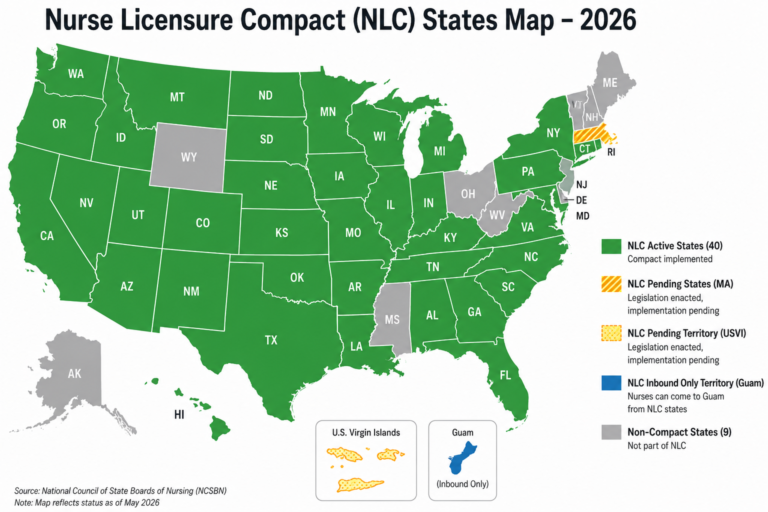
This catches nurses off guard every year. New York is not a member of the enhanced Nurse Licensure Compact (eNLC). If you hold a multistate licence from Texas, Florida, Arizona, or any other compact state, it is not valid in New York. You must apply for and obtain a separate New York state nursing licence through the New York State Education Department (NYSED).
The endorsement process involves submitting an application to NYSED, providing licence verification from every state where you hold or have ever held a nursing licence, completing a criminal background check, and meeting New York-specific education requirements (including infection control training and child abuse reporting coursework).
Processing typically takes 4 to 8 weeks for domestic applicants with clean records. A limited permit may be available for qualified endorsement applicants, allowing you to begin work while the full licence processes.
NLC legislation has been introduced in the New York State Legislature but has faced opposition from the New York State Nurses Association (NYSNA), which has expressed concerns about maintaining state-level regulatory standards. As of May 2026, the compact has not been enacted in New York.
For compact state coverage: NLC Map: Compact Nursing States 2026.
7. International Nurses: The CGFNS CVS Requirement
New York’s licensing pathway for internationally educated nurses is different from every other state, and it trips up applicants who assume the standard CGFNS process applies.
Most states require the CGFNS CES Professional Report – a credential evaluation sent to the applicant, who then forwards it to the state board. New York does not use the CES report. New York requires the CGFNS Credentials Verification Service (CVS), which is a separate product. Under CVS, CGFNS verifies your credentials and sends the report directly to NYSED. The applicant does not receive a copy.
Josef Silny evaluations are not accepted in New York. If you used Josef Silny for another state, that evaluation does not transfer to New York. You must go through CGFNS CVS.
Beyond the credential evaluation, international nurse applicants must pass the NCLEX-RN, meet NYSED’s specific education requirements (which can be more detailed than other states regarding clinical and theory hour verification), complete the infection control and child abuse coursework requirements, and clear a background check. A limited permit valid for up to one year may be issued to qualified international applicants while the full licence is processed.
For the full international licensing pathway: Fast-Track US Nursing License 2026. For credential evaluation: CGFNS vs Josef Silny.
8. Union Protections: NYSNA
New York has one of the strongest nursing union environments in the country. The New York State Nurses Association (NYSNA) represents nurses at many of the largest NYC hospital systems, including NYC Health + Hospitals, Montefiore, Mount Sinai, and others.
NYSNA contracts typically include structured pay scales (your salary is determined by your classification and years of service), overtime and shift differential provisions, safe staffing ratios (New York City passed safe staffing legislation in 2023), pension or retirement benefits, and grievance procedures. In a union environment, individual salary negotiation is generally not possible – but the collectively bargained rates, benefits, and protections are often stronger than what non-union facilities offer individually.
If you join a NYSNA-represented facility, read the contract before your start date. Understand the pay scale, the benefits, and the grievance process. These protections exist because nurses fought for them.
9. The Honest Trade-Offs
The cost of living is the real story. NYC is among the most expensive cities in the world. A $120,000 nursing salary in Manhattan does not deliver the standard of living that $85,000 delivers in Houston or $80,000 delivers in Boise. Upstate New York is dramatically more affordable, but the salary drops proportionally.
Not a compact state means extra cost and time. Every nurse moving to New York must apply for a separate licence. There is no reciprocity, no compact shortcut. Plan for it.
BSN-in-10 is a real requirement. If you enter nursing through an ADN programme in New York after June 2020, the 10-year clock is ticking. It is manageable but it is not optional.
NYSED’s international process is complex. The CGFNS CVS requirement, the direct-to-NYSED reporting, and the detailed education verification make New York one of the harder states for international nurses to license in. Plan for extra time and extra documentation.
But the career ceiling is the highest in the country. No other state concentrates this many globally ranked hospitals, this much academic medicine, this many clinical trial sites, and this much clinical diversity in one metro area. Nurses who build careers at NYU Langone, NewYork-Presbyterian, Sloan Kettering, or Mount Sinai carry credentials that open doors anywhere in the world. That is the trade New York offers: more cost, more complexity, more prestige.
10. Frequently Asked Questions
How much do nurses make in New York?
Median $105,600 (BLS 2024). Range $77,930–$153,420. NYC metro $110,000–$130,000+. State income tax 4–10.9%. NYC city tax 3–3.9% additional. Take-home after tax is significantly less than the headline.
Is New York a compact state?
No. You must obtain a separate NY licence through NYSED regardless of what other licences you hold.
What is the BSN-in-10 law?
ADN/diploma nurses licensed in NY after June 2020 must earn a BSN within 10 years. First deadline: renewal on or after June 18, 2030. April 29, 2026 amendment clarified exemptions. Only state with this mandate.
Can international nurses work in New York?
Yes, but NY requires CGFNS CVS (not CES). Josef Silny not accepted. Report goes directly to NYSED. More complex than most states.
Which area has the best salary-to-cost ratio?
Buffalo and Albany. Salaries $75,000–$88,000 with housing costs 50–70% lower than NYC. Long Island offers high pay without city tax.
What are the biggest hospitals?
Northwell (23 hospitals, largest in state), NYU Langone, NewYork-Presbyterian, Mount Sinai, Memorial Sloan Kettering, NYC H+H (public system), Montefiore, Albany Medical Center, Strong Memorial (Rochester), Roswell Park (Buffalo).
How does New York compare to Texas or Florida?
Higher gross salary but 10–15% lost to state/city tax. Much higher cost of living. Not compact. BSN required. More complex international process. Better for academic medicine and career prestige. Worse for take-home pay.
The Bottom Line
New York is not the state where nurses make the most money after tax and rent. It is the state where nurses build the most distinguished careers. The difference matters, and which one you prioritise should determine whether you move here.
If your goal is to work at a globally ranked hospital, pursue research nursing, build an academic career, or practise in the most clinically diverse environment in the country – New York delivers on that promise in ways no other state matches. If your goal is to maximise take-home pay, buy a house early, or keep your licensure simple, Texas, Florida, and Nevada are objectively better choices.
The nurses who thrive in New York are the ones who came for the right reason and made their financial plan before signing the lease – not after.
Related articles on GlobalNurseGuide.com:
Best States to Start Nursing: Nevada & Idaho 2026
Best Online RN-to-BSN Programs 2026
NLC Map: Compact Nursing States 2026
CGFNS vs Josef Silny for Nurses 2026
Nursing Specialty Salaries 2026
Salary Negotiation for Nurses 2026
Disclaimer: This article is for informational purposes only and does not constitute career, financial, or immigration advice. Salary data sourced from the US Bureau of Labor Statistics Occupational Employment and Wage Statistics (2024 data). BSN-in-10 law information from the New York State Education Department (NYSED) and University at Buffalo School of Nursing. Tax rates from the New York State Department of Taxation and Finance and NYC Department of Finance. Licensing requirements from NYSED Office of the Professions. Employer information reflects publicly available data and is not an endorsement. Salaries, tax rates, licensing requirements, and employment conditions change. Always verify current information directly with NYSED (op.nysed.gov), the relevant employer, and the BLS. Consult a tax professional for personalised tax calculations. Currency conversion approximate at May 2026 rates. GlobalNurseGuide.com is not affiliated with any hospital system, government agency, union, or licensing body. Information current as of May 26, 2026.
© 2026 GlobalNurseGuide.com – Empowering Nurses Worldwide with Real Opportunities
Author
Discover more from Global Nurse Guide
Subscribe to get the latest posts sent to your email.