How to Maximize Your Income as an ICU or ER Nurse in 2026
Updated May 17, 2026 • Reading Time: ~18 Minutes
A colleague on your unit asks what you earn. You say $85,000. She looks surprised – she is a travel nurse in the same ICU, working the same ventilators, the same patients, the same ratios. She cleared $148,000 last year. The difference between you is not clinical skill. It is strategy.
ICU and ER nurses sit in one of the most valuable positions in American healthcare – high-acuity skills, sustained demand, and a shortage that is not closing any time soon. But the default staff salary for these roles, roughly $91,000 to $92,000 for ICU and $80,000 to $110,000 for ER, captures only a fraction of the income these credentials can generate. The gap between a nurse who earns $85,000 and one who earns $140,000 in the same specialty is almost never about who is better at the bedside. It is about certifications, shift selection, employment model, location, and whether you have a plan or are just collecting paycheques.
🩺 Join FREE WhatsApp Channel for Trusted Guide
Get weekly vacancy alerts, EB-3 visa updates & daily NCLEX prep on WhatsApp — FREE.
📲 Follow the ChannelThis guide lays out every lever an ICU or ER nurse can pull to increase income in 2026 – the ones that cost nothing, the ones that require investment, the ones that scale permanently, and the ones that trade your health for dollars. All of them are real options. Not all of them are equally smart.
💰 ICU & ER Income Levers – 2026 Snapshot
Staff ICU nurse (avg): ~$91,000–$92,000 (BLS-derived)
CCRN-certified ICU nurse (avg): ~$101,000 (PayScale)
Travel ICU nurse (avg): ~$150,000 (2025 industry data)
ER nurse base range: $80,000–$110,000
ER additional pay (OT + differentials): $12,000–$22,000/year
Night differential (national avg): $4–$7/hr ($7,500–$13,000/yr)
Per diem premium over staff rate: 20–40%
NP median (if you advance): $129,210
1. The Certification Premium: What CCRN and CEN Actually Add
Certifications are the only income lever that raises your base pay permanently, costs relatively little, and requires no extra shifts. If you are an ICU or ER nurse without a specialty certification, this is the single highest-return action you can take.
CCRN (Critical Care Registered Nurse)
The CCRN, administered by the American Association of Critical-Care Nurses (AACN), is the gold-standard certification for ICU nurses. PayScale data shows CCRN-certified nurses averaging roughly $101,000, compared to approximately $91,000 for non-certified ICU staff – a gap of about $10,000 a year for a credential that costs $255 for AACN members and $370 for non-members.
Beyond the direct pay bump, CCRN does several things for your income trajectory. It qualifies you for charge nurse roles that carry per-shift premiums ($2 to $5 per hour at many facilities). It strengthens your hand in salary negotiations when changing employers. And it makes you a more attractive candidate for travel contracts, where agencies prioritise certified nurses for higher-acuity, higher-paying assignments.
Eligibility: 1,750 hours of direct care of acutely or critically ill patients within the past two years, or 2,000 hours within the past five years. Available in adult, paediatric, and neonatal tracks.

CEN (Certified Emergency Nurse)
The CEN, administered by the Board of Certification for Emergency Nursing (BCEN), is the ER equivalent. BCEN recommends two years of ER experience before sitting the exam. Like CCRN, holding a CEN signals specialised competence to employers and agencies. The pay premium varies by employer but typically ranges from $1 to $3 per hour – which translates to $2,000 to $6,000 annually.
Stack them
The nurses who earn the most from certifications do not stop at one. An ICU nurse holding CCRN plus ACLS (Advanced Cardiovascular Life Support) plus TNCC (Trauma Nursing Core Course) presents a materially different profile to an employer than one holding only a BLS card. An ER nurse with CEN plus TNCC plus PALS (Paediatric Advanced Life Support) plus stroke certification is genuinely harder to replace – and replacability is the number that drives your negotiating leverage.
Each additional certification costs $200 to $400 and a few weeks of preparation. The cumulative effect on your base salary, contract rates, and career options compounds over years.
For salary data across all specialties: Nursing Specialty Salaries 2026.
2. The Night and Weekend Math
Shift differentials are the most accessible income lever for any bedside nurse. They require no additional credential, no job change, and no investment – just a willingness to work the hours most people avoid.
Night shift differentials average $4 to $7 per hour nationally in 2026. Major academic medical centres (Kaiser, Cleveland Clinic, Mayo, NYU Langone) pay $7 to $10 or more. Smaller community hospitals pay $1.50 to $3. ICU and ER nurses, who staff the most demanding overnight units, typically receive differentials at the higher end of whatever their facility pays.
Weekend differentials add another $3 to $6 per hour at many facilities. Some hospitals offer a “weekend option” programme: commit to working every weekend (typically Saturday and Sunday 12-hour shifts) in exchange for a premium rate that can run 1.5 to 1.8 times the base hourly.
The arithmetic matters more than it sounds. A $5-per-hour night differential on three 12-hour night shifts per week adds up to approximately $9,360 per year. Add a $4 weekend differential on two weekend shifts per month and that is another $1,150. Combined: over $10,000 in additional annual income from shift selection alone, with no extra hours worked.
One thing to understand clearly: night differential is taxable income, not a tax-free stipend. It counts toward overtime calculations, which is actually a benefit – overtime on a differential-enhanced base rate pays more than overtime on the base alone.
3. Travel vs Staff: The Real Comparison
Travel nursing pay has normalised from the extreme pandemic-era highs, but the gap between travel and staff ICU/ER compensation remains substantial. In 2025, travel ICU nurses averaged approximately $150,000 in total compensation, compared to roughly $91,000 for staff. That is a $59,000 difference – real money, not a rounding error.
Travel contracts for ICU and ER nurses typically run 13 weeks, with weekly pay packages that include an hourly taxable rate plus tax-free stipends for housing and meals (if you maintain a tax home). A typical 2026 travel ICU contract might look like $2,200 to $2,800 per week all-in, depending on location, facility acuity, and shift. Peak-demand assignments and crisis contracts still pay above that range.
What the travel premium actually costs you
The $59,000 gap is not free money. Travel nursing carries real costs that staff positions do not:
No employer-sponsored health insurance stability. Most agencies offer insurance, but coverage gaps between contracts are common and the plans are often less generous than what a large hospital system provides.
No continuous retirement match. A staff nurse at a hospital contributing 4 to 6 percent of salary with a 50 to 100 percent employer match builds retirement wealth that a travel nurse, bouncing between agencies, does not accumulate in the same way.
Housing logistics. Finding and furnishing short-term housing every 13 weeks is a real cost in time, energy, and sometimes money. The tax-free stipend covers it on paper; the hassle is not captured in a pay comparison.
Personal disruption. Relationships, community, continuity of care, clinical mentorship, and career advancement at a single institution are all harder to build while travelling.
Travel nursing works best as a strategic phase – a defined period (often 1 to 3 years) where you stack income aggressively, pay down debt, build savings, and then transition to a staff or NP role with a stronger financial foundation. The nurses who struggle are the ones who treat it as a permanent career without planning for the gaps.
4. Per Diem and PRN: The Side Income That Pays Better Than Most Second Jobs
If full-time travel is not your situation, per diem and PRN shifts offer a lower-commitment way to add income.
Per diem ICU and ER shifts typically pay 20 to 40 percent above the facility’s standard staff hourly rate, because the employer carries no benefits obligation. An ICU nurse earning $45 per hour as staff might earn $55 to $65 per hour per diem at a neighbouring facility. Picking up two extra per diem shifts per month at a $20-per-hour premium adds roughly $5,500 to $6,000 per year.
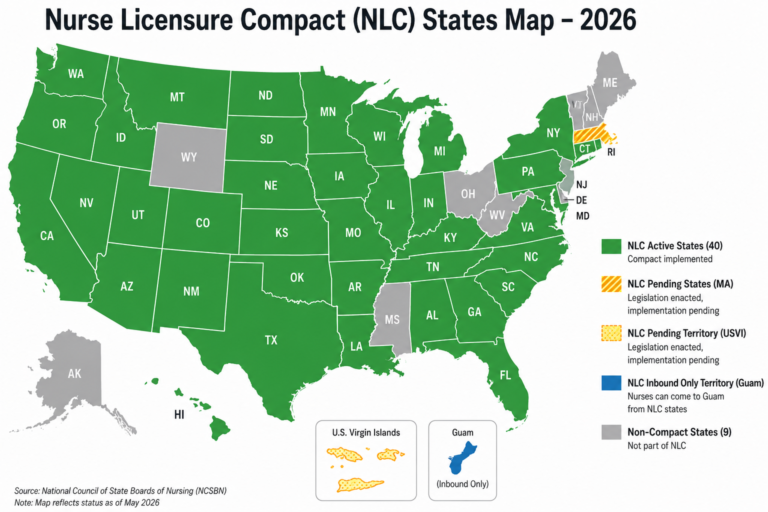
The hybrid model many experienced nurses use: maintain a core staff position (for benefits, retirement match, and schedule stability) at one facility, and pick up per diem shifts at a second facility for supplemental income. This requires active licensure valid at both facilities (straightforward in NLC compact states) and enough energy to work additional shifts without burning out.
On-demand staffing platforms have made finding per diem shifts faster than it used to be. But the approach has limits: per diem work is unpredictable, it has no holiday or PTO accrual, and adding shifts on top of full-time hours increases fatigue risk – particularly in ICU and ER where cognitive errors carry real patient consequences.
5. Geographic Arbitrage: Where You Work Matters as Much as How
Two ICU nurses with identical credentials, identical experience, and identical shift patterns can have a $15,000 to $20,000 difference in take-home pay based purely on location. The levers are salary variation by state and metro, state income tax, and cost of living.
State income tax is the easiest win. Texas, Florida, Tennessee, Washington, and Nevada have no state income tax. A nurse earning $95,000 in Texas keeps $3,000 to $5,000 more per year than a nurse earning $95,000 in California, New York, or Illinois. Over a career, that is six figures in retained income with zero effort.
Within the same state, city choice matters. In Texas, Houston pays $81,350 median while Austin pays $72,170 – a $9,000 gap – and Houston’s cost of living is actually lower than Austin’s. The nurse in Houston earns more and spends less. In California, Sacramento and Inland Empire facilities pay nearly as much as San Francisco with dramatically lower housing costs.
For travel nurses, geographic arbitrage is especially powerful. Take 13-week contracts in the highest-paying locations (California, New York, Massachusetts) while maintaining your tax home in a no-income-tax state. The tax-free stipend portion of your pay is not subject to state tax in your home state. The structure is legal and commonly used – but it requires maintaining a genuine tax home, which means real expenses at a permanent residence. Consult a tax professional familiar with travel nursing before claiming this benefit.
For state-by-state salary comparisons: US Nursing Shortage 2026 – States Hiring RNs. For Texas specifically: Nursing Jobs in Texas 2026.
6. The Overtime Reality
Overtime is the bluntest income tool and the most widely used. ER nurses earn an average of roughly $12,500 per year in overtime pay (Indeed, 2025). When combined with shift differentials and bonuses, Glassdoor reports total additional compensation of $12,000 to $22,000 per year for ER nurses beyond base salary.
At time-and-a-half, an ICU nurse earning $45 per hour makes $67.50 on overtime hours. Four overtime shifts per month add approximately $3,240 per month, or nearly $39,000 per year in gross additional income.
Those numbers are real – and they are the reason many ICU and ER nurses report total compensation well into six figures despite base salaries in the $80,000 to $90,000 range.
They are also the reason many of those same nurses burn out within five to seven years. Research published in the Journal of Emergency Nursing in 2025 found that 53 percent of emergency nurses reported high burnout. Overtime is income today at the cost of longevity tomorrow. It is not a strategy; it is a stopgap. Use it deliberately and temporarily, not as your primary income plan.
7. The NP Pathway: When It Is Time to Stop Trading Hours for Dollars
Every income strategy above has a common ceiling: you are paid per hour worked. More money means more shifts or more expensive shifts. The only way to break out of that equation is to change the equation itself – and for ICU and ER nurses, the cleanest route is an advanced practice degree.
For ICU nurses, the natural NP pathway is the Adult-Gerontology Acute Care Nurse Practitioner (AGACNP). This allows you to work in the same critical care environment at a higher scope – managing ventilator settings, ordering and interpreting diagnostics, adjusting vasoactive drips, leading resuscitation. Median NP salary: $129,210 (BLS). ER Nurse Practitioners earn approximately $152,000 (Nightingale College, BLS-derived).
For ER nurses, the Family NP (FNP) or Emergency NP track is most relevant, with growing opportunities in freestanding emergency centres and urgent care.
The financial case: the NP-to-RN salary gap is roughly $35,000 to $40,000 per year. An MSN costs $25,000 to $50,000 at a public university. The degree pays for itself within two to four years of NP practice, and the higher salary continues for the remainder of your career. If your employer offers tuition reimbursement – and many large hospital systems do – the ROI improves dramatically.
The NP path is not right for every ICU or ER nurse. It requires 2 to 4 years of graduate study while likely still working, and the work itself is genuinely different – more diagnostic responsibility, more documentation, more administrative overhead. But if you want income that scales with scope rather than shift count, it is the strongest structural move available.
For the complete NP pathway: Nurse Practitioner Career Guide USA 2026. For managing the cost: Student Loan Repayment for Nurses 2026.
8. The Income Stack: Putting It All Together
The most effective approach is not choosing one lever – it is stacking them deliberately. A worked example for an ICU nurse in 2026:
| Income Component | Annual Addition | Effort Required |
|---|---|---|
| Base staff salary | $91,000 | Standard |
| CCRN certification premium | +$5,000–$10,000 | One-time exam + renewal every 3 yrs |
| Night shift differential ($5/hr) | +$9,360 | Work nights (health trade-off) |
| Weekend differential ($4/hr, 2 shifts/mo) | +$1,150 | Minimal schedule adjustment |
| 2 per diem shifts/month at another facility | +$5,500 | Extra shifts (fatigue trade-off) |
| No state income tax (Texas/Florida/TN) | +$3,000–$5,000 retained | Location choice only |
| Estimated total | $115,000–$122,000 | Without overtime or travel |
That is a $24,000 to $31,000 increase over the default $91,000 – without working a single overtime shift or becoming a travel nurse. Add selective overtime or a travel phase and the number climbs higher still. The point is not to use every lever at once. It is to know which levers exist so you can choose the combination that fits your life.
9. What Nobody Tells You: The Sustainability Question
Every income-maximisation article focuses on the upside. This section is about the part most of them leave out.
Night shifts are not free money. The differential adds income. But sustained night-shift work is associated with increased cardiovascular risk, metabolic disruption, higher rates of depression, and relationship strain. If you are planning a career, not just a year, factor in the long-term health cost of permanent nights. Rotating schedules, while disruptive in their own way, may be more sustainable than permanent night assignments for most people.
Overtime has a diminishing return. The first four overtime shifts a month feel productive. The eighth feels like survival. Chronic overtime in ICU and ER environments – where every error matters – increases fatigue-related mistakes. Your licence, your patients, and your mental health are worth more than the marginal shift pay.
Travel nursing is a phase, not a plan. The income is real. But the nurses who come out ahead are the ones who enter travel with a goal (pay off $80,000 in student loans, save a house deposit, build an emergency fund) and an exit date. The ones who struggle are those who drift into travel for the money and discover three years later that they have high income, no savings, no professional home, and no plan.
The most sustainable income strategies are the ones that raise your floor, not your ceiling. Certifications raise your base permanently. Geographic arbitrage costs nothing. The NP pathway changes your earning structure entirely. These three are the ones that compound. Overtime and extra shifts are the ones that deplete. Both are legitimate choices – just make them with your eyes open.
10. Frequently Asked Questions
How much do ICU nurses make?
Staff: ~$91,000–$92,000. CCRN-certified: ~$101,000. Travel: ~$150,000. Range: $65,000 (entry) to $160,000+ (experienced, travel, high-cost state).
How much do ER nurses make?
Base: $80,000–$110,000. With overtime and differentials: add $12,000–$22,000. ER NP: ~$152,000.
Does CCRN certification increase pay?
Yes – roughly $5,000–$10,000/year above non-certified peers. Plus it opens charge nurse premiums, stronger negotiating leverage, and higher travel contract rates.
How much is the night shift differential?
Average $4–$7/hr. Academic centres: $7–$10+. At $5/hr on 36 hrs/week = ~$9,360/yr.
Is travel nursing still worth it in 2026?
Yes, if strategic. ~$150,000 vs ~$91,000 staff. But it costs you benefits stability, retirement accumulation, and personal continuity. Best as a defined phase with a financial goal and an exit plan.
What certifications increase ICU/ER pay?
CCRN (ICU), CEN (ER), ACLS, TNCC, PALS, CFRN (flight), stroke certification. Stacking multiple certifications has a cumulative effect on base pay and contract rates.
Should I become an NP?
If you want income that scales with scope, not shift count. AGACNP for ICU nurses, FNP or Emergency NP for ER nurses. Median NP: $129,210. MSN pays for itself in 2–4 years. Not right for everyone – the work is genuinely different.
What is geographic arbitrage?
Working where pay is high, living where costs are low. Choose a no-income-tax state, pick the highest-paying metro within it, or take travel contracts in expensive states while maintaining a tax home in a cheap one. Can add $15,000–$20,000/yr in take-home.
The Bottom Line
The difference between an ICU or ER nurse earning $85,000 and one earning $120,000 or more is rarely about who is better at the bedside. It is about whether you have made deliberate choices about certifications, shift selection, employment model, and location – or are simply accepting whatever the default puts in front of you.
Get your CCRN or CEN. That is the highest-return action and costs the least. Choose your geography with your bank account in mind, not just your preferences. Understand the shift differential math before you pick your schedule. If travel nursing fits your life, use it strategically and temporarily. And when you are ready to stop trading hours for dollars, the NP pathway is there.
The levers exist. The only question is whether you pull them.
Related articles on GlobalNurseGuide.com:
Nursing Specialty Salaries 2026
Nurse Practitioner Career Guide USA 2026
US Nursing Shortage 2026: States Hiring RNs
Student Loan Repayment for Nurses 2026
Highest-Paying Nursing Jobs 2026
Best Online RN-to-BSN Programs 2026
Disclaimer: This article is for informational purposes only and does not constitute financial, career, or tax advice. Salary and compensation data is synthesized from the US Bureau of Labor Statistics (May 2024 data), PayScale, Vivian, SkillGigs, Glassdoor, and Indeed. Certification costs and requirements are from the American Association of Critical-Care Nurses and the Board of Certification for Emergency Nursing. Shift differential rates, overtime figures, and travel nursing compensation vary significantly by employer, region, and contract terms. Tax implications of travel nursing require professional tax advice specific to your situation. Burnout statistics cited from the Journal of Emergency Nursing (2025). Always verify current salary, certification, and tax information directly with the relevant source before making decisions. GlobalNurseGuide.com is not affiliated with any staffing agency, certification body, or employer. Information current as of May 17, 2026.
© 2026 GlobalNurseGuide.com – Empowering Nurses Worldwide with Real Opportunities
Author

Discover more from Global Nurse Guide
Subscribe to get the latest posts sent to your email.