Correctional Nursing Career Guide 2026: CCHP-N, Daily Reality & Who the Specialty Suits
Correctional Nursing Career Guide 2026: CCHP-N, Daily Reality & Who the Specialty Suits
By Abirami Arumugam, RN, Chief Editor, GlobalNurseGuide.com
Correctional nurses are often the only licensed health professionals on site for hours at a time. In a county jail at 2 a.m., the nurse decides whether a man withdrawing from alcohol can stay in his cell or needs to go to an emergency department. No physician is down the hall. That level of independent judgment defines this specialty in the United States. It is also why the certification landscape changed in 2026: the National Commission on Correctional Health Care retired its RN-only nursing credential and replaced it with the CCHP-N, now open to RNs, LPNs, and LVNs. Many guides still describe the old credential. This one covers the current pathway, what the work actually involves, the legal standard behind it, and the honest trade-offs.
Why incarcerated patients have a legal right to care
Correctional health care in the US rests on a Supreme Court decision. In Estelle v. Gamble, decided in 1976, the Court held that deliberate indifference to the serious medical needs of prisoners violates the Eighth Amendment. People in custody cannot seek care on their own. The state that confines them is responsible for providing it.
🩺 Join FREE WhatsApp Channel for Trusted Guide
Get weekly vacancy alerts, EB-3 visa updates & daily NCLEX prep on WhatsApp — FREE.
📲 Follow the ChannelThat ruling shapes every shift. A nurse who dismisses a complaint without assessment is not only making a clinical error. Depending on the facts, it can become the basis of a civil rights lawsuit. Documentation in correctional nursing carries unusual weight for this reason. Sick call requests, refusals, and assessments are all written down, timed, and kept.
Jails and prisons are different workplaces
People outside the field use the two words interchangeably. Nurses inside it do not.
County jails
Jails hold people awaiting trial and those serving short sentences. Turnover is constant. Someone arrested on Friday night may be released on Monday. The nursing work concentrates on intake screening and withdrawal from alcohol and opioids. Acute mental health crises, untreated chronic disease, and injuries from before or during arrest fill the rest. Pace is fast and unpredictable. Many patients arrive with no medical records at all.
State and federal prisons
Prisons house people serving longer sentences, often years. That changes the clinical picture. Chronic disease management becomes central: diabetes, hypertension, hepatitis C, HIV, and an ageing prison population with rising rates of dementia and end-of-life care needs. Nurses in prisons get to know their patients over time. Some prisons run infirmaries, dialysis units, or hospice programmes inside the walls.
The Federal Bureau of Prisons employs nurses as federal staff, with positions posted on USAJobs. State departments of corrections employ nurses directly in some states. Many facilities contract their entire health service to private correctional health companies, so the nurse’s employer may not be the government at all.
What a correctional nurse does on a typical shift
Four functions account for most of the work.
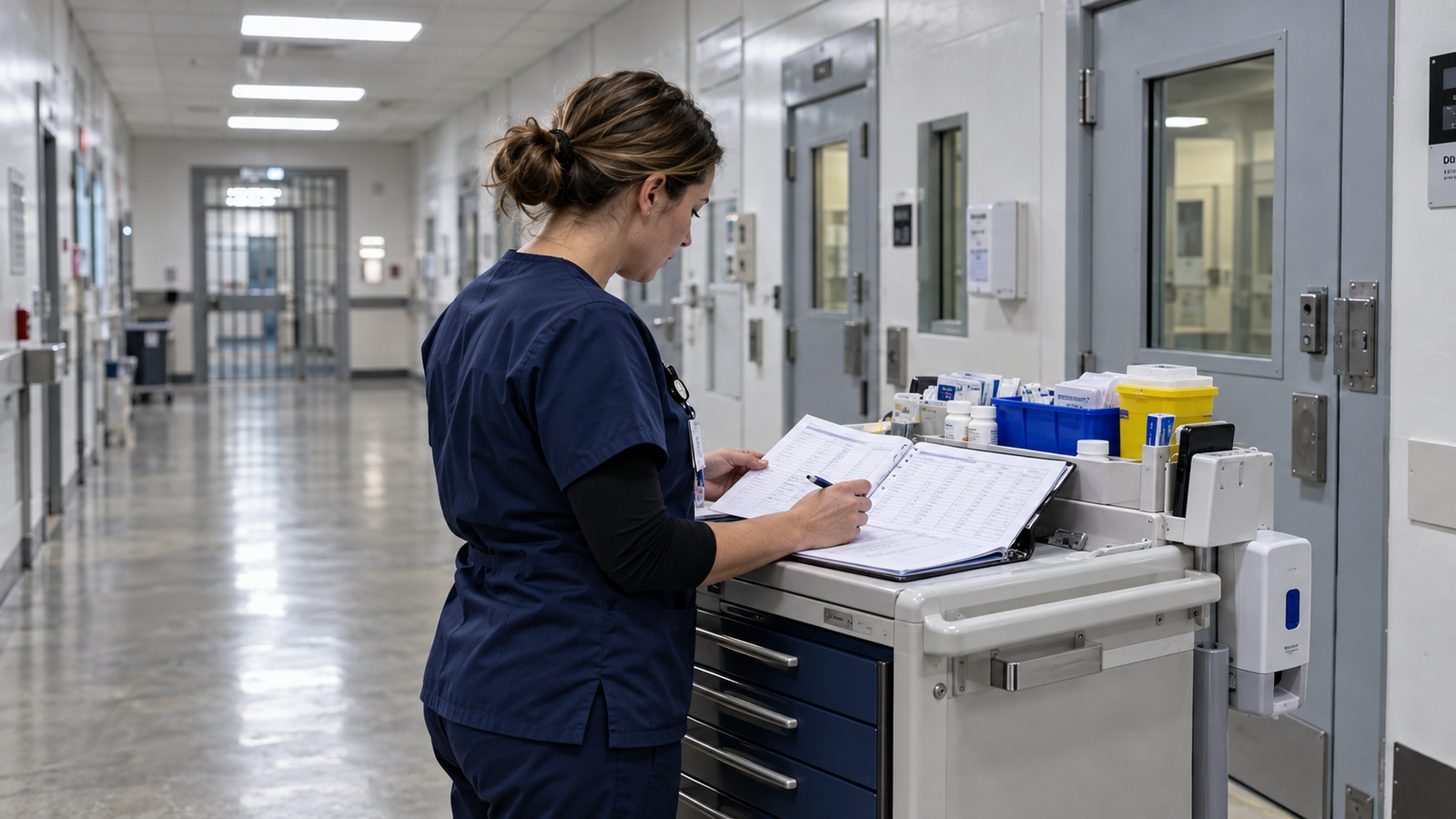
Intake screening happens when a person first arrives. The nurse gathers medical history, current medications, mental health history, suicide risk, pregnancy status, and signs of acute illness or intoxication. Custody staff use parts of this information to decide on housing. A missed finding at intake, such as an unreported seizure disorder or active suicidal ideation, can become a serious event within hours.
Sick call is the correctional version of a clinic. Patients submit written requests, and the nurse triages them. Some are seen the same day, some are scheduled with a provider, and some are resolved with nursing-level care within protocol. Triage in a jail clinic is a real skill. Nurses must separate genuine illness from requests driven by other motives without letting scepticism turn into indifference.
Medication administration, called pill line or med pass, consumes a large share of the day. In a big facility, one nurse may administer medications to hundreds of patients across several housing units. Watch-take procedures for certain drugs, checking that the patient actually swallows the dose, are standard because medication diversion inside facilities is a known problem.
Emergency response rounds it out. Assaults, overdoses, seizures, chest pain, and self-harm events happen, and the nurse is usually first on scene with custody officers.
The mental health reality
Serious mental illness is far more common among incarcerated people than in the general population. Correctional facilities in the US function, in practice, as some of the country’s largest mental health providers. For nurses, suicide risk assessment and recognising psychosis or severe depression become routine tasks. So do managing psychotropic medication and coordinating with mental health staff.
Nurses who have worked in psychiatric settings adapt faster here. The psychiatric mental health nursing guide on this site covers that specialty in depth, and the overlap is substantial.
Safety, boundaries, and the dual-loyalty problem
Facility procedures manage personal safety. Nurses typically work with custody officers present or nearby, follow strict rules on what they carry, and never bring personal items into secure areas without clearance. New staff receive security orientation before patient contact. Violence toward health staff does occur, but in well-run facilities it is uncommon, and the procedures exist precisely to keep it that way.
Boundaries matter more than in almost any other setting. Patients may attempt to build personal relationships, request small favours, or seek information about staff. Every correctional orientation covers this, and experienced nurses describe it as a skill that takes time to settle into.
Then there is dual loyalty. The nurse works for a health service inside an institution whose purpose is custody. NCCHC standards separate the two roles clearly. Health staff should not participate in disciplinary decisions, and clinical decisions belong to clinicians, not officers. In practice, nurses sometimes face pressure from the custody side. Knowing the standards, and knowing that your obligation is to the patient, is part of the job description even when no one writes it down.
Certification in 2026: CCHP first, then CCHP-N
NCCHC certification works in two tiers, and the order matters.
The first step is the CCHP, Certified Correctional Health Professional. It is open to anyone working in correctional health care, including administrators and support staff, and demonstrates knowledge of NCCHC standards. NCCHC applied its updated jail and prison standards to CCHP examinations beginning February 25, 2026. Anyone studying from older materials should confirm which edition of the standards their exam will test.
The second step is the nursing specialty credential. In 2026, the CCHP-N replaced the CCHP-RN. According to NCCHC, the new credential widens participation so that LPNs and LVNs can certify alongside RNs, with exam questions written to stay within each licence’s scope of practice. Applicants must already hold a current CCHP.
Published eligibility for the CCHP-N includes an active, unrestricted RN, LPN, or LVN licence, the equivalent of two years of full-time nursing practice, and 2,000 hours of correctional practice within the previous three years. The exam is a two-hour proctored multiple-choice test covering clinical management, professional responsibilities, health promotion, and maintaining a safe and secure care environment.
Fees, renewal terms, and testing windows for the new credential have been reported inconsistently across third-party sites during the transition. Check the current figures directly on ncchc.org before applying rather than relying on any secondary summary, including older guides that still list CCHP-RN pricing.
The American Correctional Association offers a separate credential, the Certified Corrections Nurse. It is also open to RNs and LPNs. Some employers recognise one, some the other, and some both. Ask your employer which one it values before paying for either.
What the work pays
Bureau of Labor Statistics data for May 2024 puts the national median wage for registered nurses at USD 93,600 per year. BLS does not publish a separate figure for correctional nurses, so any specialty-specific number you see comes from job postings or surveys rather than federal wage data.
Pay in corrections varies more by employer type than by clinical role. Federal Bureau of Prisons positions follow federal pay schedules published on USAJobs. Those schedules include locality adjustments and federal retirement benefits. State positions follow state civil service scales. Private contractors set their own rates, and some pay above hospital rates in rural areas where recruitment is difficult. Industry sources often report a modest hourly premium for certified correctional nurses. That figure varies widely by employer.
Many facilities sit in rural areas, which affects both pay and lifestyle. A prison may be the largest employer in its county, and some offer relocation assistance or sign-on bonuses to fill vacancies.
Who this specialty suits, and who it does not
Correctional nursing suits nurses who like autonomy, work well under structure, and can hold firm boundaries without losing compassion. It suits people who want to see a wide range of conditions, many of them untreated for years. Nurses with emergency, psychiatric, or medical-surgical backgrounds usually transition well.
It does not suit nurses who need a patient population that is grateful and cooperative, or who struggle with rigid institutional rules. It is also hard for anyone who cannot separate the patient from the reason that patient is incarcerated. The standard is simple and demanding: the nurse treats the medical condition, not the charge.
New graduates are hired in some facilities, particularly large systems with structured orientation. Most employers prefer at least one year of acute care first, because the independent judgment the role requires develops faster in a hospital with support nearby.
A view from a government hospital in India
In the government hospital system where I spent my clinical years, patients sometimes arrived under police escort, with a guard seated at the bedside for the entire admission. What I noticed was how easily the presence of the guard changed the way some staff behaved. Assessments became shorter. Pain was believed less readily. Nobody said anything openly, but the care was quietly thinner. The nurses I respected most did the opposite. They performed the same full assessment they would give anyone, spoke to the patient directly rather than through the guard, and documented as carefully as for any other admission. That habit is the whole of correctional nursing in miniature. The setting will constantly invite you to see a prisoner first. The job is to keep seeing a patient.
Sources:
National Commission on Correctional Health Care, ncchc.org, CCHP and CCHP-N certification program information (CCHP-N replacing CCHP-RN, 2026; updated standards applied to CCHP exams from February 25, 2026); American Correctional Association, aca.org, Certified Corrections Nurse credential; Estelle v. Gamble, 429 U.S. 97 (1976); Bureau of Labor Statistics Occupational Employment and Wage Statistics, May 2024, Registered Nurses (29-1141), bls.gov; USAJobs, usajobs.gov, Federal Bureau of Prisons nursing positions.
This article covers correctional nursing in the United States. Salary figures are indicative and based on BLS OES May 2024 data for all registered nurses; BLS does not track correctional nursing separately, and actual pay varies by employer type, state, and experience. CCHP-N eligibility, fees, and renewal terms were changing during the 2026 transition; verify every requirement directly with NCCHC before applying. This article is for career information purposes only and does not constitute legal advice. For clinical decisions, follow your facility’s protocols and the guidelines of your state Board of Nursing.
Author

Discover more from Global Nurse Guide
Subscribe to get the latest posts sent to your email.