Dialysis Nursing Career Guide 2026: CNN, CDN Changes & What the Work Is Really Like
Dialysis Nursing Career Guide 2026: CNN, CDN Changes & What the Work Is Really Like
By Abirami Arumugam, RN, Chief Editor, GlobalNurseGuide.com
More than 808,000 people in the United States live with kidney failure. About 68% of them depend on dialysis to stay alive, according to the National Institute of Diabetes and Digestive and Kidney Diseases. Each of those patients needs treatment several times a week, for years. That steady, predictable demand is why a dialysis nursing career remains one of the more stable choices in US health care. It also changed in 2026. The Nephrology Nursing Certification Commission rebuilt its two main nursing credentials this summer. Older requirements still quoted across the internet no longer match what NNCC publishes. This guide covers where dialysis nurses work, what a shift involves, the federal rules behind the job, the new certification picture, and the parts recruiters tend to leave out.
Four places a dialysis nurse can work
Dialysis nursing is often pictured as one job. It is really four, and they feel very different day to day.
🩺 Join FREE WhatsApp Channel for Trusted Guide
Get weekly vacancy alerts, EB-3 visa updates & daily NCLEX prep on WhatsApp — FREE.
📲 Follow the ChannelOutpatient in-center hemodialysis
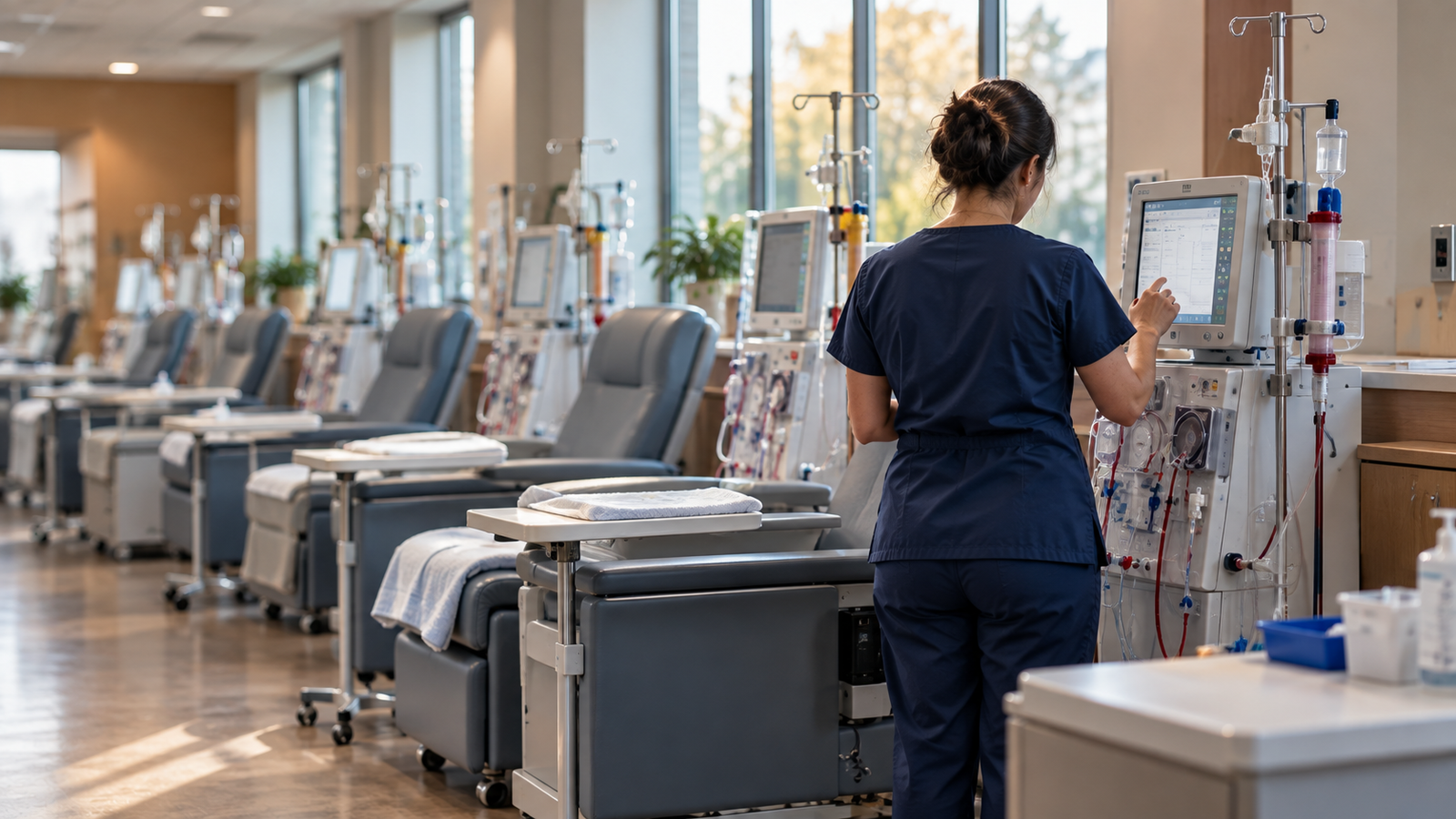
Most dialysis nurses start here. Patients come to a clinic on a fixed schedule, usually three sessions a week, and sit in a chair for each treatment. The same patients return week after week. A nurse gets to know their families, their jobs, their moods, and the small changes that signal trouble. Care is routine in structure but not in content, because people with kidney failure often carry diabetes, heart disease, and other conditions alongside it.
Home dialysis programmers
Home dialysis covers peritoneal dialysis and home hemodialysis. The nurse’s role shifts from giving treatment to teaching it. Patients and family members learn to run the therapy themselves. The nurse trains them, reviews their records, troubleshoots by phone, and sees them in clinic monthly. Nurses who enjoy education and independence often prefer this setting.
Acute and inpatient dialysis
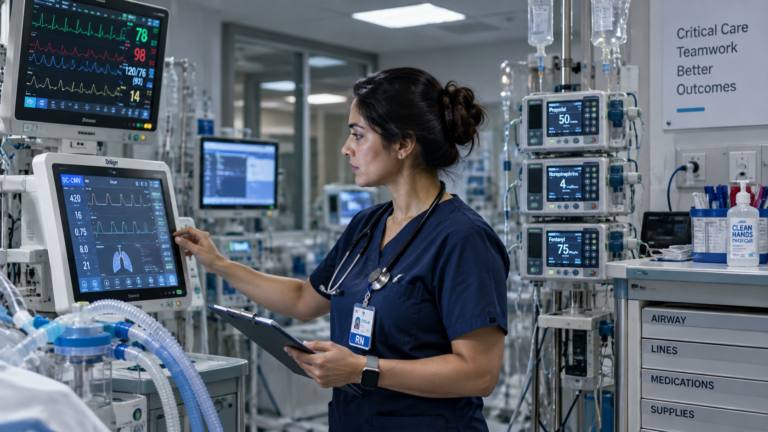
Hospital-based dialysis nurses travel to the patient. They treat people with sudden kidney injury in intensive care units, emergency departments, and medical floors. Some units run continuous kidney replacement therapy for critically ill patients around the clock. The work is less predictable and closer to critical care. Many acute dialysis nurses carry a pager and take call.
Transplant and chronic kidney disease clinics
A smaller group works before and after transplant, or in clinics that manage chronic kidney disease before dialysis becomes necessary. These roles lean toward coordination and education. The nurse navigator career guide on this site covers the coordination side of that work in more detail.
What an in-center shift actually involves
Many clinics open before dawn so that working patients can finish treatment before their jobs start. A first shift of patients arrives early, a second follows around midday, and some clinics run a third into the evening. Patients are usually scheduled on a Monday, Wednesday, Friday pattern or a Tuesday, Thursday, Saturday pattern. That second pattern is the reason Saturday shifts are a normal part of outpatient dialysis work.
Before treatment, the nurse assesses each patient: weight since the last session, blood pressure, breathing, swelling, and the condition of the vascular access. The fistula or graft in the arm is the patient’s lifeline, and protecting it is a core nursing responsibility. The nurse or technician then cannulates the access, connects the patient to the machine, and sets the treatment according to the prescription.
During the run, the nurse watches for drops in blood pressure, cramping, and changes in how the patient looks and feels. Fluid removal is the delicate part. Too little leaves the patient overloaded. Too much, too fast, and blood pressure falls. Medications ordered for dialysis, such as those for anaemia and bone health, are often given during treatment.
Between shifts, the floor turns over quickly. Chairs are cleaned, machines are disinfected, and the next group is already waiting. Infection control is taken seriously in dialysis because the access connects directly to the bloodstream.
Much of the hands-on work is shared with patient care technicians. The registered nurse supervises the floor, assesses patients, handles medication administration, and makes the decisions when something goes wrong.
The federal rules that shape the job
Dialysis clinics that serve Medicare patients must meet the federal Conditions for Coverage, found in Title 42 of the Code of Federal Regulations, Part 494. Section 494.140 sets out who may hold which role, and those rules explain a lot about how careers progress.
The nurse manager must be a full-time registered nurse. That person needs at least 12 months of clinical nursing experience plus another 6 months caring for patients on maintenance dialysis. Home dialysis training nurses must be RNs with 12 months of nursing experience and 3 more months in the modality they teach. For charge nurse roles, an RN, LPN, or LVN qualifies after 12 months of nursing experience, including 3 months in maintenance dialysis.
Two practical points follow. First, a nurse with no dialysis background can be hired and trained, but cannot immediately run the floor as charge nurse or teach home patients. Second, LPNs and LVNs have a real place in outpatient dialysis, which is less true in many hospital specialties.
Patient care technicians fall under the same section. They must complete an approved training programme and become certified within 18 months of starting work, in addition to meeting any state rules.
Certification changed in 2026
NNCC announced on January 15, 2026 that it would modify its Certified Dialysis Nurse and Certified Nephrology Nurse programmes, effective summer 2026. The commission said the change came from its 2024 practice analysis, which found the existing exams no longer fully reflected current nephrology nursing practice. NNCC also stated that current CDN and CNN holders are not affected.
The biggest shift is in how the two credentials divide the field. On NNCC’s current pages, the split follows the setting a nurse works in.
CDN, Certified Dialysis Nurse
The CDN now centres on in-center hemodialysis. NNCC lists three requirements. You need a full, unrestricted US registered nurse licence. At least 2,500 hours as an RN caring for patients on in-center hemodialysis must fall within the two years before applying. You also need 30 contact hours of nephrology continuing education from approved providers in that same two-year window.
CNN, Certified Nephrology Nurse
The CNN now covers everything beyond the in-center chair. Licence and continuing education rules match the CDN. What differs is where the 2,500 hours come from. NNCC lists home hemodialysis, home peritoneal dialysis, inpatient acute kidney injury, and critical care kidney replacement therapy. Chronic kidney disease management and kidney transplant also count.
Older guides describe the CNN as requiring a bachelor’s degree and 3,000 hours over three years. Neither appears on NNCC’s current eligibility page. A nurse who works only in outpatient hemodialysis should now look at the CDN, not the CNN.
The exam and the cost
Both exams have 150 multiple-choice questions and a three-hour time limit. NNCC reports that a standard score of 95 is needed to pass, which works out to answering 70% of the questions correctly. The standard exam fee is USD 350, or USD 300 for members of partner organisations including the American Nephrology Nurses Association. A one-time retake costs USD 200.
Recertification for the CNN runs on a three-year cycle. It requires 45 contact hours over those three years, with at least 15 specific to nephrology. Renewal by continuing education costs USD 175 at the standard rate.
The programmes were rebuilt mid-year. Read NNCC’s own current pages before paying, and be wary of any prep course that still teaches the old eligibility rules.
What dialysis nurses earn
The Bureau of Labor Statistics does not publish a separate wage figure for dialysis nurses. The closest federal benchmark is the May 2024 national median for all registered nurses, which BLS puts at USD 93,600 per year. Anything more specific comes from employer postings, not federal data.
Pay in dialysis tends to track the local RN market. Hospital-based acute dialysis roles often add on-call pay. Outpatient roles usually offer daytime hours, no night shifts, and fewer holidays worked, which many nurses value more than a higher base rate. Many outpatient clinics belong to private dialysis companies. Benefits and career ladders depend heavily on which company owns yours.
What the job ads leave out
The schedule is predictable, but it starts early. A clinic that opens before sunrise needs nurses there before the first patient walks in.
Cannulation takes time to learn. New dialysis nurses often find it the most stressful skill in the first months, especially with new or difficult fistulas. A missed stick hurts the patient and can damage the access. Good employers give new nurses supervised practice before independent cannulation. Ask about this in the interview.
Orientation length varies widely. Some employers train new staff for several weeks, others for much less. Ask how long orientation lasts, who precepts it, and when you will be expected to take a full assignment.
Emotional weight builds slowly. Dialysis patients are not passing through. Nurses see the same people decline over years, sometimes choose to stop treatment, and sometimes die between sessions. The long relationships are a reason many nurses stay in the specialty. They are also why some leave.
The policy ground is shifting. CMS pushed home dialysis through its ESRD Treatment Choices payment model, then announced in March 2025 that it would end that model early. The CY 2026 ESRD payment rule, released on November 20, 2025, finalised its end. Home dialysis programmes still exist and still need nurses, but one federal incentive behind their growth is gone. Nurses planning a career around home dialysis should watch how employers respond.
Can new graduates start in dialysis?
Some employers hire new graduates for outpatient dialysis and train them. Many prefer at least a year of medical-surgical or critical care experience first. Dialysis patients carry complex conditions, and the nurse is often the most senior clinician on the floor. Acute dialysis roles almost always require prior hospital experience.
The federal rules also set a ceiling on how fast a new nurse can progress. Charge nurse and home training roles need 12 months of general nursing experience first, regardless of how quickly someone learns dialysis.
For internationally educated nurses, dialysis follows the same US licensing path as any other specialty. You need a US RN licence first. Dialysis experience from your home country is valuable on a CV and in interviews. NNCC eligibility requires a current US RN licence, so certification comes after you are licensed here.
Dialysis nursing in India is growing too
Nurses reading this from India should know the specialty is expanding at home. The Ministry of Health and Family Welfare reported on August 1, 2025 that the Pradhan Mantri National Dialysis Programme covered 751 districts across all 36 States and Union Territories. It had 1,704 centres operational as of June 30, 2025. The programme supports both hemodialysis and peritoneal dialysis. Experience gained in these centres builds exactly the skills a US or Gulf dialysis employer looks for.
A view from the dialysis unit
In the government hospital where I worked, the dialysis unit had a rhythm unlike any other ward. The same faces came in on the same days, many after long bus journeys. Some carried lunch, because the session and the travel would take the whole day. The nurses there knew each patient’s access by touch. They could feel a change in the thrill of a fistula before anyone ordered a scan. What stayed with me was how much of dialysis nursing is attention rather than intervention. The machine does the filtering. The nurse notices the patient who is quieter than last week, the ankle that is more swollen, the son who has stopped coming with his father. Those small observations are where this specialty does its real work.
Sources:
National Institute of Diabetes and Digestive and Kidney Diseases, Kidney Disease Statistics for the United States, niddk.nih.gov; Nephrology Nursing Certification Commission, CDN and CNN certification and CNN recertification pages, and announcement “Important Information Regarding CNN and CDN Examination Changes,” January 15, 2026, nncc-exam.org; Electronic Code of Federal Regulations, 42 CFR 494.140, Personnel qualifications, ecfr.gov; Centers for Medicare and Medicaid Services, ESRD Treatment Choices Model page and CY 2026 ESRD Prospective Payment System Final Rule, cms.gov; Bureau of Labor Statistics Occupational Employment and Wage Statistics, May 2024, Registered Nurses, bls.gov; Press Information Bureau, Ministry of Health and Family Welfare, “Update on Pradhan Mantri National Dialysis Program,” August 1, 2025, pib.gov.in.
This article describes dialysis nursing careers mainly in the United States, with a note on India. BLS does not track dialysis nurses separately, so the salary figure given is the national median for all registered nurses and actual pay depends on employer, setting, and location. NNCC rebuilt its CDN and CNN programmes in 2026; confirm eligibility, fees, and exam content on nncc-exam.org before applying. Clinical descriptions are for career context only and are not treatment guidance. Follow your facility’s policies and your state Board of Nursing for all practice decisions. Information current as of September 2026.
Author

Discover more from Global Nurse Guide
Subscribe to get the latest posts sent to your email.