CRNA Career Guide USA 2026: Salary, Path & What ICU Nurses Need to Know
Updated May 31, 2026 • Reading Time: ~19 Minutes
You are an ICU nurse with two years of critical care experience, a CCRN, and a 3.6 GPA. Your base salary is $91,000. A colleague who entered nurse anesthesia school alongside you three years ago now earns $215,000 in the same hospital system. The path that separates your income from hers is three more years of doctoral education and roughly $80,000 to $100,000 in tuition. At the starting CRNA salary of approximately $180,000, that investment is recovered in less than one year of additional earnings. Over a 30-year career, the salary difference between an RN and a CRNA exceeds $3.5 million.
The Certified Registered Nurse Anesthetist (CRNA) is the highest-paid nursing credential in the United States — not one of the highest, the highest — with a BLS mean of $223,210 (May 2024) and a projected 35 percent job growth through 2034. It is also the hardest advanced practice nursing degree to obtain, requiring the most demanding prerequisite (high-acuity ICU experience), the longest doctoral programme in the APRN world, and full-time study that makes outside employment nearly impossible. This guide covers the whole picture — what CRNAs do, how to qualify, what the education costs and how long it takes, the 2025 doctoral degree mandate, state practice authority, and the honest reality of CRNA school before you commit to the path.
🩺 Join FREE WhatsApp Channel for Trusted Guide
Get weekly vacancy alerts, EB-3 visa updates & daily NCLEX prep on WhatsApp — FREE.
📲 Follow the Channel💉 CRNA Career 2026 — Verified Data
Mean CRNA salary: $223,210 (BLS, May 2024)
Median CRNA salary: $212,650 (BLS, May 2024)
New graduate starting pay: ~$180,000
Salary range: ~$123,000 (10th) to $247,000+ (90th)
RN median (comparison): $93,600
Job growth 2024–2034: 35% — 7x the national average
Projected shortage by 2033: ~12,500 anesthesia providers (AANA)
Practicing CRNAs: ~57,000
Degree required: Doctoral (DNP or DNAP) — mandatory as of January 2025
ICU experience required: Minimum 1 year (competitive: 2–3 years)
Total pathway timeline: 7–10 years from BSN
Accredited programmes: ~140 in the US
In INR: $223,210 ≈ ₹1.87 crore/year at May 2026 rates
1. What a CRNA Actually Does
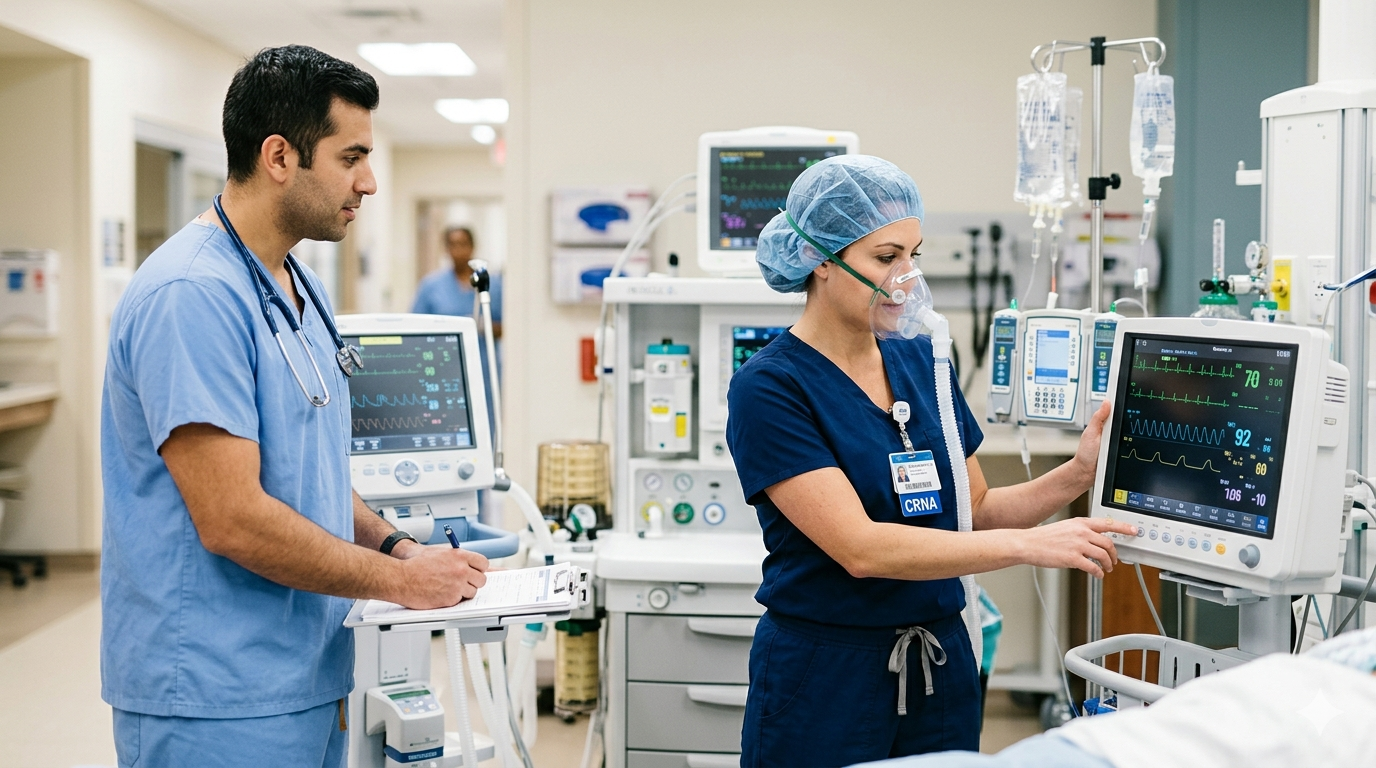
A Certified Registered Nurse Anesthetist administers anaesthesia for surgical, obstetric, diagnostic, and therapeutic procedures. CRNAs are the primary anaesthesia providers in the United States and the sole anaesthesia providers in many rural hospitals, military facilities, and outpatient surgical centres. The American Association of Nurse Anesthesiology (AANA) reports that CRNAs administer approximately 55 million anaesthetics in the US each year — roughly half of all anaesthetics administered.
Day-to-day work includes pre-anaesthesia assessment of patients, developing and implementing an individualised anaesthesia care plan, administering and monitoring general, regional, and monitored anaesthesia care, managing airways, responding to anaesthesia emergencies, and providing post-anaesthesia care. CRNAs work with physicians, surgeons, and other providers, but in independent practice states they manage the anaesthesia from assessment to recovery without physician oversight.
The scope is broad, technically demanding, and carries significant responsibility. Anaesthesia errors can be fatal. The training is rigorous precisely because the stakes are. Nurses drawn to high-level procedural independence, physiological complexity, and high-acuity patient management find the work deeply satisfying. Nurses who want the interpersonal continuity of long-term patient relationships generally do not, because CRNA patient contact is typically procedural and time-limited.
2. The Numbers That Justify the Path
The financial case for CRNA is the strongest return on investment in graduate nursing education. The arithmetic is straightforward:
The median RN earns $93,600. The median CRNA earns $212,650. The annual gap is $119,050. Over 30 years of practice, that gap compounds to over $3.5 million in additional earnings — before accounting for the higher percentage-based retirement contributions and the higher overtime base.
CRNA programme tuition typically runs $50,000 to $120,000. At a starting CRNA salary of $180,000, the tuition cost is recovered within the first year of CRNA practice. The real cost of the programme, however, is not just tuition. Three years of full-time doctoral study means three years during which most students cannot work significant hours as RNs. The forgone income — typically $80,000 to $90,000 per year — adds $240,000 to $270,000 to the real investment. Even accounting for that, the cumulative lifetime earnings advantage exceeds $2.5 million for most CRNAs.
No other nursing credential produces this return. The NP median is $129,210 — impressive, but less than two-thirds of the CRNA median, with a longer time before the degree pays for itself.
3. The ICU Experience Requirement — The Real Gatekeeper
Most information about becoming a CRNA focuses on the education. The real selection filter happens before you even apply to a programme.
Accredited CRNA programmes require a minimum of one year of full-time critical care experience in an adult, paediatric, or neonatal ICU. That is the baseline. Competitive programmes at academic medical centres — the ones with the highest NCLEX-equivalent exam pass rates, the strongest clinical training, and the most sought-after residency placements — routinely expect 2 to 3 years in a high-acuity ICU setting.
What counts as qualifying experience: cardiovascular ICU (CVICU), surgical ICU (SICU), neuro ICU, medical-surgical ICU (MSICU), trauma ICU, and paediatric ICU (PICU) at a Level I or II trauma centre or academic medical centre.
What typically does not satisfy the requirement: telemetry, step-down, coronary care without ventilator management, general emergency department (without ICU-level critical care), or floor nursing regardless of acuity.
The CCRN certification (Critical Care Registered Nurse, administered by AACN) is not always required, but it is strongly valued by admissions committees. A CCRN signals that you can demonstrate your ICU competency through a standardised national examination — not just claim it on a resume. In a competitive application pool, a CCRN combined with high-acuity ICU experience at an academic centre is the single strongest differentiator.
The practical advice: if CRNA is your goal, your first nursing job should be an ICU position at the highest-acuity facility accessible to you. A cardiovascular ICU at an academic medical centre is the gold standard. Build your CCRN certification in year two. Apply to CRNA programmes in year three.
For maximising your ICU career while building toward CRNA: How to Maximize Income as an ICU or ER Nurse 2026.
4. The Doctoral Degree Mandate — What Changed in 2025
This is one of the most significant recent changes to the CRNA pathway and one that is not yet reflected in much career guidance written before 2025.
As of January 2025, a doctoral degree is required for all new CRNAs. The Council on Accreditation of Nurse Anesthesia Educational Programs (COA) set this transition deadline in 2016, and it took effect at the start of 2025. All accredited nurse anesthesia programmes now award either a Doctor of Nursing Practice (DNP) or a Doctor of Nurse Anesthesia Practice (DNAP) rather than a master’s degree.
If you completed an MSN-level CRNA programme before January 2025, your credential remains valid. You are not required to return for a doctoral degree. But all new CRNA students from 2025 onward complete doctoral-level education.
DNP vs DNAP: the practical difference
DNP (Doctor of Nursing Practice) in nurse anesthesia. Offered through nursing schools. Aligns with the broader DNP framework that governs NP programmes. Emphasises evidence-based practice, healthcare systems, population health, and clinical leadership alongside the nurse anesthesia clinical curriculum. Programme length: typically 36 to 42 months.
DNAP (Doctor of Nurse Anesthesia Practice). A practice doctorate specific to nurse anesthesia, offered by programmes under medical or combined school governance. Focused exclusively on anesthesia science and clinical practice. Programme length: typically 36 months.
Clinically, graduates of either programme are identical in scope and function. Both qualify for the National Certification Examination (NCE) and the same state licensure. The choice is primarily about academic environment, cost, and career interest: the DNP may appeal more to those considering academic or leadership roles; the DNAP appeals to those focused purely on clinical practice.
Roughly 140 accredited programmes exist across both degree types. Some are exclusively on-campus and clinic-based (no online component). None are fully online — the clinical hours cannot be delivered virtually. Programme selection should be based on clinical training quality, programme pass rates, class size, geographic access, and cost, not on the degree designation.
5. Getting In: What Strong Applications Look Like
CRNA programme admission is competitive. The typical required elements:
Current RN licence. Active and unencumbered in the state where you intend to study.
BSN. Required for most programmes. Some accept other bachelor’s degrees in combination with an RN licence, but a BSN is the standard.
GPA. Minimum 3.0 at most programmes; competitive programmes expect 3.4 or higher. Science GPA (chemistry, biology, A&P, microbiology) is often evaluated separately.
ICU experience. The minimum is one year full-time; competitive applicants bring two to three years in high-acuity settings.
CCRN certification. Strongly preferred. Some programmes now list it as preferred rather than required, but applicants without it are at a disadvantage against those who hold it.
GRE scores. Required by some programmes, waived by others. Check each programme’s current requirements, as many dropped the GRE requirement post-2020.
Letters of recommendation. Typically three: one from a CRNA or CRNA programme director, one from your ICU nurse manager or charge nurse, and one academic or professional reference.
Personal statement. Describes your motivation for nurse anesthesia, your clinical preparation, and your specific career goals. A strong statement explains why anaesthesia specifically, not just “I want to advance.” Programmes reject generic statements routinely.
The nurses who get in on first application are the ones who started building their application on day one of their first ICU job: keeping their GPA documentation current, pursuing the CCRN systematically, requesting the right letters early, and shadowing a CRNA before they write the personal statement.
6. What CRNA School Is Actually Like
CRNA programmes are among the most intensive graduate healthcare programmes in existence. The honest description: the first year is comparable to first-year medical school in cognitive load. Students cover advanced pathophysiology, pharmacology of anaesthesia agents, physics of gas delivery, equipment, regional techniques, and clinical pharmacology at a depth that exceeds most nursing graduate programmes by a significant margin.
Clinical rotations run across general surgery, cardiac, paediatric, obstetric, trauma, neurosurgical, and regional anaesthesia. Students administer thousands of anaesthetics under supervision, gradually taking on more independence as competence develops. The clinical hours are long, the reading is relentless, and the stakes of each case are real.
Most programmes cannot be completed while maintaining significant outside employment. This is not a suggestion — it is a practical reality that many students underestimate. The students who struggle most are those who tried to work significant hours alongside the programme and found the cognitive demand of both unsustainable. Budget for three years of minimal to no earned income from nursing, fund it from savings or loans, and treat the programme as your full-time job.
Attrition exists in all programmes and is higher in the first year than the second or third. Nurses who make it through consistently describe it as the most demanding and most rewarding experience of their professional lives.
7. Certification and Licensure After Graduation
After graduating from an accredited DNP or DNAP programme, new CRNAs must:
- Pass the NCE (National Certification Examination), administered by the National Board of Certification and Recertification for Nurse Anesthetists (NBCRNA). The NCE is a computer-adaptive examination testing across all domains of nurse anesthesia practice.
- Obtain state APRN licensure with CRNA designation. Each state has its own application process, fees, and requirements.
- Obtain DEA registration for controlled substance prescribing and drug administration, which is central to anaesthesia practice.
- Maintain certification through the NBCRNA’s Continued Professional Certification (CPC) programme — a four-year cycle requiring continuing education, practice hours, and professional development.
8. Practice Authority — Where CRNAs Work Independently
Practice authority for CRNAs is determined by state law, specifically whether a state has “opted out” of the federal Centers for Medicare & Medicaid Services (CMS) requirement that physician supervision be present for CRNAs to be reimbursed under Medicare.
In approximately 21 opt-out states, CRNAs can practise fully independently — assessing patients, administering anaesthesia, and managing post-anaesthesia care without a physician present. These states include Alaska, Arizona, California, Colorado, Idaho, Iowa, Kansas, Minnesota, Montana, Nebraska, New Hampshire, New Mexico, North Dakota, Oregon, South Dakota, Washington, Wisconsin, and Wyoming.
In remaining states, CRNAs work in an anesthesia care team model with an anesthesiologist, or under a collaborative physician agreement. In many of these states, the practical independence is substantial, but the legal and billing structure differs.
For nurses considering independent practice or rural anesthesia, opt-out state laws are a significant career planning factor. CRNAs in opt-out states often earn more because they can bill independently, take on a broader scope of cases, and command higher compensation in settings where they are the sole anaesthesia provider.
9. The Honest Trade-Offs
The pathway is long and expensive. Seven to ten years from BSN to CRNA is a substantial commitment, and the three-year doctoral programme involves both tuition debt and forgone RN income. The total real investment is often $300,000 to $400,000 when both are counted. The ROI is still positive over a career, but the cash flow during the programme is genuinely difficult.
ICU experience must be high quality. Not all ICU experience is equal in the eyes of admissions committees. A year in a community hospital’s small ICU without ventilator-dependent patients, vasopressors, and invasive lines is not competitive with two years in a cardiovascular ICU at a Level I trauma centre. If you are targeting top programmes, be strategic about where you get your ICU experience.
The work is procedural, not relational. CRNAs provide care at a specific, intense point in a patient’s experience, then move to the next case. There is no longitudinal relationship, no following a patient through recovery, no the kind of nursing relationship that draws many people to the profession. This is a genuine trade-off. Nurses who value the relational aspect of direct care most often find greater satisfaction in NP or clinical nursing roles than in CRNA practice.
Not all states treat CRNAs equally. Practice authority differences affect both scope and earning potential. Research your target state’s CRNA landscape before committing to a geographic location.
The shortage is real, and so is the demand. The AANA projects a shortage of 12,500 anesthesia providers by 2033. New CRNA graduates will not struggle to find work. The question is which practice environment — hospital, outpatient surgical centre, rural critical access, or independent — best matches your goals.
For the NP pathway comparison: Nurse Practitioner Career Guide USA 2026. For managing the education investment: Student Loan Repayment for Nurses 2026.
10. Frequently Asked Questions
How much do CRNAs earn?
Mean $223,210, median $212,650 (BLS, May 2024). New grads start ~$180,000. Top 90th percentile: $247,000+. More than double the RN median of $93,600.
How long to become a CRNA?
7–10 years total: BSN (4 years) + ICU experience (1–3 years) + doctoral programme (3 years).
Is a doctoral degree required?
Yes, as of January 2025. All new CRNAs must hold a DNP or DNAP. Pre-2025 MSN-level CRNAs are not affected.
What ICU experience do I need?
Minimum 1 year full-time critical care. Competitive: 2–3 years in CVICU, SICU, neuro ICU, or MSICU at a high-acuity facility. CCRN strongly differentiates applicants.
DNP or DNAP?
Both qualify graduates for the same practice. DNP suits those interested in leadership/academia. DNAP is focused exclusively on anesthesia clinical practice. Choose based on programme quality, cost, and career goals.
Can CRNAs practise independently?
In ~21 opt-out states, yes. In other states, collaborative or team-based model. Independent practice states often offer higher earnings.
What does CRNA school cost?
$50,000–$120,000 in tuition. Add 3 years of reduced/no RN income. Total real investment: $300,000–$400,000. Recovered through the salary differential within 3–5 years of CRNA practice.
Is CRNA school hard?
Yes — among the most demanding graduate healthcare programmes. First year is medical-school-level intensity. Full-time study means minimal outside employment. Most graduates describe it as the hardest and most rewarding experience of their careers.
The Bottom Line
The CRNA credential is the highest-paid, highest-demand advanced practice nursing pathway in the United States. The salary is real — $223,210 mean, $212,650 median, new-grad starting salaries around $180,000 — and the 35 percent projected growth makes this one of the most secure long-term career bets in healthcare. The path is also genuinely demanding: multiple years of high-acuity ICU experience, a competitive programme admission, three years of intensive doctoral study, and a certification exam that requires full preparation.
The nurses who succeed in this pathway are the ones who decide early, build strategically, get their ICU experience at the right facility, earn the CCRN before they apply, and enter the programme with clear eyes about what the next three years will cost them in time, money, and effort. The return, across a career, is substantial. But it is earned. Nothing about the CRNA path is handed to you — which is probably why the credential commands the respect and the salary that it does.
Related articles on GlobalNurseGuide.com:
Nurse Practitioner Career Guide USA 2026
How to Maximize Income as an ICU or ER Nurse 2026
Nursing Specialty Salaries 2026
Student Loan Repayment for Nurses 2026
Salary Negotiation for Nurses 2026
Disclaimer:
This article is for informational purposes only and does not constitute career, financial, or educational advice. Salary data is sourced from the US Bureau of Labor Statistics Occupational Employment and Wage Statistics (May 2024 data release). Job growth projections from BLS Occupational Outlook Handbook 2024–2034. Anesthesia provider shortage projections from the American Association of Nurse Anesthesiology (AANA). Programme cost data from publicly available university tuition schedules. Doctoral degree mandate effective January 2025 per the Council on Accreditation of Nurse Anesthesia Educational Programs (COA). Practice authority opt-out states from AANA’s state-by-state resources. Salaries, programme requirements, and state practice laws change. Always verify current information with the relevant state board of nursing, NBCRNA, and the specific programme you are considering. Currency conversion approximate at May 2026 rates. GlobalNurseGuide.com is not affiliated with any nursing school, NBCRNA, AANA, or COA. Information current as of May 31, 2026.
© 2026 GlobalNurseGuide.com — Empowering Nurses Worldwide with Real Opportunities
Author

Discover more from Global Nurse Guide
Subscribe to get the latest posts sent to your email.