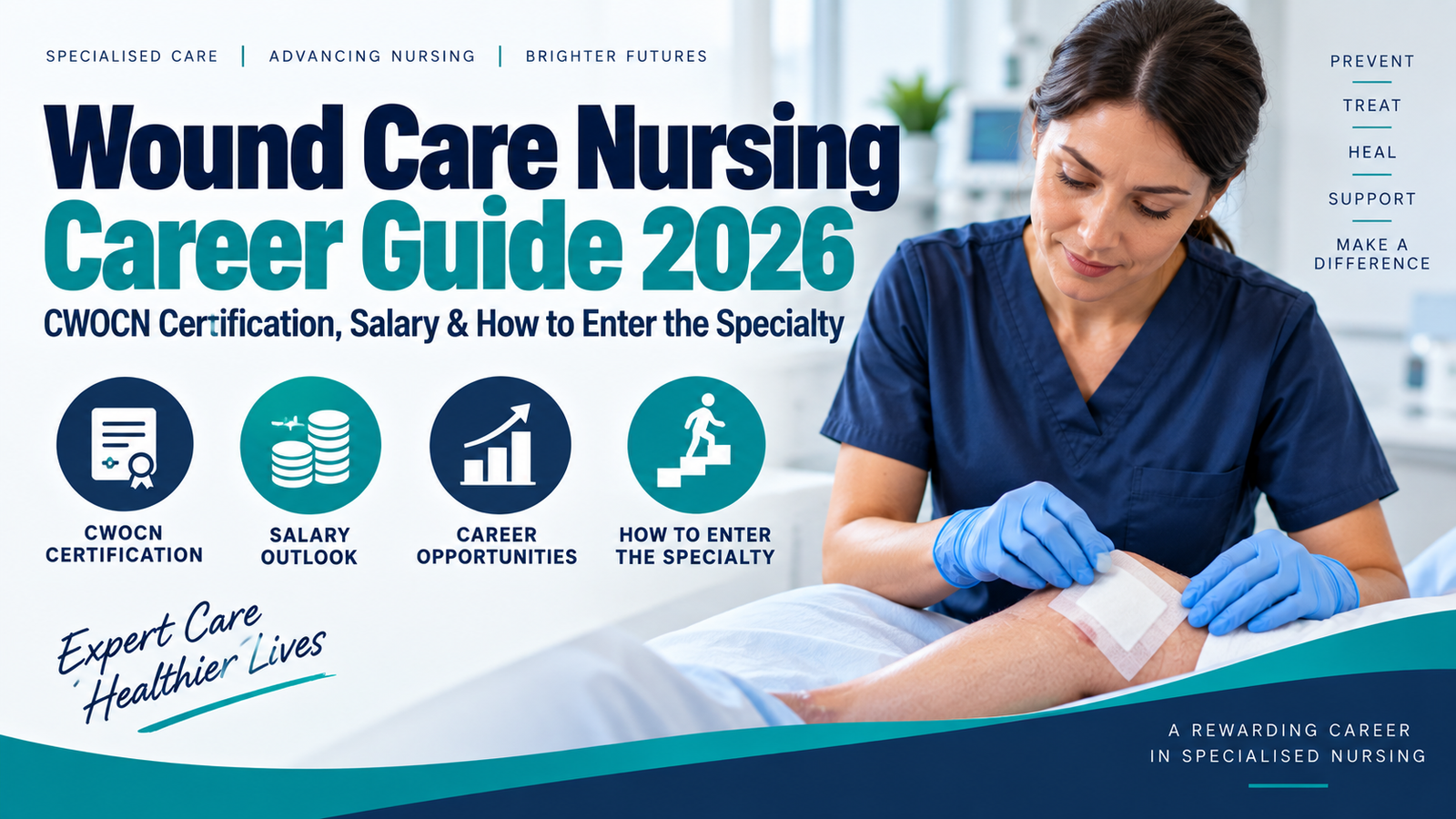
Wound Care Nursing Career Guide 2026: CWOCN Certification, Salary & How to Enter the Specialty
Wound Care Nursing Career Guide 2026: CWOCN Certification, Salary & How to Enter the Specialty
By Abirami Arumugam, RN, Chief Editor, GlobalNurseGuide.com
Wound care nursing is one of the most technically specific and autonomy-driven specialties a registered nurse can enter. A certified WOC nurse assesses complex wounds that other clinical staff have already attempted to treat. They select products and protocols that general nursing training does not cover. They consult across units and across care settings, from inpatient acute care to home health to outpatient wound clinics. Fewer than 10,000 certified wound, ostomy, and continence nurses practice in the United States, and only 36.6% of hospitals employ a CWOCN. That gap is the job market this specialty enters. This guide explains what WOC nurses actually do, the two pathways to CWOCN certification from the Wound, Ostomy and Continence Nursing Certification Board, what the education programmes cost and involve, and what the specialty pays compared to the general nursing median.
Three disciplines in one credential
The CWOCN credential covers three distinct clinical disciplines. Understanding each one before choosing a pathway matters, because the certifications can be pursued individually or together.
🩺 Join FREE WhatsApp Channel for Trusted Guide
Get weekly vacancy alerts, EB-3 visa updates & daily NCLEX prep on WhatsApp — FREE.
📲 Follow the ChannelWound care addresses the assessment and management of chronic and complex wounds. Pressure injuries across all stages, diabetic foot ulcers, venous and arterial leg ulcers, surgical wounds with healing complications, fistulae, and trauma wounds are all within scope. The wound care component requires the nurse to identify wound aetiology correctly before selecting treatment. A venous leg ulcer and a diabetic foot ulcer can present similarly at first assessment. The treatment approach differs substantially. Compression therapy is central to venous ulcer management. It is contraindicated when arterial insufficiency is the primary driver. Getting that distinction wrong, and treating the wrong wound type, causes direct patient harm.
Assessment skills in wound care include measuring and documenting wound dimensions, identifying the stage of a pressure injury, characterising exudate, assessing periwound skin, identifying signs of infection or biofilm, and determining whether wound bed preparation is adequate for healing. Documentation in wound care is clinical and legal simultaneously. Most wound care nurses use standardised wound photographs and measurement templates that create a visual and numerical record of wound trajectory over time.
Ostomy care is the management of stomas created through surgical diversion of the urinary or gastrointestinal tract. Patients with colostomies, ileostomies, urostomies, and continent diversions all require specialised nursing education. The pre-operative component involves site marking, where the WOC nurse selects the optimal stoma location on the abdomen based on the patient’s body contours, skin folds, waistline, and planned clothing. A poorly sited stoma creates management difficulties the patient lives with indefinitely.
Post-operatively, the WOC nurse teaches the patient to manage their pouch system, troubleshoots complications including peristomal skin breakdown, stomal prolapse, retraction, hernia, and parastomal fistulae, and selects pouching systems that match the stoma type, output characteristics, and the patient’s dexterity and visual capacity. Pouch selection is not standardised. A convex pouching system is needed for a retracted stoma. A flat system suits a well-budded stoma on a flat abdominal surface. The nurse who knows these distinctions is the one patients and families are relying on for sustainable self-management after discharge.
Continence care addresses urinary and faecal incontinence, urinary retention, and bladder and bowel dysfunction. Assessment includes identifying the type of incontinence, contributory factors, and appropriate interventions. These range from pelvic floor rehabilitation and bladder training to catheter management, containment device selection, and skin care for incontinence-associated dermatitis. Continence nursing is underrecognised in scope but directly affects patient quality of life and falls risk, both of which carry measurable outcome implications in most hospital quality programmes.
Pursuing the CWOCN: two pathways to the credential
The Wound, Ostomy and Continence Nursing Certification Board, WOCNCB, administers the CWOCN at wocncb.org. Founded in 1978, WOCNCB is a not-for-profit international organisation that certifies nearly 7,600 registered nurses as of its most recent data.
WOCNCB offers two eligibility pathways.
The Education Pathway
The Education Pathway requires graduating from a WOC nursing education programme accredited by the WOCN Society at the time of graduation. The programme must have been completed within five years of the exam application date. A bachelor’s degree or higher is required for this pathway.
WOC nursing education programmes typically run six to twelve months. They combine formal didactic content covering wound, ostomy, and continence theory with a supervised clinical practicum. Cost ranges from approximately USD 5,000 to USD 15,000 depending on the institution. A current list of WOCN Society-accredited programmes is maintained at wocn.org under the accredited programmes section. Verify that a programme holds active accreditation before enrolling, because accreditation status can change.
Graduates of an accredited programme are eligible to sit the WOCNCB examination for their areas of study. The WOCN Society and WOCNCB are separate organisations with separate governance. Graduating from a WOCN-accredited programme qualifies the nurse to sit the WOCNCB exam but does not in itself grant certification.
The Experiential Pathway
The Experiential Pathway does not require completing a formal WOC education programme. It requires practice hours and continuing education earned post-licensure in each specialty area.
For each specialty, wound, ostomy, or continence, 1,500 practice hours in that specialty and 50 CE contact hours in that specialty within the past five years are required. To sit for the full CWOCN covering all three specialties, a nurse needs 4,500 total practice hours and 150 CE contact hours across all three areas, all completed within the past five years.
This pathway is more demanding in total accumulated hours and takes longer than the education pathway for most nurses. It is the route for nurses who developed significant wound care or ostomy experience through a general bedside role before transitioning to a formal certification track.
Verify current eligibility requirements directly at wocncb.org before beginning either pathway, as WOCNCB has updated its requirements periodically and the most current information on the website supersedes any summary.
The specialty-specific credentials
A nurse who specialises in one or two of the three disciplines can pursue individual credentials rather than the full CWOCN. The CWCN covers wound care only. The COCN covers ostomy care only. The CCWCN covers continence care only. Each carries its own eligibility structure with proportional hour and CE requirements. The CWOCN-AP is an advanced practice version requiring an APRN licence, an MSN or higher, and a current CWOCN credential.
WOCNCB also offers the Certified Foot Care Nurse, CFCN, for nurses specialising in foot care across diabetic and vascular populations. CFCN is a separate credential not bundled into the CWOCN.
What the exam involves
WOCNCB administers its certification examinations through testing providers. Effective May 20, 2025, Meazure Learning no longer administers WOCNCB exams. Check wocncb.org directly for the current examination delivery provider and scheduling process before applying.
The examination format is a written exam assessing clinical knowledge across the specialty areas for which the nurse is applying. Results are provided after the examination. Verify the specific question count, time allowance, and passing standard on the WOCNCB website at the time of your application.
Certification renews through the Professional Growth Programme, which requires accumulating a minimum of 80 to a maximum of 90 PGP points over the renewal cycle. Contact hours, professional activities, and CE in the specialty areas contribute to PGP points.
What the specialty pays
The Bureau of Labor Statistics OES May 2024 data reports a national median annual wage of USD 93,600 for registered nurses across all specialties and settings. BLS does not publish a separate category for wound, ostomy, or continence nurses.
Industry compensation data from 2026 sources shows a meaningful certification premium in this specialty. Non-certified RNs performing wound care tasks typically earn in the USD 70,000 to USD 75,000 range. CWCN-certified nurses typically earn USD 82,000 to USD 90,000. CWOCN holders covering all three specialties typically earn USD 88,000 to USD 100,000 based on employer job posting and compensation survey data from 2026. These are third-party figures, not BLS primary data. Treat them as directional indicators.
PayScale’s 2026 data for early-career WOCNs shows an average of USD 35.85 per hour, placing full-time annual compensation at approximately USD 74,500 at that experience level. Experienced certified WOCNs, particularly those in hospital-based consultation roles or independent practice, reach above the national RN median.
The education pathway investment is typically USD 5,000 to USD 15,000. The salary premium over a non-certified wound care nurse runs USD 10,000 to USD 20,000 annually based on certification. Most nurses who complete the credentialing path recover the education investment within the first 12 to 18 months of practice.
Additional specialty training adds further earning potential. Hyperbaric oxygen therapy training, used for specific wound types including radiation-damaged tissue and some diabetic wounds, adds USD 2,000 to USD 5,000 to base compensation at facilities that offer it.
Settings where CWOCN nurses work
The majority of WOC nurses work in one of four settings.
Hospital-based wound and ostomy consultative services are where most hospital-employed CWOCNs operate. They carry a consult caseload across units, seeing referred patients from surgery, oncology, ICU, and medical floors. The pre-operative ostomy siting visits are frequently time-sensitive and require coordination with surgical scheduling. A hospital may have one or two CWOCNs covering an entire facility. The clinical autonomy is high. The isolation is real. On-call coverage for ostomy consults is common.
Outpatient wound care centres manage chronic wounds in a clinic setting. Patients attend weekly or biweekly appointments. The nurse tracks wound progress over cycles of treatment, adjusting product selection and management protocols as the wound trajectory changes. The pace differs from inpatient nursing. The patient relationship extends across months rather than days.
Home health agencies employ wound care nurses for home visits to patients with chronic wounds, ostomies requiring ongoing education and troubleshooting, and continence management needs. The home health wound care role is described in detail in the home health nursing career guide on this site. WOC certification adds clinical authority to that role and typically affects the level of cases a home health agency assigns.
Skilled nursing facilities and long-term care environments have high rates of pressure injury prevalence and incontinence-associated dermatitis. A CWOCN in that setting often functions as both clinician and educator, training CNAs and LPNs in skin care, repositioning protocols, and moisture management.
What this specialty requires that bedside nursing does not fully prepare you for
Wound assessment is a learned clinical skill that does not transfer from standard nursing training without deliberate study. General bedside nursing teaches nurses to change dressings on the orders of a physician or wound care nurse. It does not teach the differential diagnosis that informs why a specific treatment was ordered, how to assess whether the order should be changed, or what to document to support continuing or modifying a treatment plan.
Product knowledge is extensive and specific. Wound care nurses develop familiarity with dozens of dressing categories: alginates, hydrocoloids, foams, silicone contacts, negative pressure wound therapy systems, collagen products, and antimicrobials, and learn the specific indications and contraindications for each. This knowledge comes partly from formal education and partly from supervised clinical experience. A nurse who has read about wound products but not used them in a supervised setting is not yet safe to practice autonomously in wound care.
I spent years in a setting where wound care was managed with the resources available rather than the resources indicated. Nurses dressed wounds with whatever was in the supply room. Complex wounds received the same treatment as superficial ones because no one with specialist knowledge was available to differentiate them. Patients left with wound complications that a competent WOC nurse would have prevented or caught earlier. That experience made clear to me that wound care nursing is not ancillary. The work of correctly identifying what a wound is, why it is not healing, and what it needs is clinical decision-making with direct patient outcome implications. A pressure injury that is misidentified and undertreated progresses. A poorly managed ostomy creates skin breakdown that compounds an already difficult recovery. The specialisation exists because the consequences of not having it are visible and documented.
Sources:
Wound, Ostomy and Continence Nursing Certification Board, wocncb.org, CWOCN eligibility requirements, credential structure, and renewal requirements; WOCN Society, wocn.org, accredited education programme directory; Bureau of Labor Statistics Occupational Employment and Wage Statistics, May 2024, Registered Nurses (29-1141), bls.gov; PayScale wound, ostomy, and continence nurse hourly rate data, 2026; NurseCompensation.com CWOCN and CWCN salary comparison data, June 2026 (third-party employment data, not a BLS primary source).
BLS OES May 2024 reports a national median of USD 93,600 for registered nurses across all settings and specialties. BLS does not separately track wound, ostomy, or continence nursing compensation. Salary figures from third-party sources are indicative and based on posted positions and reported compensation; actual pay varies by employer, certification level, setting, geographic region, and experience. WOCNCB certification requirements, exam delivery arrangements, and renewal criteria are set by WOCNCB and are subject to change. Verify all current requirements directly at wocncb.org before enrolling in a programme or submitting an application. This article is for career information purposes only and does not constitute clinical guidance or professional licensing advice.
Author

Discover more from Global Nurse Guide
Subscribe to get the latest posts sent to your email.