How to Survive Your First Nursing Clinical Rotation: An Honest Guide
Updated June 8, 2026 • Reading Time: ~16 Minutes
Nobody tells you what a nursing clinical rotation actually feels like before you walk in. The textbook covered assessment. The instructor covered documentation. The simulation lab covered technique. Nobody told you that you would forget everything you know the moment a real patient looks up at you and asks a question you were not expecting. Nobody mentioned how disorienting it is to suddenly be responsible, even partially, for another human being when yesterday you were taking a written exam about it.
That disorientation is normal. It is also temporary. Every nurse who has ever worked a clinical floor went through the same first rotation — uncertain, alert, trying to look more confident than they felt. What determines whether you come out the other side skilled and ready is not talent or prior knowledge. It is preparation, honest communication with your preceptor, and a willingness to be a learner rather than a performer for however many weeks the rotation runs. This guide covers everything the orientation handout does not.
🩺 Join FREE WhatsApp Channel for Trusted Guide
Get weekly vacancy alerts, EB-3 visa updates & daily NCLEX prep on WhatsApp — FREE.
📲 Follow the Channel📋 Clinical Rotation — Key Facts for 2026
ADN clinical hours required: 500–750
BSN clinical hours required: 700–1,000+
Shift length: 4–12 hours (2026 trend: 8–12 hour concentrated shifts)
Schedule: Typically 1–3 clinical days per week
Rotation length per specialty: 4–8 weeks
Clinical pay: None — unpaid, part of tuition-funded curriculum
NCLEX requirement: Cannot sit without completing required clinical hours
Key specialties (BSN): Med-surg, paediatrics, OB, psych, community health, critical care
Guided by: Clinical instructor (school-assigned) or preceptor (facility-based)
1. The Gap Nobody Prepares You For
Classroom nursing and clinical nursing share the same vocabulary but operate differently in every other way. In the classroom, you solve problems at your own pace, with a textbook open, with time to think. In the clinical environment, problems arrive on their own schedule, the patient is watching, other staff may be watching, and your hands need to do what your brain has been describing in lecture notes.
This gap — between knowing and doing, between describing and performing — is the central experience of nursing clinical education. It is not a sign that your preparation was insufficient. It is the nature of procedural and relational learning, which cannot be completed in any space other than the one where it is needed. You will not close the gap by studying harder or sleeping less the night before. You close it by showing up, doing, making small mistakes in a supervised environment, and doing again. Rotations exist precisely because this gap exists, and no amount of classroom excellence eliminates the need to cross it.
The students who struggle most in clinical rotations are often the ones who were strongest in the classroom, because they arrive expecting competence and are humbled by the reality of real patients. The students who do best are often those who expect to be novices and lean into that honestly. Your clinical instructor and your preceptor know you are a student. They are not expecting mastery. They are watching for your learning approach, your safety awareness, and your character under pressure.

2. The Preparation That Actually Matters
The night before a clinical shift, most students do one of two things: they study everything they can find about every possible condition, or they collapse from exhaustion and do nothing. Neither is optimal. The preparation that actually makes a difference is targeted and specific.
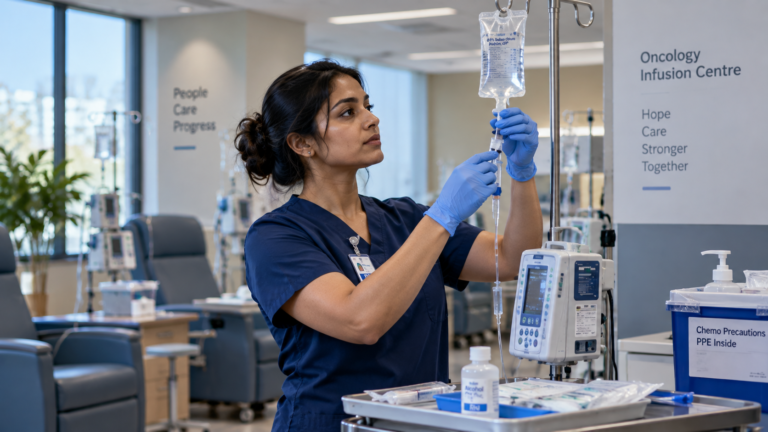
Look up your assigned patients. If your programme allows it, access the patient information the evening before. Find the primary diagnosis for each assigned patient, read two or three paragraphs about the pathophysiology, note the medications on their medication list and what each one is used for, and identify the key nursing considerations. You do not need to memorise anything. You need to walk in knowing enough to recognise what you are seeing and ask informed questions about it.
Review the skills you expect to perform. If you know tomorrow’s rotation involves wound care, IV access, or catheter insertion, spend 20 minutes reviewing the procedure step-by-step. Not to memorise it perfectly, but to refresh the sequence so your hands are not starting from cold.
Prepare your supplies and uniform the night before. This sounds obvious, but the cognitive load of a first clinical morning is significant. Laying out your uniform, packing your bag, and confirming your route the evening before removes the possibility of arriving flustered or late. Clinical instructors notice punctuality. It signals respect for the patients, the staff, and the learning environment.
Sleep. Genuinely. A rested student assesses faster, communicates more clearly, catches more, and handles stress better than an exhausted one. Six hours of sleep with the right preparation beats three hours of reading with none.
3. Your First Day — What to Expect
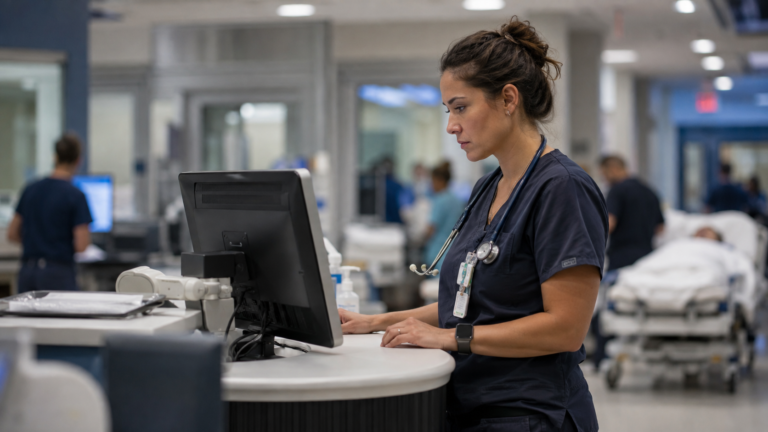
The first day of any clinical rotation is almost always orientation-heavy. You will not be assigned five patients and expected to manage them independently. You will receive a safety and facility orientation covering emergency procedures, documentation systems, and unit-specific protocols. You will meet the staff. You will observe.
This observation phase is more valuable than most students realise. Watch how the experienced nurses move through the unit — how they prioritise, how they communicate with patients, how they interact with the team, how they handle interruptions. The patterns you absorb in the first few hours of observation are the ones you will unconsciously begin to replicate. Be an active observer: notice, not just watch.
Your personal role on day one is to be helpful, visible, and communicative. Introduce yourself to every staff member you encounter. Help with tasks that do not require a licence — answering call lights, fetching equipment, repositioning a patient alongside a nurse. Ask the nurses what they need. Small contributions on day one build the goodwill that opens more learning opportunities on day two and beyond.
The most common first-day mistake is standing at the nurses’ station waiting to be told what to do. Staff are busy, and a student who waits to be assigned is a background presence. A student who asks “Is there anything I can help with right now?” is a participant.
4. Working With Your Clinical Instructor or Preceptor
The person supervising your rotation — whether a school-assigned clinical instructor or a facility-based preceptor — is the single most important variable in the quality of your experience. You cannot control their personality or their teaching style. You have significant control over how the relationship develops.
Arrive prepared, not just present. The difference is measurable. An instructor asks about a patient’s diagnosis; the prepared student can answer. The unprepared student cannot. After the second or third time, the instructor will stop asking the unprepared student and invest their teaching energy elsewhere.
Ask specific questions. “Can you show me how you perform the neurological assessment on a patient with altered consciousness?” is a question that opens a teaching moment. “I don’t know what to do” is a statement that closes one. Preceptors and instructors teach to students who demonstrate curiosity. Vague helplessness frustrates them.
Receive feedback without defensiveness. You will be corrected. Many times. A correction is not a condemnation — it is a teaching act. Responding with “You’re right, I’ll adjust that” and then actually adjusting earns respect. Arguing, deflecting, or becoming visibly upset about feedback signals immaturity. Clinical nursing has no space for ego. The patient’s safety depends on nurses who can accept correction and act on it.
Thank your preceptor at the end of every shift. Genuinely, not performatively. Precepting a student is additional cognitive work on top of a full clinical load. Nurses who precept do it because they value education and remember what it felt like to be where you are. Acknowledging that is both decent and strategically wise — a preceptor who feels appreciated will invest more in your learning.
5. The Skills That Matter Most — Not the Ones You Expect
Most nursing students enter clinical rotation worried about performing skills: IV insertion, catheter placement, medication administration. Those anxieties are reasonable. They are not, however, where the real learning happens in early rotations.
The skills that determine how quickly you develop clinical competence are:
Clinical observation. The ability to enter a patient room and systematically note what is different from last assessment — colour, breathing pattern, facial expression, level of engagement — before you touch anything or say a word. This skill is built only through repetition and attention.
Therapeutic communication. Sitting at eye level with a frightened patient and asking one open-ended question that lets them tell you what they most need to tell you. This is not a skill you can practise on a mannequin.
Prioritisation. When two patients need something at the same time, which one first and why. Clinical priority is driven by the ABCs (Airway, Breathing, Circulation), Maslow’s hierarchy, and the specific status of each patient. Learning to triage competing demands in real time is one of the most valuable skills clinical rotations develop, and it cannot be taught from a textbook.
Asking for help before you need it. Recognising the moment a situation is exceeding your current competence and communicating that to the nurse or instructor before it becomes a problem is not weakness. It is the foundational patient safety behaviour. The most dangerous clinical students are not the ones who do not know things; they are the ones who do not know they do not know things and do not ask.
6. When You Make a Mistake
You will make mistakes in clinical rotation. Every nurse who has ever practised made mistakes in clinical rotation. The question is not whether it will happen but how you respond when it does.
Report it immediately. To your clinical instructor or the supervising nurse. Not after you have seen what happens. Not after you have asked a classmate what they think you should do. Immediately. Patient safety is the first priority in every case, and concealing an error removes the possibility of immediate corrective action. The cover-up is almost always worse than the original mistake in clinical training.
Be factual. Describe exactly what happened without minimising, exaggerating, or adding interpretation. “I administered the medication before checking the patient’s allergy band” is a factual report. “I think I may have accidentally sort of maybe given the medication a little early” is not. Instructors and nurses respond to clarity.
Document according to facility policy. Your instructor will guide this. Follow the guidance precisely.
Reflect, do not ruminate. After the shift, process what happened: what led to the error, what you would do differently, what system check was missing. This reflection is the most clinically productive response. What does not help is carrying the weight of the mistake into the next shift without resolution. Errors in clinical training, handled honestly and thoughtfully, are among the most powerful learning events in a nursing student’s education. The nurses who carry that lesson forward make fewer errors as practitioners.
7. The Emotional Weight of Early Clinical Work
Clinical rotation asks you to engage with human suffering in a professional capacity, often for the first time. A patient receiving a terminal diagnosis. A family at the bedside of someone who is dying. A child in pain. A patient whose cognitive decline means they no longer recognise the people who love them.
The emotional load of this work is real, and it deserves acknowledgment that most clinical orientation packets do not give it. Feeling moved, disturbed, or heavy after a clinical shift involving suffering is not a sign that you are not suited for nursing. It is a sign that you are human and that you were present with the patient in a way that matters. The goal is not to stop feeling. The goal is to develop a sustainable relationship with these emotions — one that honours the weight of what you witnessed without carrying it so heavily that it damages your ability to return the next day and be present again.
After a difficult shift: debrief with a classmate who was there, if your programme allows. Write in a clinical journal. Exercise if it helps you. Sleep. Do not suppress or minimise. Do not drown in it either. The emotional processing skills you build as a student become the foundation of the compassion fatigue resistance that experienced nurses depend on throughout their careers.
8. The Networking Opportunity Most Students Miss
Clinical rotation is your first audition for your professional life, and most students do not know it.
Many new graduate nurses are hired by the units where they completed clinical rotations. This is not a marginal occurrence — it is a well-documented pathway, particularly at hospitals with formal new-graduate residency programmes. A student who made a strong impression over several weeks of rotation starts that job application conversation from a position of familiarity and demonstrated competence. An external candidate applying cold is just a resume.
The implications are practical: treat every clinical rotation as if you are being evaluated for a position, because in a meaningful sense you are. Learn the names of the nurses, the charge nurse, the nurse manager. Ask nurses about their career paths. At the end of a rotation where you have performed well, ask your preceptor or unit manager directly: “Does this unit hire new graduates, and would it be appropriate for me to apply?” Most will tell you honestly, and many will offer to be a reference.
This is not cynicism about clinical education. It is reality about the nursing job market, and nurses who understand it early build better careers than those who discover it late.
For what happens after you graduate: Nursing Class of 2026: Your First 30 Days. For residency programme advice: Best Residency Programs for New Grad Nurses. For interview preparation: Nursing Interview Questions 2026.
9. What Each Clinical Specialty Teaches You
BSN programmes rotate students through multiple specialties, each with a distinct clinical character. Understanding what each one primarily teaches helps you approach it with the right focus.
Medical-Surgical. The foundation. Highest patient volume, broadest disease mix, most demanding prioritisation practice. Med-surg teaches time management more than any other rotation. You will feel overwhelmed. That is the point.
Paediatrics. Teaches you to assess a patient who cannot always tell you what is wrong, to communicate with families as care partners, and to calibrate normal values to age. Emotionally intense. Builds emotional resilience.
Obstetrics. Teaches physiological change, foetal monitoring, and the care of patients through one of the most significant experiences of their lives. Also teaches you how quickly a situation can change.
Psychiatric-Mental Health. The rotation most students dread and many say changed them the most. Teaches therapeutic communication at a depth no other rotation matches. Clinical skills are replaced by relational ones. Sitting with discomfort — in patients and in yourself — is the core competency.
Community Health. Takes nursing out of the hospital and into homes, schools, and clinics. Teaches social determinants of health, resource navigation, and the scope of what shapes a patient’s ability to follow a care plan.
Critical Care / ICU. Usually a later rotation. High-acuity monitoring, ventilator care, invasive lines, vasoactive medications. Teaches physiological depth and the pace of complex decision-making. If you are considering a future in critical care or CRNA, this rotation is your audition for yourself.
10. Frequently Asked Questions
What happens on the first day of clinical rotation?
Mostly orientation and observation. Facility overview, documentation systems, meeting staff. First days are intentionally observation-heavy. Do not expect to perform complex skills immediately.
What should I bring?
School ID, clinical badge, stethoscope, penlight, bandage scissors, notebook and pen, pocket drug reference, approved footwear. The night before: research your patients.
What if I make a mistake?
Report it immediately to your instructor or supervising nurse. Be factual. Document per facility policy. Reflect after the shift on what led to it. Never hide it.
Is it normal to feel overwhelmed?
Yes. Completely. The classroom-to-clinical gap is one of the most significant transitions in professional education. Everyone crosses it. What you build in the discomfort is clinical judgment that cannot be learned any other way.
How do I work well with my preceptor?
Arrive on time, come prepared, ask specific questions, receive feedback without defensiveness, and thank them genuinely at the end of each shift. Preceptors invest in students who show they are taking the experience seriously.
Can I get hired from a clinical rotation?
Yes — many new grads are hired by their clinical units. Treat every rotation as an audition. Learn names, show up prepared, ask your manager about new-grad hiring at the end of a strong rotation.
Which rotation is hardest?
Varies by student. Psychiatric-mental health and paediatrics are most commonly cited. The hardest is typically the one where the gap between your classroom preparation and the clinical reality is widest.
The Bottom Line
Your first clinical rotation will not go exactly as planned. There will be a moment when your mind goes blank, a skill that takes three attempts, a patient encounter that sits with you for days. All of this is normal and none of it is permanent.
What stays with you from early clinical rotations is not the skills you performed — those build up over hundreds of repetitions. What stays is the first time you genuinely connected with a frightened patient and helped them feel less alone. The first time you noticed something that the chart did not show and spoke up about it. The first time you walked off a floor exhausted but certain you had contributed something real to someone’s care.
Nursing school teaches you what nursing is. Clinical rotation teaches you that you can do it. Show up prepared, ask every question that occurs to you, report your mistakes, take care of yourself after difficult shifts, and give the rotation the full attention it deserves. The foundation you build here carries into every year of practice that follows.
Related articles on GlobalNurseGuide.com:
Nursing Class of 2026: Your First 30 Days as a New RN
Best Residency Programs for New Grad Nurses 2026
Nursing Interview Questions 2026
New Grad Nursing Resume Template
How to Pass the NCLEX on Your First Attempt
Disclaimer: This article is for informational purposes only and does not constitute clinical, educational, or professional advice. Clinical hour requirements are sourced from programme and state board of nursing standards as of June 2026. Individual programme requirements vary. Always consult your nursing programme’s clinical guidelines and your clinical instructor for programme-specific requirements and expectations. Facility policies, patient care standards, and clinical education requirements change. GlobalNurseGuide.com is not affiliated with any nursing school, clinical facility, or educational accreditor. Information current as of June 8, 2026.
© 2026 GlobalNurseGuide.com — Empowering Nurses Worldwide with Real Opportunities
Author

Discover more from Global Nurse Guide
Subscribe to get the latest posts sent to your email.