Nursing in Ireland 2026: NMBI Registration, Salary & the PR Pathway
Updated June 8, 2026 • Reading Time: ~18 Minutes
“Why Ireland? Everyone goes to the UK.”
“Because after two years on a Critical Skills permit, I get Stamp 4. I can change employers, my husband can work from the day he lands, and I’m on the road to an EU passport. My friend went to the NHS in 2021 — she’s still three years away from settlement, and the rules changed under her twice.”
🩺 Join FREE WhatsApp Channel for Trusted Guide
Get weekly vacancy alerts, EB-3 visa updates & daily NCLEX prep on WhatsApp — FREE.
📲 Follow the ChannelThat exchange — between two nurses comparing offers — captures the case for Ireland better than any brochure. Ireland is the only English-speaking EU country actively recruiting international nurses, and its settlement mathematics are among the most generous in the developed world: Stamp 4 permanent status after just 2 years, versus 5 years for UK settlement.
The trade is a slower start: NMBI registration takes 3 to 4 months, and the realistic total timeline from first application to your first shift in an Irish hospital is 6 to 9 months. This guide covers the entire pathway — NMBI registration step by step, the 2026 HSE pay scales and what premium pay does to your real take-home, the Critical Skills Employment Permit, the honest comparison with the UK, and the friction points official sources gloss over.
🍀 Nursing in Ireland 2026 — Verified Data
Staff nurse starting salary: €34,000–€37,000 (2026 HSE scale)
Senior staff nurse: €53,000+
Real take-home: ~20% above base (Sunday double pay, nights +25%)
Working week: 37.5 hours | Leave: 24–27 days + 10 public holidays
Regulator: NMBI via the MyNMBI online portal
Qualification recognition fee: ~€350
NMBI processing: 3–4 months (cannot be accelerated)
Visa route: Critical Skills Employment Permit (threshold €40,904)
CSEP processing: 2–4 weeks (HSE / Trusted Partners)
PR pathway: Stamp 4 after 2 years on CSEP
Realistic total timeline: 6–9 months
In INR: €37,000 ≈ ₹33.5 lakh/year at June 2026 rates
1. Why Ireland Belongs on Your Shortlist
Ireland rarely tops the lists international nurses read. The UK recruits louder, the Gulf pays faster, and the US pays more. But three structural facts make Ireland worth serious consideration in 2026, and the first one outweighs almost everything else.
The fastest path to permanent status in the English-speaking world. A nurse on a Critical Skills Employment Permit reaches Stamp 4 after two years. Stamp 4 means you no longer need an employment permit: you can change employers freely, your career is no longer tied to a sponsor, and you are on the road to long-term residency and citizenship through naturalisation after five years of reckonable residence. Compare: UK settlement takes 5 years (with rules that have shifted repeatedly), Australian PR depends on visa subclass and quota availability, US green cards run through the EB-3 queue, and the Gulf offers no settlement at all. For a nurse whose end goal is a permanent home rather than a contract, Ireland’s arithmetic is the strongest on offer.
EU membership. Irish residence is residence in the European Union. Long-term, an Irish passport is an EU passport — the right to live and work in 27 countries. No other English-speaking destination offers that.
Genuine, sustained demand. The HSE and private sector both recruit internationally every year. Registered nurses sit on the Critical Skills Occupations List, which is the Irish state formally declaring: we need you, and the permit system is built to bring you in. Nurses with 1 to 2 years of post-qualification experience have the strongest prospects.
2. NMBI Registration — Step by Step
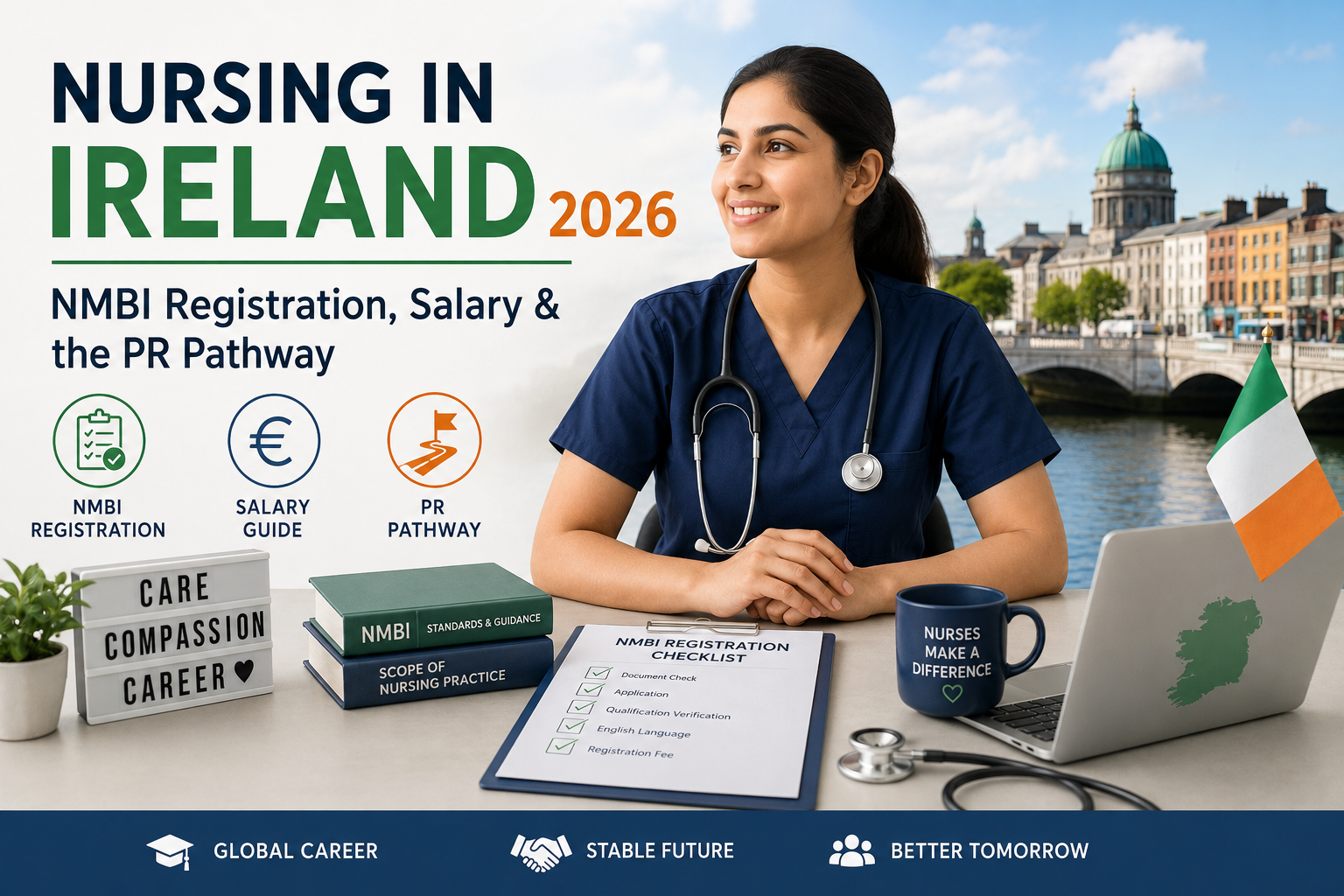
Before any Irish employer can put you on a ward, you must hold active registration with the Nursing and Midwifery Board of Ireland (NMBI) — Ireland’s equivalent of the NMC (UK), AHPRA (Australia), or your state board (US). The entire process now runs online through the MyNMBI portal, which eliminated the postal delays that plagued older applications.
Nurses trained outside the EU/EEA — India, the Philippines, Nigeria, the Gulf, everywhere else — apply as Group 3 applicants. The steps:
Step 1 — Qualification recognition application.
Submit through MyNMBI with verified transcripts, evidence of clinical hours (theory and practice breakdowns), and registration verification sent directly from your home regulator — the INC state council for Indian nurses, the PRC for Filipino nurses, the NMCN for Nigerian nurses. Fee: approximately €350. The single most common cause of delay is incomplete documentation: applications missing clinical-hour breakdowns sit in the queue while NMBI requests the missing pieces. Assemble everything before you submit.
Step 2 — English language evidence.
NMBI accepts IELTS Academic or OET. Most working nurses find the OET easier to prepare for — writing a referral letter and role-playing a patient consultation draw on skills you already use every shift, where IELTS academic essays do not. Take the test early; an expired or pending result stalls everything behind it.
Step 3 — The decision: direct registration or adaptation.
NMBI assesses your education against Irish standards and issues one of three outcomes: direct registration (your qualification is recognised as comparable — most likely for BSc-degree nurses with strong documented hours), a required adaptation period (a supervised placement of typically 6 to 12 weeks in an Irish facility, during which your competence is assessed), or an aptitude test as an alternative to adaptation. An adaptation requirement is not a rejection — many employers arrange and pay for the placement as part of recruitment.
Step 4 — Registration and pin.
Once recognition is complete and any conditions are met, you are entered on the register and can be appointed to a nursing post.
Total NMBI timeline:
3 to 4 months with complete documentation. It cannot be paid to go faster. This is the longest single stage of the Irish pathway, which is why the universal advice is: start NMBI before anything else — before the job search, before the visa, before you tell your current employer anything.
3. What You Will Actually Earn — The 2026 Pay Scales
Irish public-sector nursing pay follows the structured HSE scale, updated under the Public Service Pay Agreement running through June 2026. The numbers:
| Level | 2026 Salary (EUR) | Approx. INR/year |
|---|---|---|
| Staff nurse (Point 1, entry) | €34,000–€37,000 | ₹30.8–33.5 lakh |
| Staff nurse (5+ years) | €45,000+ | ₹40.7 lakh+ |
| Senior staff nurse (top of scale) | €53,000+ | ₹48 lakh+ |
| Director of Nursing | €100,000+ | ₹90.5 lakh+ |
The base figure understates what you will actually bank. Irish premium pay is generous by international standards: Sundays pay double time, night duty adds 25 percent, and public holidays carry their own premiums. A full-time hospital nurse working a normal rotating roster typically takes home around 20 percent above their base point. A Point 1 nurse on €36,000 base is realistically earning €43,000+ with premiums — before any overtime.
The package around the salary matters too: a 37.5-hour standard week, 24 to 27 days of annual leave plus 10 public holidays, the Public Service Pension Scheme, incremental progression that rewards every year of service, INMO union representation, and a structured CNM (Clinical Nurse Manager) career ladder. Agency nursing pays higher hourly rates but without the pension, guaranteed hours, or progression — for international nurses building a long-term Irish career, the HSE package generally wins on total value.
The honest caveat: Dublin’s cost of living is high, and housing is the pressure point. Rent for a one-bedroom in Dublin commonly runs €1,800 to €2,200 per month. Many international nurses share accommodation for the first year or target Cork, Galway, or Limerick, where salaries are nearly identical and rents are meaningfully lower.
4. The Visa: Critical Skills Employment Permit
Registered nurses and midwives sit on Ireland’s Critical Skills Occupations List — the category reserved for professions the state most wants to attract. That status qualifies you for the Critical Skills Employment Permit (CSEP), the strongest work permit Ireland issues.
The 2026 minimum salary threshold is €40,904. Most nursing positions above Point 2 of the HSE scale meet it, and employers structure offers accordingly. Processing takes 2 to 4 weeks for HSE employers and Trusted Partner organisations — among the fastest skilled-worker permits in Europe.
What the CSEP gives you that ordinary permits do not:
Stamp 4 after 2 years. The headline benefit. After two years on a CSEP you apply for Stamp 4, which removes the permit requirement entirely. You can change employers freely, take promotions anywhere, and your residence is no longer tied to a sponsor.
Immediate family rights. CSEP holders can bring a spouse/partner and children, and the spouse receives immediate access to the labour market — no separate permit, no waiting period. For nurses with working spouses, this single feature often decides the Ireland-versus-UK question, because UK dependant rules have tightened repeatedly.
The path to citizenship. Five years of reckonable residence makes you eligible to apply for naturalisation — and an Irish passport is an EU passport.
One practical wrinkle: some nurses enter first on an Atypical Working Scheme (AWS) visa — a short-term permission used for adaptation placements or pre-registration requirements — and convert to the CSEP once NMBI registration completes. Your employer or recruiter will structure this; it is routine.
5. Where the Jobs Are
Dublin is the centre of gravity. The major hospital groups — Beaumont Hospital, the Mater Misericordiae University Hospital, St James’s Hospital, Tallaght University Hospital, and the Children’s Health Ireland campuses — run continuous international recruitment across med-surg, theatre, ICU, ED, and older people care. Dublin pay carries no formal weighting over the rest of the country, which means the high capital-city rents are not offset — factor that into your sums.
Cork University Hospital and University Hospital Galway anchor the south and west. Both recruit internationally, and both cities offer a markedly better rent-to-salary ratio than Dublin with strong established Indian and Filipino communities.
Private hospitals and nursing homes hire faster than the HSE and frequently sweeten offers with relocation packages — flights, first weeks of accommodation, help with the PPS number and bank account. The trade-off: private-sector pensions, maternity entitlements, and progression structures are usually weaker than the HSE’s. Compare the full package, not the headline figure, and research individual nursing homes carefully — staffing quality varies widely in that sector.
Recruiters worth registering with: TTM Healthcare and Cpl Healthcare are the established specialist healthcare recruiters and list vacancies before public advertisement. Standard warning applies: legitimate recruiters are paid by employers. Anyone charging you a placement fee is not a recruiter you want.
6. Ireland vs the UK — The Honest Comparison
Most nurses weighing Ireland are really weighing it against the UK. The honest side-by-side:
| Factor | Ireland | UK |
|---|---|---|
| Total timeline to first shift | 6–9 months | 9–14 months (but CBT at home first) |
| Clinical exam hurdle | None for most (adaptation if required) | CBT + OSCE (£794, real failure rates) |
| Permanent status | Stamp 4 after 2 years | Settlement after 5 years |
| Starting pay (with premiums) | ~€43,000 effective | Band 5 £32,073 + unsocial-hours enhancements |
| Spouse work rights | Immediate, automatic | Dependant rules tightened repeatedly |
| Long-term prize | EU passport via naturalisation | UK passport |
The pattern: the UK wins on speed and recruitment-pipeline maturity; Ireland wins on settlement, family rights, and the EU dimension. A nurse who wants income flowing as fast as possible still leans UK (or the Gulf, faster again). A nurse planning a permanent move with a family leans Ireland, and the two-years-to-Stamp-4 arithmetic is the reason.
A growing third pattern: nurses doing both — UK first for the faster start and NHS experience, then crossing to Ireland later. NMC registration and NHS experience strengthen an NMBI application considerably, and the Common Travel Area makes the move administratively simple for those who reach UK settlement. But for most non-EU nurses choosing one destination today, it is a fork, not a sequence.
For the UK pathway in full: UK NHS Nursing Jobs Guide 2026. For the wider comparison: UK vs Canada vs Australia for Nurses 2026.
7. The Friction Official Sources Gloss Over
NMBI is thorough and slow, and the queue is real. Three to four months assumes complete documentation. Applications missing clinical-hour breakdowns, with unverified transcripts, or with registration verification stuck at the home regulator sit in the queue while NMBI requests the missing pieces — and each round trip with an Indian university or the NMCN portal adds weeks. Treat document assembly as a project: request everything from your university and regulator on day one, in parallel, before you submit anything to MyNMBI.
The adaptation period decision is not in your control. You will not know whether NMBI requires adaptation until your assessment is complete. Budget mentally and financially for the possibility of a 6–12 week supervised placement. Ask prospective employers early whether they arrange and pay for adaptation placements — the good ones do, and the answer tells you a lot about the employer.
Dublin rent will shock you. €1,800–€2,200 for a one-bedroom is normal. Most arriving nurses share accommodation for the first year. Cork, Galway, and Limerick pay the same scales with rents 30–40 percent lower — seriously consider starting outside Dublin.
Your first weeks involve real bureaucracy. PPS number, Irish bank account, GP registration, IRP card appointment — each has its own queue. Employers with proper relocation support (many private recruiters and the larger HSE hospitals) walk you through all of it; ask exactly what is included before you accept an offer.
Ireland is small. The entire country has about 5.3 million people. Specialty depth is concentrated in Dublin; some sub-specialties (paediatric cardiac surgery, major transplant) run through a single national centre. If your ambition is a narrow clinical niche, check that the niche exists in Ireland before committing.
8. Frequently Asked Questions
How much do nurses earn in Ireland?
€34,000–€37,000 starting base on the 2026 HSE scale; €53,000+ senior. Real take-home runs ~20% above base with Sunday double pay and night premiums. 37.5-hour week, 24–27 days leave.
How long does NMBI registration take?
3–4 months with complete documentation, via the MyNMBI portal. Qualification recognition fee ~€350. Cannot be accelerated — start it first.
Does Ireland give nurses permanent residency?
Yes — Stamp 4 after 2 years on a Critical Skills Employment Permit. Then citizenship eligibility after 5 years of reckonable residence. The fastest settlement maths in the English-speaking world.
What is the realistic total timeline?
6–9 months: NMBI 3–4 months, CSEP 2–4 weeks, entry visa 4–8 weeks.
IELTS or OET?
NMBI accepts both. Most working nurses prefer OET — the clinical scenarios match skills you already use. Full comparison here.
Can my spouse work in Ireland?
Yes — immediately. CSEP family members receive direct labour-market access with no separate permit. A major advantage over current UK dependant rules.
Is Ireland better than the UK?
UK is faster to start; Ireland is faster to permanence (2 years vs 5) with stronger family rights and the EU dimension. Choose by your end goal, not by which recruiter calls first.
The Bottom Line
Ireland asks more patience upfront than the UK or the Gulf — the NMBI months are real, the Dublin rents are real, and the adaptation question hangs over the application until the assessment lands. What it offers in return is the thing most international nursing pathways cannot: a short, clearly defined road to permanence. Two years to Stamp 4. Freedom from sponsorship. A spouse working from day one. And at the end of the naturalisation road, a passport that opens 27 countries.
The nurses who choose Ireland well are the ones choosing it for that destination, not for the speed of the journey. If you need income moving in three months, the Gulf is your answer. If you want the fastest Western start, the UK still wins. But if the question you are actually asking is “where can my family and I permanently build a life?” — Ireland’s answer, in 2026, is hard to beat. Start the NMBI application first, assemble every document before you submit, take the OET early, and look seriously at Cork and Galway before defaulting to Dublin.
Related articles on GlobalNurseGuide.com:
UK NHS Nursing Jobs Guide 2026
UK vs Canada vs Australia for Nurses 2026
NCLEX-RN Guide for Indian Nurses 2026
NCLEX Guide for Filipino Nurses
Nigerian Nurses: Pathway to Work Abroad 2026
Disclaimer:
This article is for informational purposes only and does not constitute immigration, legal, or career advice. NMBI registration requirements, fees, and processing times are determined by the Nursing and Midwifery Board of Ireland and change periodically. HSE pay scales reflect the Public Service Pay Agreement 2024–2026 as published in HSE HR circulars and INMO member updates. Critical Skills Employment Permit thresholds and Stamp 4 rules are set by the Department of Enterprise, Trade and Employment and the Irish Immigration Service and are subject to change. Rent figures are indicative market estimates as of mid-2026. Currency conversions are approximate at June 2026 rates. Always verify current requirements directly with NMBI (nmbi.ie), the Department of Enterprise (enterprise.gov.ie), Irish Immigration Service Delivery, and your prospective employer before making decisions. GlobalNurseGuide.com is not affiliated with NMBI, the HSE, any recruitment agency, or any Irish government body. Information current as of June 8, 2026.
© 2026 GlobalNurseGuide.com — Empowering Nurses Worldwide with Real Opportunities
Author

Discover more from Global Nurse Guide
Subscribe to get the latest posts sent to your email.