Nursing Class of 2026: Your First 30 Days as a New RN – Salary, Residency Programs, NCLEX & What to Expect
Published May 6, 2026 • National Nurses Week • Reading Time: ~22 Minutes
You did it. The clinicals, the care plans, the all-night study sessions, the NCLEX prep that made you question every life choice – it’s done. You’re part of the Nursing Class of 2026, graduating into a profession that needs you more than ever, during a National Nurses Week whose theme – “The Power of Nurses” – was practically written for you.
But now comes the part nobody fully prepares you for: the first 30 days. The transition from nursing student to working nurse is one of the most intense professional experiences you’ll ever have. This guide is your honest, practical roadmap for everything that happens next – from passing the NCLEX and landing your first job, to surviving orientation, learning your unit, and finding your footing as a real nurse taking care of real patients.
🩺 Join FREE WhatsApp Channel for Trusted Guide
Get weekly vacancy alerts, EB-3 visa updates & daily NCLEX prep on WhatsApp — FREE.
📲 Follow the Channel🎓 Class of 2026 – By the Numbers
$74,000–$90,884 average new grad RN salary (Salary.com / Glassdoor)
$62,000–$108,000+ full salary range (varies by state and employer)
85–90% NCLEX-RN first-time pass rate (US-educated BSN graduates)
85–150 questions on the Next Generation NCLEX (NGN) format
12 months typical nurse residency program length
36,000+ nursing vacancies in California alone (UCSF)
National Nurses Week: May 6–12, 2026 – “The Power of Nurses”
1. The NCLEX: When to Take It & How to Pass
The clock starts the moment you graduate. The NCLEX-RN is the single barrier between you and your nursing licence, and every week you delay makes the material less fresh in your mind.
Timeline recommendation: Apply to your state Board of Nursing and register with Pearson VUE before you graduate if possible. Take the NCLEX within 45–90 days of graduation. Once you receive your Authorization to Test (ATT), schedule immediately – ATTs expire in 60–90 days depending on your state.
The exam in 2026: The Next Generation NCLEX (NGN) format features 85–150 questions, a 5-hour time limit, and Computer Adaptive Testing (CAT). Since April 2023, the NGN has incorporated case studies (split-screen patient scenarios with 6 sequential questions), bowtie items, trend questions, and matrix matching – all testing your clinical judgment rather than memorised facts. Partial credit scoring applies to some items.
What works for preparation: Two to four weeks of focused, full-time study using a question bank is the approach most successful new graduates follow. UWorld remains the gold standard for NCLEX preparation – its rationales and NGN-style case studies closely mirror the real exam. Archer Review offers an affordable alternative with readiness assessments. Saunders Comprehensive Review provides a solid content foundation if you need to revisit specific topics.
The study routine that gets results: Do 75–100 practice questions daily. Read every rationale – even for questions you get right. Focus on understanding why the correct answer is correct and why each distractor is wrong. Track your performance by category and spend extra time on weak areas. Take at least two full-length practice exams under timed conditions. When your readiness assessments consistently show “high” or “very high” probability of passing, you’re ready.
Pass rate reality: First-time pass rates for US-educated BSN graduates are approximately 85–90%. You’ve spent years preparing for this. Trust your education.

2. What You’ll Actually Earn: 2026 New Grad Salary Data
New grad nursing salaries vary enormously depending on where you work. Here’s what the data shows as of spring 2026:
| Source | Average New Grad RN Salary | Range |
|---|---|---|
| Glassdoor (New Grad RN) | $90,884/year | 25th: $73K – 75th: $114K – 90th: $139K |
| Salary.com | $73,998/year ($36/hr) | 25th: $66K – 75th: $83K – 90th: $91K |
| ZipRecruiter | $61,807/year ($29.71/hr) | 25th: $51.5K – 75th: $69K – 90th: $80.5K |
| Glassdoor (California) | $107,622/year | 25th: $91K – 75th: $128K – 90th: $149K |
| Glassdoor (New York City) | $110,373/year | 25th: $94K – 75th: $130K – 90th: $150K |
Why the range is so wide: A new grad starting at a community hospital in rural Mississippi earns a different salary than a new grad starting at Stanford or Kaiser in San Francisco. Geography is the single biggest variable. Cost of living matters too – a $65,000 salary in a low-cost state may give you more disposable income than $110,000 in Manhattan.
BSN premium: BSN graduates typically start 5–10% higher than ADN graduates at the same facility. Over a career, this gap widens as BSN-prepared nurses access management, education, and advanced practice pathways.
3. Nurse Residency Programs: The Best Ones & How to Get In
If there’s one piece of advice that every experienced nurse gives new graduates, it’s this: do a residency program. These structured 12-month transition-to-practice programmes are specifically designed to bridge the gap between nursing school and independent clinical practice.
What a residency includes
Clinical orientation with a dedicated preceptor (typically 350+ hours of precepted shifts), monthly didactic education covering leadership, patient outcomes, and evidence-based practice, simulation training, mentorship from experienced nurses, peer support groups, and a professional development project. Many programmes now incorporate AI-assisted clinical judgment assessments and structured reflection exercises.
Top residency programmes with 2026 openings
Kaiser Permanente National RN Residency: 36+ medical centres across California, Oregon, Washington, Hawaii, Colorado, and more. ANCC-accredited. 12-month programme with simulation, AI-assisted assessments, and preceptorship. NorCal info sessions: June 15–19, 2026. Multiple cohort start dates.
Stanford Health Care: Cohort 45 applications opened April 6–12, 2026. Programme starts September 28, 2026. BSN/MSN required. California RN licence by July 27, 2026. One of the highest-paying new grad programmes in the country.
HCA Healthcare: The largest nurse residency programme in the United States, spanning 100+ hospitals across the country. Accepts BSN and ADN graduates. Rolling applications. Includes tuition reimbursement, student loan assistance, and clear career pathways.
UCLA Health: BSN or MSN required. Magnet-designated. Fall 2026 cohort information available July 2026. Multiple specialty tracks.
Mayo Clinic: Arizona campus: October 2026 cohort applications close June 1–2, 2026. Florida and Minnesota campuses also offer programmes. ANCC-accredited.
Cedars-Sinai: Six consecutive Magnet designations. Los Angeles. New graduate residency with multiple specialty exposures. #1 hospital in California.
Scripps Health (San Diego): 40-week programme. Multiple cohorts per year. HireVue video interviews. Great quality of life in San Diego.
Texas Health Resources: July 13, 2026 start date positions currently posted. October 19, 2026 positions post May 21, 2026. BSN preferred, not required.
UC Davis Health: Vizient/AACN Nurse Residency Program. ANCC-accredited with distinction. Applications for each cohort open during a one-week window – monitor closely.
💡 Application Windows Are Short – Be Ready
Many top programmes have application windows of 3–7 days. Stanford’s was just 6 days. UC Davis uses a one-week window. MemorialCare posts positions for only 5 days. Have your resume, cover letter, unofficial transcripts, letters of recommendation, and BLS certification ready before windows open. Set alerts on hospital career pages. Missing a window means waiting months for the next cohort.
4. Landing Your First Job: A Strategic Approach
Start early. Begin your job search 3–6 months before your target start date. Many residency programmes accept applications from students who will graduate within 6 months.
Leverage your clinical rotations. The hospitals where you did your clinicals know you. Internal candidates who performed well during rotations often have a significant advantage. Express interest to nurse managers before you graduate. Ask if they have new grad openings coming. Request letters of recommendation from preceptors who supervised your best clinical work.
Apply broadly. Don’t limit yourself to one hospital or one specialty. Competition at top academic centres is fierce. Apply to 10–15 programmes simultaneously. Be open to med-surg, telemetry, or step-down units as your starting point – you can move into your dream specialty after gaining foundational experience.
Where to look: Hospital career portals directly (this is where most residency positions are posted first), Indeed, Glassdoor, Vivian Health, LinkedIn, and your nursing school’s career services office. Many hospitals attend nursing school career fairs and virtual hiring events.
Your resume matters. Highlight clinical rotation hours and specialties, any externship or nurse intern experience, certifications (BLS, ACLS), leadership roles, and relevant healthcare work experience (CNA, PCT, medical scribe). Keep it to one page. Use keywords from the job posting. Many hospitals use applicant tracking systems (ATS) – format your resume cleanly without tables, headers, or graphics that ATS software can’t read.
Read more: New Grad Nursing Resume Template (ATS-Optimised)
5. BSN vs. ADN: Does It Matter?
Both ADN and BSN graduates take the same NCLEX and earn the same RN licence. But in 2026, the professional landscape strongly favours the BSN.
The Magnet reality: Magnet-designated hospitals (the gold standard for nursing excellence) increasingly require BSN-prepared nurses. Many hire ADN graduates with the requirement that they complete an RN-to-BSN programme within 3–5 years of hire.
Residency access: Some top residency programmes (UCLA, Stanford) explicitly require a BSN or MSN. Others (HCA, Texas Health) prefer BSN but accept ADN graduates.
Pay difference: BSN graduates typically earn 5–10% more at the same facility. Over a 30-year career, that compounds into a significant earnings difference.
Career trajectory: Every advanced nursing role – Nurse Practitioner, Clinical Nurse Specialist, Nurse Educator, Nurse Administrator – requires at minimum a master’s degree, which requires a BSN as a prerequisite.
If you have an ADN: Enrol in an RN-to-BSN bridge programme as soon as possible. Many are fully online and can be completed in 12–18 months while working. Several employers offer tuition reimbursement. Don’t wait – the earlier you start, the sooner you unlock career advancement.
6. Week 1: Hospital Orientation – What to Expect
Your first week will likely be spent in a conference room, not on a patient floor. Hospital-wide orientation covers everything the organisation needs you to know before you touch a patient:
Administrative essentials: HR paperwork, benefits enrolment (health insurance, retirement plan, life insurance), badge photo, parking assignment, payroll setup, and employee handbook review.
Electronic Health Record (EHR) training: This is often 1–3 days of intensive training on Epic, Cerner, or whatever system your hospital uses. Pay close attention – your charting speed in the first few months depends entirely on how well you learn the EHR during orientation. Practice in the training environment as much as possible.
Safety and compliance: Fire safety, infection control, patient safety reporting systems, HIPAA, workplace violence prevention, and emergency codes (Code Blue, Code Red, Code Grey, etc.). You’ll take quizzes. It feels tedious. It matters.
Facility tours: Pharmacy, lab, radiology, blood bank, supply chain, cafeteria, locker rooms. Knowing where things are physically located saves you enormous time once you’re on the floor.
7. Weeks 2–4: Unit Orientation & Your Preceptor
This is where real nursing begins. You’ll be paired with a preceptor – an experienced nurse who will guide your transition over the next several weeks (typically 8–16 weeks of precepted shifts, depending on the unit and your progress).
The preceptor relationship is everything. Your preceptor is your teacher, your safety net, your mentor, and your most honest critic. A few things that make this relationship work:
Ask questions constantly – there are no foolish questions in your first 30 days. Genuinely, your preceptor expects you to ask. What concerns them is when new grads don’t ask.
Write things down. Carry a pocket notebook. When your preceptor shows you where the crash cart is, the code for the medication room, the process for calling a rapid response – write it down. You will not remember everything from verbal instruction alone.
Accept feedback without defensiveness. Your preceptor will correct you. Often. This isn’t personal – it’s how you learn to practice safely. The new grads who improve fastest are the ones who hear feedback, say “thank you,” and adjust.
Patient load progression: You’ll typically start with 1–2 patients and gradually increase. By the end of your preceptorship, you should be managing a full patient assignment with your preceptor observing. The pace of this progression depends on your unit type, your facility’s standards, and your individual readiness.
8. The First 30 Days: Honest Survival Guide
You will feel overwhelmed. Every new nurse does. The gap between what you knew as a student and what you need to know as a practitioner feels enormous. This is called “reality shock” or “transition shock,” and it is universal, normal, and temporary.
Your time management will be terrible at first. Tasks that experienced nurses do in 5 minutes will take you 20. Medication passes that should take 45 minutes will take 2 hours. Documentation that seasoned nurses complete in real-time will pile up until the end of your shift. This improves dramatically by month 3. It’s not a reflection of your intelligence – it’s a reflection of your experience, which you’re building every single shift.
Focus on safety, not speed. Your number one job in the first 30 days is to not harm anyone. Speed comes with repetition. Safety comes from discipline. Check your medications against the MAR every time. Verify patient identities. Don’t skip hand hygiene. When in doubt, ask.
Build your support network. Your preceptor, your charge nurse, your fellow new grads in the residency cohort, your nurse educator – these are your people. Lean on them. You are not expected to do this alone.
Take care of yourself. Eat before your shift. Hydrate on the floor (keep a water bottle at the nurses’ station). Wear compression socks. Break in your shoes before your first clinical day. Protect your sleep schedule fiercely – especially if you’re working nights. The nurses who burn out fastest are the ones who neglect their own basic needs.
It gets better. By day 30, you’ll know your unit. By day 90, you’ll have confidence in your routine. By month 6, you’ll mentor the next cohort of new grads. By month 12, you’ll look back and barely recognise the overwhelmed version of yourself who started. Every experienced nurse you admire went through exactly what you’re going through right now.
9. Certifications to Get Now (and Later)
Required at hire (have these before day 1): BLS (Basic Life Support) – American Heart Association. Most hospitals will not start your orientation without a current AHA BLS card.
Typically required within 90 days: ACLS (Advanced Cardiac Life Support), NIH Stroke Scale certification, CPI (Crisis Prevention Institute) for de-escalation. Your employer will usually provide these during orientation or residency.
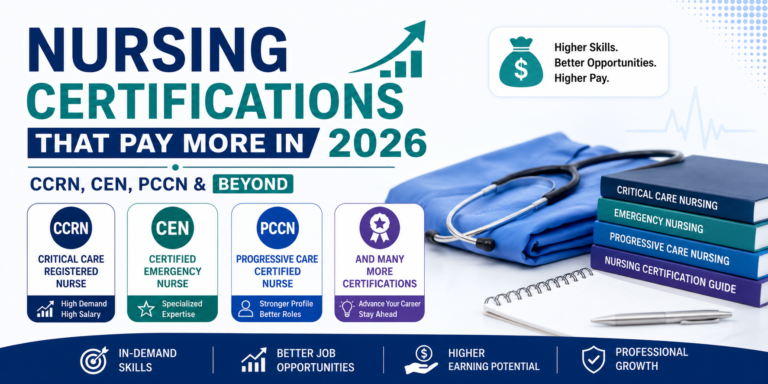
After 1–2 years of experience: Pursue a specialty certification aligned with your unit. CCRN (critical care), CEN (emergency), RNC-OB (obstetric), PCCN (progressive care), CMSRN (medical-surgical). These certifications often come with pay differentials of $1,000–$3,000 per year, demonstrate expertise, and strengthen your resume for career advancement.
10. Nurses Week 2026: Celebrate Your Start
You’re graduating during National Nurses Week 2026 (May 6–12), with the ANA theme “The Power of Nurses.” That theme isn’t just for veteran nurses – it’s for you. The power of a new nurse is the fresh perspective, the energy, the idealism, and the commitment to patient-centred care that you bring to a profession that desperately needs renewal.
Ways to mark the occasion:
Take advantage of Nurses Week discounts from brands like Nike, Adidas, Samsung, Apple, and more (verified through ID.me or SheerID). You’ve earned them.
Join a professional organisation. ANA membership is available at student rates. Your state nursing association offers networking, continuing education, and advocacy opportunities.
Attend ANA Nurses Week events and webinars – many are free and focused on professional development.
Update your LinkedIn profile with your new credentials. Connect with classmates, preceptors, and nursing leaders. Your professional network starts now.
Share your story. The profession needs new voices. Post your graduation photo. Write about why you chose nursing. Use #NursesWeek2026 and #ThePowerOfNurses.
See also: National Nurses Week 2026: “The Power of Nurses” Career Guide
11. Frequently Asked Questions
How much do new grad nurses earn in 2026?
National average: $74,000–$91,000 depending on source. Range: $62K–$108K+. California new grads: $91K–$108K. NYC: $94K–$110K. Rural/lower-cost states: $45K–$65K. BSN graduates earn 5–10% more than ADN graduates at the same facility.
Should I do a nurse residency?
Strongly recommended. 12-month programmes with preceptorship, mentorship, simulation, and professional development. Top programmes: Kaiser, Stanford, HCA, UCLA, Mayo, Cedars-Sinai, Scripps, UC Davis, Texas Health. Significantly reduces reality shock and builds clinical confidence.
When should I take the NCLEX?
Within 45–90 days of graduation. Apply to your BON and Pearson VUE before graduation if possible. 85–150 questions, 5 hours, NGN format. US-educated BSN first-time pass rate: ~85–90%. Use UWorld and 2–4 weeks of focused preparation.
Is a BSN necessary?
Not legally required for licensure, but strongly advantageous. Magnet hospitals increasingly require BSN. Some top residencies require BSN/MSN. 5–10% pay premium. Required for all advanced practice pathways. ADN holders should pursue RN-to-BSN immediately.
How do I find my first job?
Apply to 10–15 residency programs simultaneously. Start 3–6 months early. Leverage clinical rotation connections. Use hospital career portals, Indeed, Glassdoor, Vivian. Be flexible on specialty and location. Have your resume, transcripts, and references ready before application windows open.
What should I expect in the first 30 days?
Week 1: Hospital orientation (HR, EHR training, safety, tours). Weeks 2–4: Unit orientation with preceptor, starting with 1–2 patients and building. Expect to feel overwhelmed – this is normal. Focus on safety over speed. Ask questions constantly. Write everything down.
What certifications do I need?
At hire: BLS (AHA). Within 90 days: ACLS, NIH Stroke Scale, CPI. After 1–2 years: Specialty certs (CCRN, CEN, RNC, PCCN, CMSRN). Pay differentials of $1K–$3K/year.
Is it hard to get a new grad nursing job?
Market is strong but competitive at top centres. 36,000+ nurse shortage in California alone. Application windows at prestigious hospitals last 3–7 days. Be prepared, apply broadly, and consider community hospitals as excellent starting points.
What are the best hospitals for new grads?
Kaiser (36+ centres), Stanford (Cohort 45 starts Sept 2026), HCA (largest programme), UCLA, Mayo Clinic (Oct 2026 cohort), Cedars-Sinai (6x Magnet), Scripps (San Diego), UC Davis, Texas Health (July/Oct 2026 starts).
How can I celebrate Nurses Week as a new grad?
May 6–12, 2026. Theme: “The Power of Nurses.” Take advantage of Nurses Week discounts (Nike, Samsung, etc. via ID.me/SheerID). Join ANA. Attend Nurses Week events. Update LinkedIn. Share your graduation story with #NursesWeek2026.
Final Words: You’re Ready
Every nurse you’ve ever admired – every charge nurse who seems unshakeable, every ICU nurse who moves with quiet precision, every nurse practitioner who diagnoses with confidence – started exactly where you are right now. Overwhelmed, uncertain, and wondering if they were really ready.
They weren’t. And neither are you. Not completely. And that’s the point. You become ready by doing the work, shift after shift, patient after patient, mistake after correction after growth. The degree gave you the foundation. The licence gave you the authority. The first 30 days give you the beginning. The rest of your career gives you the nurse you’ll become.
Welcome to nursing, Class of 2026. The profession is better because you’re here.
Related Articles on GlobalNurseGuide.com:
National Nurses Week 2026: “The Power of Nurses” Career Guide
Nursing Jobs in USA 2026: Ultimate Guide
Nursing Jobs in California 2026: Complete Guide
Highest-Paying Nursing Jobs 2026
New Grad Nursing Resume Template (ATS-Optimised)
The Ultimate Nurse Resume Guide
Kaiser Permanente Nursing Jobs 2026
Disclaimer: This article is for informational purposes only and does not constitute employment, financial, or legal advice. Salary figures, programme details, and application timelines are subject to change. Always verify current information directly with individual employers, Pearson VUE, and your state Board of Nursing. GlobalNurseGuide.com is not affiliated with any hospital system, programme, or government agency. Salary data sourced from Glassdoor, Salary.com, ZipRecruiter, and PayScale, current as of May 2026.
© 2026 GlobalNurseGuide.com – Empowering Nurses Worldwide with Real Opportunities
Author
Discover more from Global Nurse Guide
Subscribe to get the latest posts sent to your email.