The Ultimate Head-to-Toe Assessment Nursing Checklist
Introduction: The Anxiety Is Real – Here’s Your Fix
You’ve studied the textbooks, reviewed your lab skills, and still – the moment your instructor says “begin your assessment,” your mind goes blank. You forget whether to auscultate before or after you palpate. You skip the cranial nerves entirely. Sound familiar? You’re not alone. The clinical check-off is one of the most anxiety-inducing milestones in nursing school, and the number one reason students stumble is simple: they don’t have a locked-in sequence.
The good news is that a head-to-toe assessment nursing framework doesn’t have to feel like an improvised performance. When you approach it as a repeatable, chronological script – top of the head, literally down to the toes – you create muscle memory that holds up even under pressure. This checklist gives you exactly that: a systematic, step-by-step guide to every action, every assessment technique, and what normal versus abnormal findings look like.
Think of this article as your clinical co-pilot. Read it before your check-off, quiz yourself on it, and use it until the sequence becomes second nature. Let’s walk through it together.
🩺 Join FREE WhatsApp Channel for Trusted Guide
Get weekly vacancy alerts, EB-3 visa updates & daily NCLEX prep on WhatsApp — FREE.
📲 Follow the Channel
Pre-Assessment: Before You Touch the Patient
A skilled nurse never rushes to the bedside. The moments before you lay hands on your patient are just as clinically significant as the assessment itself. Skipping this phase is one of the most common mistakes nursing students make during evaluations.
Start with your safety checks. Confirm the correct patient using two identifiers – typically name and date of birth. Check that the call light is within reach, the bed is in the lowest position, and side rails are up per protocol. These aren’t formalities; they are patient safety fundamentals that instructors actively look for.
Next, perform hand hygiene. Wash your hands or use alcohol-based rub for a full 20 seconds. This must be visible and deliberate – not a quick swipe.
Introduce yourself using the AIDET framework:
- Acknowledge: “Good morning, my name is [your name], and I’m your nursing student today.”
- Introduce: “I’ll be performing a physical assessment as part of your care.”
- Duration: “This should take about 15 minutes.”
- Explanation: “I’ll be checking your head, lungs, heart, abdomen, and legs. Please let me know if anything is uncomfortable.”
- Thank You: “Thank you for allowing me to care for you today.”
Finally, gather your equipment: stethoscope, penlight, blood pressure cuff, pulse oximeter, thermometer, and your assessment form. Confirm the patient’s comfort and position them in Semi-Fowler’s (30–45 degrees) to start.
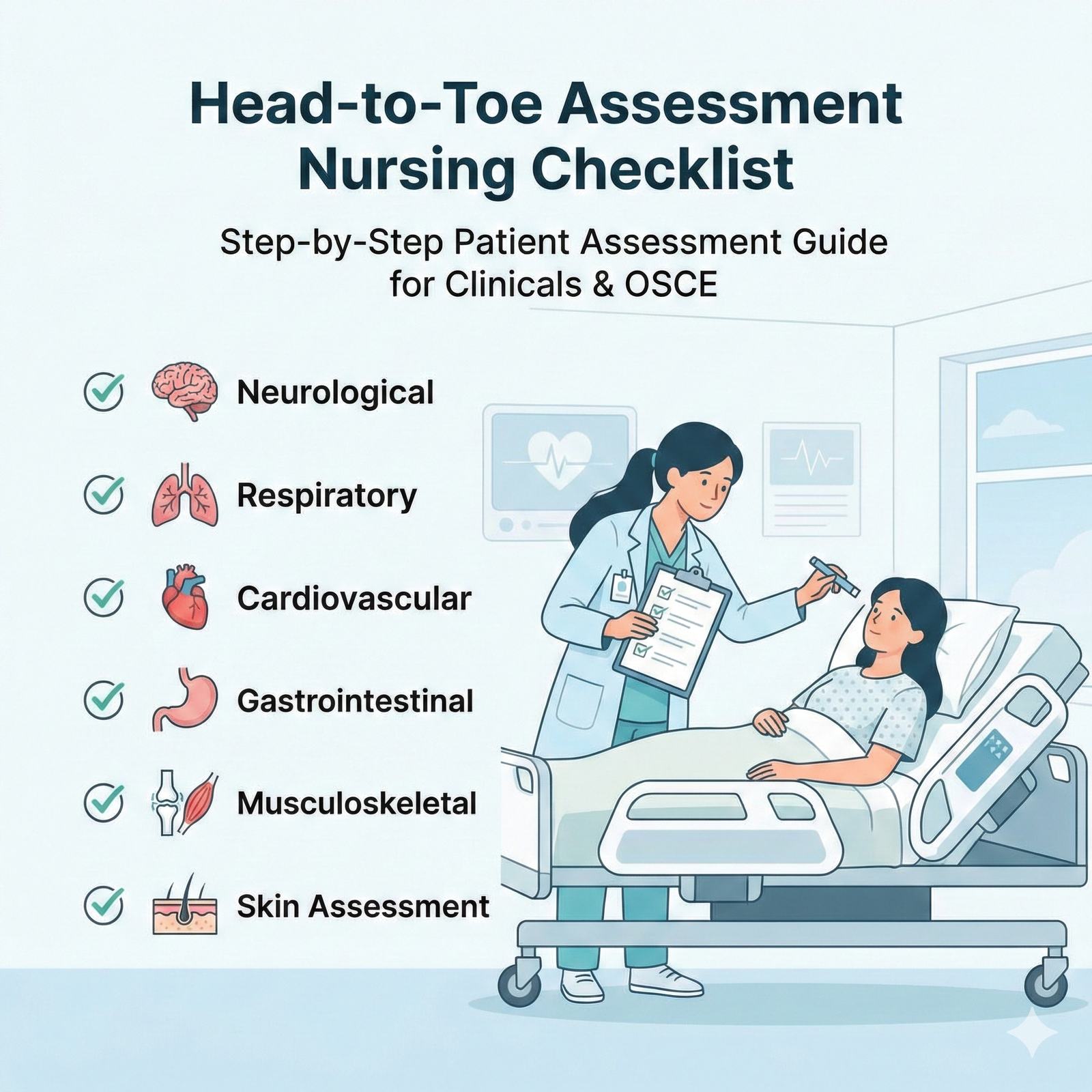
The Head-to-Toe Assessment Script (Step-by-Step)
This is the core of your head-to-toe assessment nursing check-off. Follow each section in order without jumping ahead. Each H3 below represents a body system assessed in anatomical sequence – top down.
1. Neurological Assessment (Head & Face)
Begin by assessing the patient’s level of consciousness (LOC) and orientation. Ask: “Can you tell me your name, where you are, and what today’s date is?”
- A&Ox4: Alert and Oriented to person, place, time, and event – this is your normal finding.
- Abnormal: Confusion, disorientation, lethargy, or inability to follow commands warrants immediate escalation.
- GCS: Score eye opening, verbal response, and motor response. Document the total (15 = fully intact).
Next, assess the pupils using your penlight. Check pupil size, shape, equality, and reaction to light (PERRLA – Pupils Equal, Round, and Reactive to Light and Accommodation).
- Normal: 2–5 mm, brisk bilateral reaction, equal in size.
- Abnormal: Unequal pupils (anisocoria), sluggish or absent response, or pinpoint pupils can indicate neurological emergency or opioid toxicity.
Assess the face for symmetry. Ask the patient to smile, raise their eyebrows, and puff their cheeks. Facial droop is a hallmark sign of stroke (FAST acronym applies here).
2. Respiratory Assessment (Chest)
Move to the thorax. Begin with inspection. Observe the chest for symmetry of expansion, use of accessory muscles, and the patient’s breathing pattern and rate.
- Normal RR: 12–20 breaths per minute, unlabored, even, and regular.
- Abnormal: Tachypnea (>20), bradypnea (<12), Cheyne-Stokes pattern, or tripod positioning are red flags.
Palpate the chest wall bilaterally for tactile fremitus and tenderness. Then auscultate all lung fields – posterior first, then anterior. Use the diaphragm of your stethoscope.
- Normal: Clear breath sounds bilaterally – vesicular over lung fields, bronchovesicular over major airways.
- Abnormal: Crackles (fluid/atelectasis), wheezes (bronchospasm), and rhonchi (mucus in large airways) are all reportable findings.
- Percussion: Resonant over healthy lung tissue; dullness over consolidation or pleural effusion; hyperresonance over a pneumothorax.
3. Cardiovascular Assessment (Heart & Pulses)
Place your stethoscope over the four cardiac landmarks. Auscultate in order: Aortic (2nd right ICS), Pulmonic (2nd left ICS), Erb’s Point (3rd left ICS), Tricuspid (4th left ICS), and Mitral/Apex (5th left ICS, MCL).
- Normal: Regular rate and rhythm, S1 and S2 heard clearly (“lub-dub”), no murmurs.
- Abnormal: Irregular rhythm, S3 gallop (heart failure), S4 (stiff ventricle), or audible murmurs require documentation and reporting.
Check all pulses systematically: carotid (one at a time), radial, and then brachial when obtaining blood pressure. Rate, rhythm, and quality (0–4+ scale) must all be documented.
- Normal: 2+ (normal/brisk), regular, equal bilaterally.
- Abnormal: Bounding pulses (3–4+) may indicate sepsis; diminished pulses (0–1+) suggest vascular compromise or dehydration.
Assess capillary refill time (CRT) by pressing the nail bed until it blanches, then releasing. Normal CRT is less than 2 seconds. Prolonged CRT suggests poor peripheral perfusion.
4. Gastrointestinal Assessment (Abdomen)
This system requires a specific order – inspection, auscultation, percussion, palpation – in that exact sequence. Palpating before auscultating can artificially alter bowel sounds.
- Inspect: Note shape (flat, round, distended, scaphoid), symmetry, visible pulsations, or skin discoloration (Cullen’s sign or Grey Turner’s sign).
- Auscultate: Listen in all four quadrants. Normal bowel sounds are present, active, and heard every 5–15 seconds.
- Abnormal: Absent bowel sounds (listen for 5 full minutes before documenting absent), hyperactive sounds, or high-pitched tinkling sounds may indicate obstruction.
- Percuss: Tympany over air-filled bowel (normal); dullness over fluid or organomegaly.
- Palpate: Light palpation first (assess for guarding, rigidity, tenderness), then deep palpation for organ borders. Rebound tenderness is a key sign of peritoneal irritation.
5. Genitourinary Assessment
The GU assessment in most clinical check-offs is abbreviated but still essential. Ask the patient about urinary frequency, color, odor, pain, or difficulty voiding. Inspect the suprapubic area for distension – bladder distension is palpable and percussed as dull above the symphysis pubis.
- Normal: Clear to light yellow urine, no complaints of dysuria or urgency, no suprapubic tenderness.
- Abnormal: Dark amber urine (dehydration/jaundice), hematuria, cloudy urine with foul odor (UTI), or urinary retention.
If a urinary catheter is present, assess tubing placement, urine characteristics in the drainage bag, and that the bag is secured below bladder level. Always document intake and output (I&O) when relevant.
6. Integumentary & Extremities (Head-to-Toe Close-Out)
Skin assessment runs throughout your entire evaluation, but this is where you consolidate your findings and assess the extremities in detail. Inspect skin color, temperature, moisture, turgor, and integrity as you move down the body.
- Normal: Warm, dry, intact skin with good turgor (tent test recoils in <2 seconds).
- Abnormal: Jaundice, cyanosis, pallor, diaphoresis, or poor skin turgor are all significant findings.
Assess the upper extremities for strength and sensation (grip strength bilaterally, equal?). Then move to the lower extremities. Assess for pitting edema by pressing your thumb over the dorsum of the foot or the tibia for 5 seconds.
- Pitting Edema Scale: 1+ (2mm, rapid rebound) to 4+ (8mm, no rebound). Anything 2+ and above warrants reporting.
- Assess pedal pulses: Dorsalis pedis and posterior tibial bilaterally. Even a 1+ pedal pulse requires documentation – absent pulses are a clinical emergency.
- Range of motion (ROM): Active or passive ROM of major joints. Note crepitus, pain, or limited movement.
End your assessment by repositioning the patient for comfort, lowering the bed, replacing call light, and performing hand hygiene again. Always close the loop.
The “WDL” Charting Hack: Chart Smarter, Not Longer
One of the most time-saving strategies in nursing documentation is understanding how to use Within Defined Limits (WDL). Unlike ‘Within Normal Limits (WNL),’ WDL acknowledges that a finding may not be textbook normal for every patient – but it’s within the expected range given the clinical context.
For example: a patient with chronic COPD who has diminished breath sounds at the bases bilaterally – that’s their baseline. Charting ‘lung sounds WDL’ after confirming with prior notes saves time and is clinically accurate.
The WDL charting shortcut: For every system you assess, ask yourself one question – Is this finding within the expected range for this patient right now? If yes, chart WDL for that system. If no, chart the specific deviation using objective, measurable language.
- Do: “2+ pitting edema bilateral lower extremities, non-pitting at baseline per chart.”
- Avoid: “Legs look swollen.” (Non-specific, non-measurable, not defensible)
Use the SOAP or DAR formats your facility requires, and always document your interventions and any notifications made to the charge nurse or provider for abnormal findings. Incomplete documentation is incomplete care in the eyes of the law.
How This Shows Up on the NCLEX: Assessment Meets Prioritization
The skills you build doing a head-to-toe assessment nursing check-off directly translate to the NCLEX – particularly in prioritization questions. The NCLEX won’t ask you to name each lung lobe, but it will absolutely ask you to recognize crackles in a post-op patient and identify that as early pulmonary edema requiring immediate action.
NCLEX prioritization questions rely on your ability to rapidly triage abnormal assessment findings. Use the ABC framework (Airway, Breathing, Circulation) as your north star. Abnormal respiratory findings trump cardiovascular findings, which trump GI findings – unless there’s an acute emergency (like absent bowel sounds post-surgery, which signals possible paralytic ileus).
Key assessment findings that the NCLEX loves to test:
- New-onset confusion in a post-op elder → Rule out hypoxia, electrolyte imbalance, infection (Assess neuro + vital signs FIRST).
- Crackles + SOB + JVD → Classic heart failure triad → Priority: O2, position, notify provider.
- Absent pedal pulses post-procedure → Vascular emergency → Notify immediately, do not leave patient.
- Rigid, board-like abdomen → Peritoneal irritation → NPO, IV access, immediate notification.
When you practice your assessment repeatedly in the right order, you begin to recognize patterns – and pattern recognition is exactly what the NCLEX tests. Every single system you assessed in your check-off has a corresponding clinical scenario waiting for you on the exam.
Conclusion: Systematic, Confident, Clinical
Mastering the head-to-toe assessment nursing framework is one of the most powerful things you’ll do in nursing school. When you have a locked-in script, you stop wasting mental energy trying to remember what comes next – and you start investing that energy in actually seeing your patient.
Use this checklist before every check-off until the sequence is automatic. Say the words out loud, practice on your classmates, and review abnormal findings until you can name them without hesitation. The nurse who assesses systematically is the nurse who catches things early – and that is the nurse who saves lives.
You’ve got this. Now go walk through it from the top – literally.
Author

Discover more from Global Nurse Guide
Subscribe to get the latest posts sent to your email.