OET for Nurses 2026: What the Exam Really Tests and How to Prepare
Writing a referral letter is something nurses do without thinking. Writing one in an exam room with 45 minutes, a set of case notes you have never seen before, and the knowledge that your score determines your eligibility to register in the UK, Ireland, Australia, or New Zealand — that is a different experience entirely. The OET is the English exam most international nurses underestimate, not because it is harder than IELTS, but because clinical English fluency and OET exam technique are not the same thing. A nurse who writes clear, professional clinical documentation every shift can still score below the passing grade in OET Writing on the first attempt, simply because the exam requires specific skills that clinical work does not always develop.
This guide explains what the OET actually tests in each of the four subtests, the scores required by each destination, the specific mistakes that most commonly cost Indian and Filipino nurses marks, and an 8-week preparation plan designed for nurses who are working full-time while preparing for the exam. It also includes two pieces of information that most OET guides skip: the NMC (UK) writing score exception that many nurses do not know, and the OET@Home option that allows nurses in India, the Philippines, and Nigeria to take the exam from their own home without travelling to a test centre.
🩺 Join FREE WhatsApp Channel for Trusted Guide
Get weekly vacancy alerts, EB-3 visa updates & daily NCLEX prep on WhatsApp — FREE.
📲 Follow the Channel📋 OET for Nurses 2026 — Key Facts
What it tests: Healthcare-specific English across 4 subtests (Listening, Reading, Writing, Speaking)
Total duration: Approximately 3 hours
Score scale: 0–500 per subtest | Grade A = 450+ | Grade B = 350+ | Grade C+ = 300+
NMC (UK) requirement: Grade B in Listening, Reading, Speaking; Grade C+ in Writing
AHPRA (Australia) / NCNZ (NZ) / NMBI (Ireland): Grade B in ALL four subtests
Cost in India: approximately ₹15,000–₹22,000 per sitting
OET@Home: Available in India and Philippines — take from your own home
No retake limit: You can sit OET as many times as needed
Free official resources: oet.com/ready (sample tests, OET Pulse assessment)
Accepted by: NMC (UK), NMBI (Ireland), NCNZ (NZ), AHPRA (Australia), CGFNS (US — check state)
1. The Scores You Need — By Destination
Before preparation begins, you need to know exactly what score you are preparing for — because the target differs by destination, and the NMC UK requirement contains an exception that most nurses do not know about.
| Regulator | Country | Listening | Reading | Writing | Speaking |
|---|---|---|---|---|---|
| NMC | UK | Grade B (350+) | Grade B (350+) | Grade C+ (300+) | Grade B (350+) |
| AHPRA | Australia | Grade B (350+) | Grade B (350+) | Grade B (350+) | Grade B (350+) |
| NCNZ | New Zealand | Grade B (350+) | Grade B (350+) | Grade B (350+) | Grade B (350+) |
| NMBI | Ireland | Grade B (350+) | Grade B (350+) | Grade B (350+) | Grade B (350+) |
The NMC writing exception is significant. A nurse who scores 310 in Writing (Grade C+) but achieves Grade B in the other three subtests meets the NMC requirement. A score of 310 in Writing would fail the AHPRA, NCNZ, and NMBI requirements. If you are preparing for the UK only, you can pass OET with a slightly lower Writing score than the Grade B threshold. If you are preparing for multiple destinations or specifically for Australia, New Zealand, or Ireland, prepare to Grade B standard in all four subtests.
Always verify the current English language requirements directly with your destination’s regulatory body before booking the exam, as requirements can change.
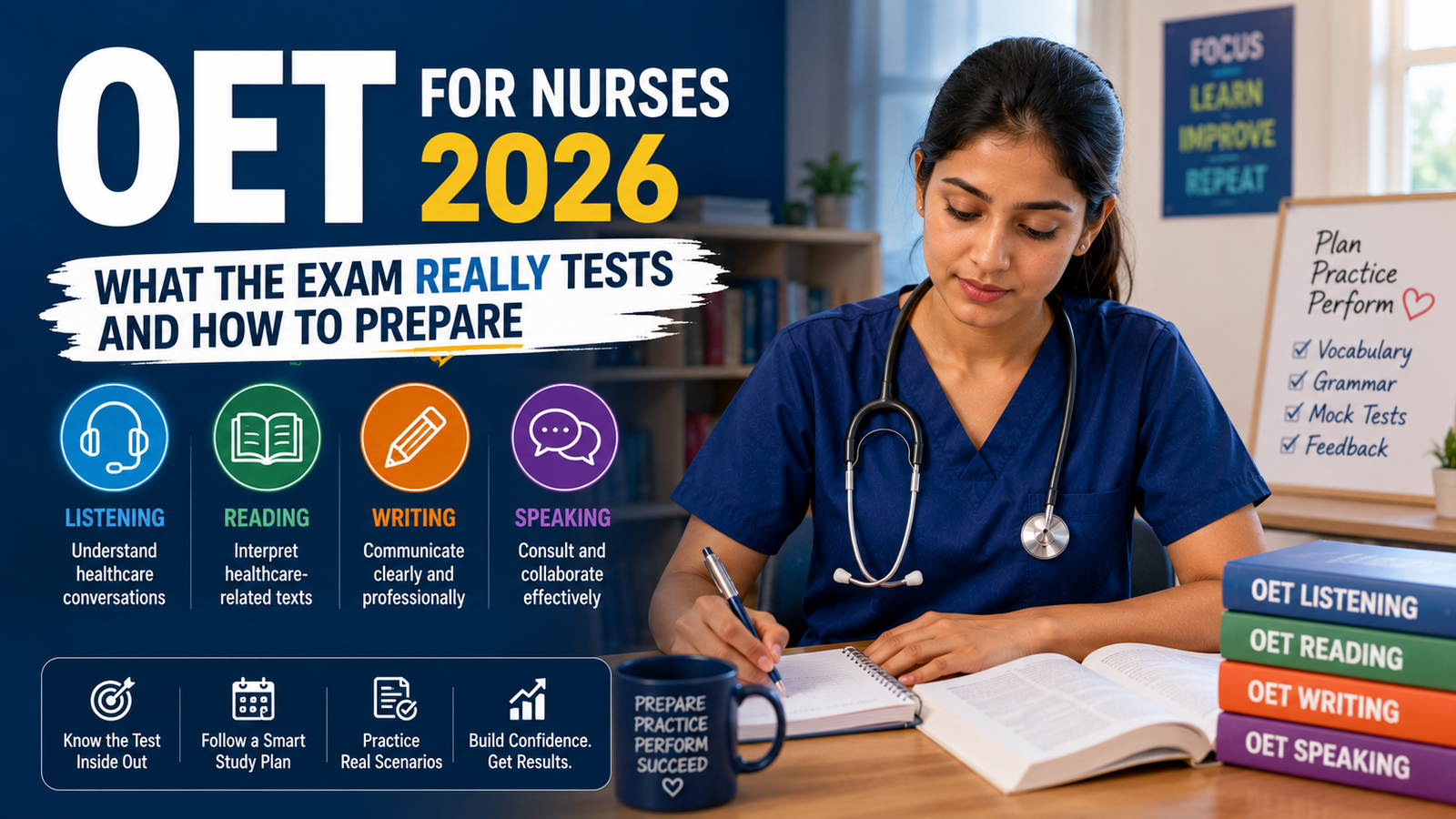
2. The Four Subtests — What Each Actually Involves
Listening (~45 minutes, 42 questions)
The OET Listening subtest has three parts, all recorded in healthcare settings:
Part A: A consultation between a healthcare professional and a patient. You complete a set of notes while listening. The language is clear but the pace is natural — pauses are realistic, not dramatic. Approximately 12 questions.
Part B: Six short audio extracts from workplace interactions — a nurse briefing, a ward round discussion, a phone conversation. One question per extract. Fast and dense with information.
Part C: Two longer recordings of health-related talks, interviews, or discussions — similar to a conference presentation or clinical teaching session. Multiple questions per recording. The longest section and where sustained concentration is most tested.
What trips nurses up in Listening: Part C demands concentration across 15 to 20 minutes of audio. After a full clinical shift, most nurses are mentally fatigued, and sustaining attention through Part C without active note-taking is difficult. The solution is not to listen more — it is to take structured notes throughout, treating Part C the same way you would approach a handover you need to remember in detail.
Reading (60 minutes, 42 questions)
Reading has three parts, and one of them operates under a rule most nurses do not discover until the exam itself:
Part A: Four short texts on the same healthcare topic (drug protocols, clinical guidelines, workplace policies). Twenty questions. Part A has a separate 15-minute time limit. When the invigilator says “begin Part A,” a 15-minute clock starts. At 15 minutes, you must stop Part A and move on — you cannot return to those questions. Missing this rule means potentially losing 20 questions.
The strategy: read all 20 questions first, then scan each of the four texts for specific answers rather than reading each text in full.
1. Part A rewards scanning ability, not thorough reading.
2. Part B: Six short extracts from workplace notices or communications, each matched to a specific question or scenario.
Part C: Two longer texts drawn from healthcare publications. Multiple choice and short-answer questions testing detailed comprehension and ability to infer meaning.
What trips nurses up in Reading: The 15-minute Part A limit catches most first-time OET candidates who have not practised specifically under that timing. Practise Part A separately with a 15-minute timer before attempting full Reading mock tests.
Writing (45 minutes, 1 task)
This is the subtest with the highest failure rate for internationally educated nurses, and the one that requires the most targeted preparation.
You receive a set of case notes from a hypothetical patient encounter and are asked to write a professional clinical letter — almost always a referral letter, discharge letter, or transfer letter — to a specific recipient (a specialist, a GP, a community nurse, a residential care facility). The letter must be written in 45 minutes.
What examiners are looking for:
A clear purpose statement in the opening sentence. The reader must know within the first line why they are receiving this letter: “I am writing to refer Mr K, a 62-year-old gentleman with Type 2 diabetes, for specialist cardiology review following recent ECG findings.”
Appropriate selection of case note information. You will be given more clinical detail than belongs in the letter. Part of what is being assessed is your clinical judgment about what is relevant for this specific recipient. A referral to a cardiologist needs cardiac history, current medications, relevant investigations, and the specific concern — it does not need the patient’s full social history or every incidental clinical finding.
Appropriate tone and register.
a) The tone of a letter to a consultant specialist is formal and clinical.
b) The tone of a discharge letter to a patient’s family GP is professional but slightly warmer.
c) The tone in either case is never the same as a clinical handover to a colleague — and it is never the same as a message to the patient themselves.
Accurate clinical language without excessive jargon. Medical terms should be accurate but the recipient is also a healthcare professional. The writing does not need to oversimplify, but it should be clear and precise, not dense with abbreviations the reader may not share.
The most common writing mistakes for Indian and Filipino nurses:
Copying case notes verbatim. Reproducing the case notes almost word for word — even reorganised under headings — is not a referral letter. It demonstrates data transfer, not clinical communication. Examiners score for synthesis and appropriate selection, not transcription.
Including all case note details regardless of relevance. If the case notes mention a patient has a history of childhood eczema and you are referring them for knee replacement surgery, the eczema is not in your letter. Selecting what matters for this specific referral is the task.
No clear opening purpose statement. Beginning with the patient’s name and date of birth rather than stating the referral purpose in the first sentence means the recipient must read the entire letter to understand why they received it. That is not professional clinical communication.
Wrong tone for the recipient. A letter addressed to “The Treating Team” reads differently from one addressed to a specific named consultant. “Please find enclosed…” is dated. “I would be grateful for your specialist review…” is appropriate. The tone should be collegial and professional, not either overly formal or casual.
One practical approach that works: Before writing any letter in practice, write two sentences at the top of your draft: “Who am I writing to?” and “What do I need them to do?” Every paragraph in the letter should serve those two answers. If a case note detail does not help the recipient understand the situation or decide on action, it probably does not belong in the letter.
Speaking (approximately 20 minutes, 2 role-plays)
You play the nurse. The OET interlocutor plays the patient or family member. Two separate role-play scenarios, each with three minutes of preparation time and approximately five minutes of speaking time.
Scenarios involve clinical nursing communication: explaining a diagnosis in patient-friendly language, educating a patient about a new medication, managing a patient’s anxiety or confusion, conducting discharge planning, handling a patient who is refusing treatment, or speaking with a concerned family member.
What is being assessed: Communication (building rapport, listening actively, responding to what the patient says), language (fluency, grammar, vocabulary, pronunciation), and nursing-specific communication (patient-centred approach, clarity, safety awareness in explanations).
The most common speaking mistakes:
Scripted and memorised responses. Role-plays require genuine communication, not a recitation. Examiners can identify when a nurse is delivering a prepared speech rather than actually listening and responding to the patient. If the interlocutor says something unexpected — as patients do — a scripted response will miss it entirely.
Communicating in clinical language the “patient” would not understand. An OET nurse speaking to a simulated patient should use lay language: “Your blood pressure is higher than we would like it to be” rather than “You have hypertension.” The examiner is assessing whether you can communicate clearly with a non-clinical person, not demonstrate clinical knowledge to a colleague.
Not responding to emotional cues. If the patient in the role-play expresses anxiety, confusion, or frustration and you continue with your prepared information without acknowledging it, the examiner will note the missed communication moment. Nurses in clinical practice do not proceed with medication education when a patient is clearly distressed. Neither should a nurse in the OET Speaking subtest.
3. OET@Home: The Option Most Indian Nurses Miss
OET@Home allows you to take the Listening, Reading, and Writing subtests — and the Speaking subtest via video call — from your own home. No test centre, No travel costs and No half-day away from work.
Requirements: a quiet, private room with a door that can close (not a shared space where others can see or hear), a laptop or desktop computer (not a mobile phone or tablet), a webcam, a microphone, and a stable internet connection of at least 10 Mbps. OET uses proctoring software that monitors the testing environment — the room will be checked by a remote proctor before the session begins.
The content, timing, and scoring are identical to the test centre version. The score is equally valid for regulatory submissions. The only difference is where you sit.
For nurses in Indian cities outside the major test centre locations, or for nurses who cannot take time off work for a test centre visit, OET@Home significantly reduces both the logistical burden and the cost. Book through oet.com and verify current availability in your location.
4. The 8-Week Study Plan for Working Nurses
This plan assumes you are working full-time and can dedicate 1 to 2 hours per day on workdays and 3 to 4 hours on non-working days. Adjust the intensity based on your baseline — if your first mock test score is near Grade B, compress to 6 weeks; if it is significantly below, extend to 10 to 12 weeks.
Before starting: Take OET Pulse.
OET offers a free 30-minute assessment at oet.com that gives you an estimated baseline score for Listening, Reading, and Language Knowledge. Take it before anything else. It tells you where you currently stand and where the preparation gap is largest.
Weeks 1 and 2 — Understand and baseline.
Complete one full official OET sample test (available free at oet.com/ready) under test conditions: timed, without breaks, in a quiet space. Score yourself. Review every incorrect answer — not to memorise the correct answer, but to understand what reading, listening, writing, or speaking skill produced the error. Begin reading a healthcare publication in English (the BMJ, Nursing Times, or a professional nursing magazine) for 20 minutes daily to build clinical English fluency.
Weeks 3 and 4 — Listening and Reading focus.
Practise Part A Reading with a strict 15-minute timer every day. Develop the habit of reading all questions before scanning the texts. For Listening, practise Part C specifically with full note-taking — clinical lectures, nursing conference talks, and hospital documentaries in English are good supplementary material for training your ears to follow sustained clinical discussion. Complete Part B Listening practice sets to build speed on the short extract format.
Weeks 5 and 6 — Writing intensive.
Write one practice referral or discharge letter every day during these two weeks. This sounds like a lot; it is the minimum necessary for the technique to become automatic. After each practice letter, check it against these four questions: Does the first sentence state the purpose clearly? Did I include only relevant case note information? Is the tone appropriate for this recipient? Is every medical term accurate? Seek feedback where possible — a colleague, a tutor, or a structured OET writing correction service. Writing without feedback develops fluency in your mistakes as much as your strengths.
Weeks 7 and 8 — Speaking practice and mock tests.
Conduct speaking role-plays daily with a partner, using official OET sample role-play cards. Focus on responding to what the “patient” says rather than delivering prepared content. Record yourself and listen back — the gap between how you think you sound and how you actually sound in English is frequently revealing. Complete two full timed mock tests in these weeks. Schedule your actual OET exam for the end of Week 8 or early Week 9. On the day before the exam: do not study. Prepare your documents, test the OET@Home equipment if applicable, and rest.
5. Free Official Resources from OET
The most accurate and reliable preparation resources for OET are the official ones. They are also free. Before spending money on a preparation course, use what OET provides directly:
OET Pulse (oet.com) — free 30-minute baseline assessment. Start here.
Free sample tests (oet.com/ready) — one free sample test for each of the four subtests. These are the closest to real exam content because they are made by the same organisation that writes the actual exam.
Preparation guides (oet.com/ready) — official subtest-specific guides explaining format, timing, and scoring criteria.
OET-approved teacher directory (oet.com) — if you want a preparation class, the OET website lists teachers who have completed OET’s own training programme and have verified knowledge of exam requirements. A course led by an OET-approved teacher is more likely to prepare you for the actual exam format than a generic English class.
Additional materials from third-party providers can supplement official resources, particularly for Writing correction feedback and Speaking role-play practice. Use them alongside, not instead of, the official sample tests.
1. For the OET vs IELTS comparison: OET vs IELTS for Nurses 2026.
2. For the full UK pathway: UK NHS Nursing Jobs Guide 2026.
3. For real cost of working abroad: The Real Cost of Working Abroad as a Nurse 2026.
6. Frequently Asked Questions
What OET score does NMC UK require?
Grade B (350+) in Listening, Reading, and Speaking. Grade C+ (300+) in Writing — lower than most other regulators. Verify at nmc.org.uk before registering.
What OET score does Australia, New Zealand, and Ireland require?
Grade B (350+) in all four subtests — stricter than NMC UK. If preparing for multiple destinations, prepare to Grade B in all four.
Can I take OET from home in India?
Yes. OET@Home is available. Requires private room, laptop/desktop, webcam, microphone, and 10 Mbps internet. Same content, timing, and scoring as test centre. Book at oet.com.
How long to prepare?
4–8 weeks for nurses already communicating clinically in English. 8–12 weeks for nurses who use English primarily for documentation. Start with OET Pulse to find your baseline.
What is Part A in Reading?
Separate 15-minute time limit. 4 texts, 20 questions, clock stops at 15 minutes. Read all questions first, then scan texts. Most important timed section to practise specifically.
Why is Writing hardest for Indian and Filipino nurses?
Writing case notes verbatim, including irrelevant details, not stating purpose in first sentence, wrong tone for recipient. Fix: write one letter per day for 2 weeks with feedback. Technique, not clinical knowledge, is what needs to improve.
How much does OET cost in India?
Approximately ₹15,000–₹22,000 per sitting. No retake limit. Book through oet.com only — never through third parties.
Is OET easier than IELTS?
Healthcare-familiar scenarios make OET more natural for clinical nurses. But OET Writing technique is specific and requires targeted practice. Easier in concept; requires the same commitment in preparation.
The Bottom Line
The OET is not a test of how good a nurse you are. It is a test of specific English communication skills in specific healthcare formats — and those formats have rules that clinical experience does not automatically teach you.
Part A has a 15-minute limit that stops regardless of where you are. Writing requires synthesis of case notes, not transcription of them. Speaking requires you to listen and respond to a “patient” rather than deliver a prepared script. These are the places where OET preparation makes the difference between a first-attempt pass and a resit.
Start with the free OET Pulse assessment to know your baseline. Use the official free sample tests from oet.com/ready before spending money on preparation courses. Write one practice letter every day for two weeks and get feedback on it. Practise Part A Reading with a 15-minute timer. Record your Speaking role-plays and listen back. Book OET@Home if a test centre visit is difficult. These steps, done consistently over 8 weeks, will convert clinical English fluency into OET-specific examination performance.
Related articles on GlobalNurseGuide.com:
Nursing Jobs in Australia 2026
UK NHS Nursing Jobs Guide 2026
Nursing Jobs in New Zealand 2026
The Real Cost of Working Abroad as a Nurse 2026
Fast-Track US Nursing License 2026
Disclaimer:
This article is for informational and educational purposes only and does not constitute professional or immigration advice. OET score requirements for regulatory registration are determined by each country’s regulatory body and are subject to change. NMC (nmc.org.uk), AHPRA (ahpra.gov.au), NCNZ (ncnz.org.nz), and NMBI (nmbi.ie) requirements verified as of June 2026. Always verify the current English language requirements with your specific regulatory body before registering for the OET. Free official OET preparation resources are available at oet.com/ready. OET@Home availability and technical requirements should be confirmed at oet.com. Cost figures in INR are approximate at June 2026 rates. GlobalNurseGuide.com is not affiliated with OET, Cambridge Assessment, or any preparation course provider. Information current as of June 22, 2026.
© 2026 GlobalNurseGuide.com — Empowering Nurses Worldwide with Real Opportunities
Author

Discover more from Global Nurse Guide
Subscribe to get the latest posts sent to your email.