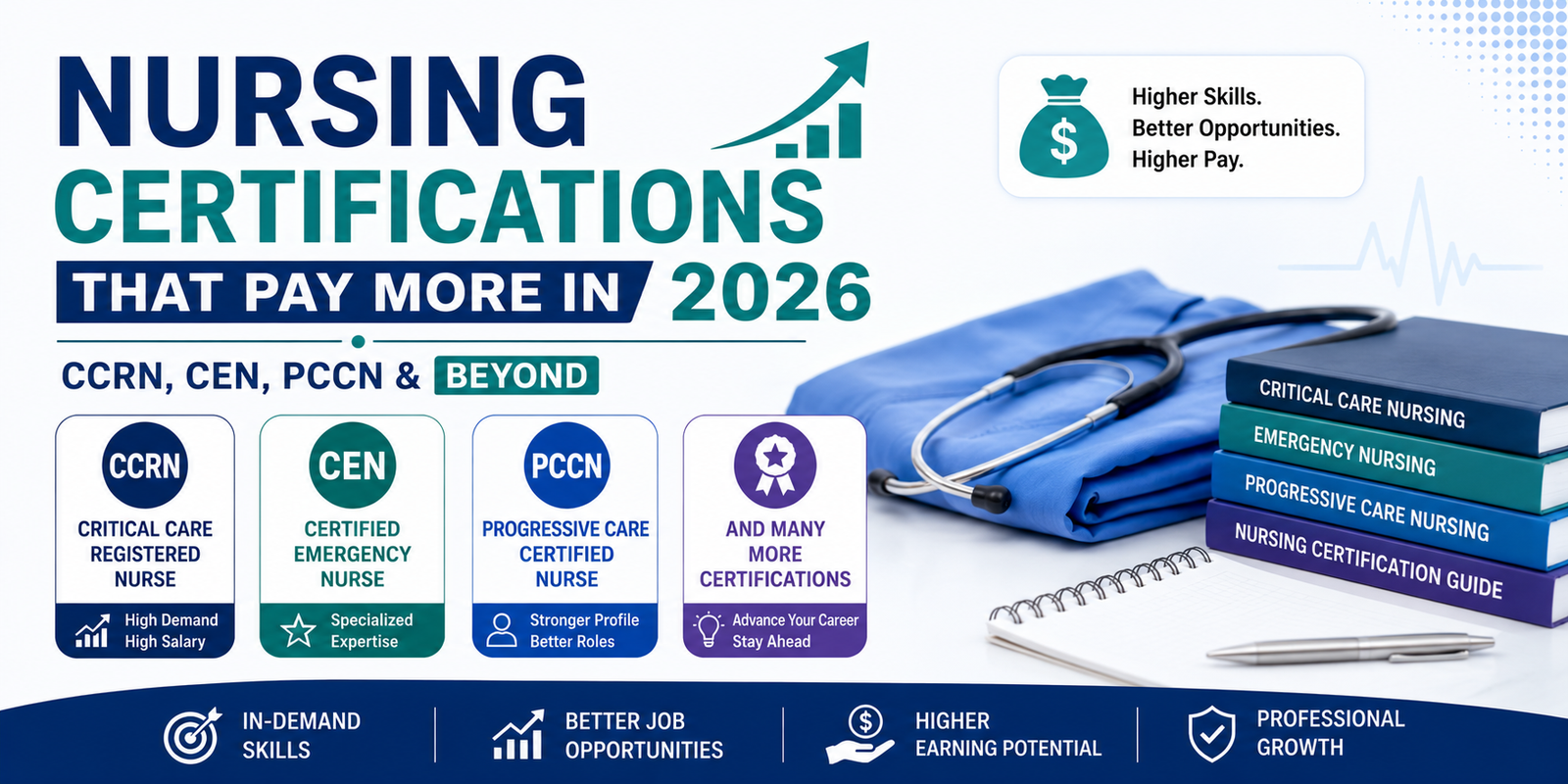
Nursing Certifications That Pay More in 2026: CCRN, CEN, PCCN & Beyond
Updated June 22, 2026 • Reading Time: ~14 Minutes
A $1.50 per hour certification differential on three 12-hour shifts per week adds $2,808 to your first year’s income. Against a $250 exam fee, that is an eleven-fold return in year one. For the CCRN, this is the conservative end of what most hospital systems pay — the real differential runs $1.25 to $2.00 per hour, or approximately $2,300 to $3,700 per year for a full-time nurse. If your hospital also pays a sign-on or renewal bonus for certification, the payback period shrinks further.
The widely cited $18,000 figure that appears in CCRN marketing does not represent the certification differential alone. It conflates the CCRN differential with the broader salary premium that comes with ICU experience, shift differentials, and geographic variation. The real number is $2,300 to $3,700 — still excellent, still worth pursuing, but not a number nurses should anchor their expectations to. This article gives you the verified figures for the major specialty certifications, what each one actually tests, who should get which one first, the CCRN pass rate drop nobody is talking about, and the stacking strategy that compounds certification value over a career.
🩺 Join FREE WhatsApp Channel for Trusted Guide
Get weekly vacancy alerts, EB-3 visa updates & daily NCLEX prep on WhatsApp — FREE.
📲 Follow the Channel📋 Major Nursing Certifications 2026 — Comparison at a Glance
| Cert | Body | Cost (member) | Pass rate | Salary impact/year |
| CCRN | AACN | $250 / $365 | 72% (first-time) | $2,300–$3,700 |
| CEN | BCEN | ~$230 / $370 | ~51% (overall) | $1,000–$5,000 |
| PCCN | AACN | $250 / $370 | >72% (est.) | $1,000–$3,500 |
| CMSRN | MSNCB | $230 / $320 | ~51% (overall) | Variable |
| CNOR | ASPAN/ABPANC | ~$275 / $385 | ~62% | $1,500–$4,000 |
Note: AACN reports first-time pass rates; BCEN and MSNCB report overall rates including retakes. Not directly comparable.
1. CCRN: The Certification That Opens Two Doors
The CCRN is issued by the American Association of Critical-Care Nurses and certifies competency in the direct care of acutely or critically ill patients. With 102,129 active adult CCRN certificants in 2025, it is the most widely held critical care nursing credential in the United States and the most recognised.
Who can sit for it
You need an active, unrestricted RN or APRN licence plus one of two clinical experience options:
- 2-year option: 1,750 hours of direct critical care in the past 2 years, with 875 of those in the most recent year
- 5-year option: 2,000 hours of critical care in the past 5 years, with 144 in the most recent year
This eligibility gate is part of what makes the CCRN pass rate meaningful. You cannot sit the exam without demonstrating sustained critical care practice. A 72 percent pass rate among a pre-screened pool of experienced ICU nurses is a genuinely rigorous standard.
The exam
150 questions, 125 scored, 3 hours, computer-based. The current cut score is approximately 87 of 125 (roughly 70 percent). The November 2025 blueprint adjustment made the exam harder in practice — the first-time pass rate fell from 81 percent in 2023 to 72 percent in 2025. Nurses using study materials written before 2025 are preparing for an exam that no longer exists in its original form. Allow 10 to 12 weeks of structured preparation and use current blueprint materials.
The cost
$250 for AACN members, $365 for non-members. AACN annual membership is $78. Joining before taking the exam saves $115 — a net gain of $37 plus access to continuing education resources. If there is any chance you will need a second attempt, AACN membership pays for itself: retake fees are $180 for members versus $285 for non-members. The certification is valid for 3 years.
The salary impact: the honest version
The CCRN certification differential at most hospital systems runs $1.25 to $2.00 per hour. For a full-time nurse working 36 hours per week, this is $2,340 to $3,744 per year. The exam pays for itself in approximately 4 to 6 weeks of work after passing. Over 5 years before renewal, the cumulative differential is approximately $11,700 to $18,720.
The frequently cited $18,000 annual increase attributed to CCRN certification in AACN-referenced studies reflects the total salary premium for certified critical care nurses compared to uncertified nurses, which includes ICU experience premiums, geographic adjustments, shift differentials, and Magnet hospital premiums — not the certification differential alone. When talking about what the CCRN certificate itself adds to the next pay period, $2,300 to $3,700 is the verified range. It remains excellent ROI. It is simply not $18,000.
The door nobody mentions: CRNA school
Approximately 70 percent of accredited CRNA programmes require or strongly recommend CCRN certification for admission. Even for programmes that do not formally require it, CCRN in an applicant pool of 50 candidates is a clear differentiator. For any ICU nurse who has considered CRNA training, the CCRN is not optional — it is the practical prerequisite. The financial return on that pathway is the $223,000 mean CRNA salary discussed in the CRNA career guide, which makes the $250 exam fee genuinely small in the decision.
For the full CRNA pathway: CRNA Career Guide USA 2026. For ICU income strategies: How to Maximize Income as an ICU or ER Nurse.
2. CEN: The Emergency Credential With Growing Employer Expectations
The Certified Emergency Nurse (CEN) is issued by the Board of Certification for Emergency Nursing (BCEN). It certifies competency in emergency nursing practice across the full spectrum of emergency presentations.
Who can sit for it
Any nurse with an active RN licence. No clinical hour requirement. This is the fundamental difference from the CCRN: the CEN is open to every nurse who wants to take it, which produces a broader candidate pool and a lower overall pass rate. The 51 percent overall figure (BCEN, including retakes) is not directly comparable to CCRN’s 72 percent first-time-only figure. The first-time CEN pass rate is likely significantly higher than 51 percent — the overall rate is dragged down by repeat takers who do not change their preparation between attempts.
Why the CEN is increasingly non-negotiable for ED nurses
Many US emergency departments are moving toward requiring or expecting CEN certification within a stated timeframe of hire. In competitive urban markets and Magnet hospitals, CEN is becoming a prerequisite rather than a differentiator. A CEN-uncertified ED nurse applying at a major trauma centre in 2026 is competing against CEN-certified candidates. The practical recommendation: if you have been working in the ED for two years or more and have not sat the CEN, the window for doing it proactively rather than reactively is narrowing.
Salary impact
$1,000 to $5,000 per year, with higher premiums at trauma centres and major urban emergency departments. The range is wider than the CCRN differential because the ED nursing market varies more by facility type, geography, and whether CEN is a requirement versus an incentive.
3. PCCN: The Stepping Stone That Is Also a Destination
The Progressive Care Certified Nurse (PCCN) is issued by AACN for nurses working in step-down, telemetry, intermediate care, and progressive care units. The exam structure, cost, and renewal process mirror the CCRN — the difference is the patient population (moderately versus critically ill).
The PCCN has two roles in a nursing career:
As a destination: If you work in progressive care and intend to stay there, the PCCN validates your specialist competence in a unit type that gets less certification recognition than the ICU or ED but involves genuinely complex patients. It typically adds $1,000 to $3,500 per year in differential, less than the CCRN but real.
As a stepping stone: Many nurses pursue the PCCN while working in step-down, then transition to the ICU and pursue the CCRN. The AACN shared exam framework means that PCCN preparation translates directly into CCRN preparation — the question style, the scoring model, and much of the content overlap significantly. A nurse who has already passed the PCCN enters CCRN preparation with a substantial head start. This stacking pathway is one of the most underused career strategies in critical care nursing.
4. CMSRN: The Certification for the Specialty Nobody Talks About
The Certified Medical-Surgical Registered Nurse (CMSRN) is the credential for adult medical-surgical nursing — the largest single nursing specialty in the United States. More nurses work in med-surg than in any other setting, yet it is chronically underrepresented in certification conversations dominated by ICU and ED content.
Eligibility and exam
Active RN licence plus a minimum of two years med-surg experience and 2,000 practice hours in the previous three years. Issued by the Medical-Surgical Nursing Certification Board (MSNCB). Cost: approximately $230 for AMSN members, $320 for non-members.
Why it matters
The CMSRN’s salary impact is variable but meaningful at hospital systems that explicitly value certification as a quality signal. More practically: the CMSRN demonstrates specialist-level competence in the unit type where most nursing careers begin, which strengthens applications to charge nurse, clinical educator, and clinical nurse specialist roles. For a med-surg nurse planning to build a career at the bedside rather than move to a higher-acuity unit, it is the natural credential to pursue.
5. The Stacking Strategy: Building Credentials That Compound
Individual certifications add value. Stacking them strategically adds more. The most common effective sequences among experienced nurses:
For critical care career trajectory:
PCCN (step-down, 1-2 years) → Transition to ICU → CCRN (after 1,750 hours) → Subspecialty certification (CMC for cardiac, CSC for cardiac surgery) → CCRN as prerequisite for CRNA application if advanced practice is the goal
For emergency nursing:
CEN (after 2+ years in ED) → TCRN (trauma certified RN) for trauma centres → Emergency NP pathway if pursuing advanced practice
For medical-surgical nurses building toward clinical leadership:
CMSRN (after 2 years med-surg) → Clinical Nurse Leader programme or BSN completion → Charge nurse → CNS or nurse educator pathway
The general principle: start with the broadest credential for your current unit. Then add a subspecialty or crossover credential after 1 to 2 years. Certification stacking signals depth and versatility to both hospital employers and advanced practice programme admissions committees.
6. What the Pass Rate Drop Means for Your Preparation
The CCRN first-time pass rate fell from 81 percent in 2023 to 72 percent in 2025. That 9-point drop is the largest year-over-year shift in recent CCRN history and reflects a November 2025 cut score adjustment by AACN.
Most study guides currently in circulation were written when the pass rate was in the low 80s. The preparation approach that earned an 81 percent pass rate environment may not be sufficient in a 72 percent environment. The practical implications:
Allow 10 to 12 weeks of structured preparation rather than the 6 to 8 weeks some older guides recommend. Confirm that your study materials are based on the post-November 2025 blueprint. Use official AACN blueprints and practice materials alongside any third-party resources. Know that the eligibility gate is part of what makes the certification meaningful — if you have the hours and you prepare properly, the pass rate reflects real exam difficulty, not an arbitrary barrier.
7. What Employers Actually Do With Certification
Hospital responses to nursing certifications fall into three categories:
Differential only: The hospital pays an hourly or annual rate increase for holding the certification. The $1.25 to $2.00/hour range is the most common form. Some hospitals pay a flat annual bonus instead of an hourly differential. Some pay both on Magnet-designated units.
Differential plus promotion advantage: Certification is not required for advancement but consistently favours certified nurses when charge nurse, educator, or clinical specialist positions open. In practice, certification becomes effectively required over time in competitive environments.
Requirement with timeline: Some hospitals and units state that certification is expected within a defined period of hire — 18 months to 2 years for ICU, often sooner for ED at major trauma centres. In these environments, the certification is not a bonus-earning credential. It is a professional obligation.
Before you sit the exam, understand which category your employer falls into. A hospital that pays no differential but expects certification within 18 months should still be pursued — the professional protection and career value are real — but the ROI calculation is different from a hospital that pays $2.00/hour and offers promotion preference to certified nurses.
For salary negotiation using certification credentials: Salary Negotiation for Nurses 2026. For nursing specialty salaries: Nursing Specialty Salaries 2026.
8. Frequently Asked Questions
How much does CCRN increase salary?
$1.25–$2.00/hour differential → approximately $2,300–$3,700/year for full-time nurses. Exam pays for itself in 4–6 weeks. The $18,000 figure is not the certification differential alone — it conflates CCRN with broader ICU premiums.
What is the CCRN pass rate in 2026?
72% first-time (2025 data, AACN). Dropped from 81% two years earlier after November 2025 cut score adjustment. Allow 10–12 weeks preparation with current blueprint materials.
Is the CCRN required for CRNA school?
~70% of CRNA programs require or strongly recommend it. Effectively non-negotiable for competitive CRNA applications.
CCRN or CEN — which should I get?
Get the one that matches where you work now. CCRN = ICU nurses (1,750 hour eligibility gate). CEN = ED nurses (no hour requirement, any RN can sit). Don’t pursue a certification you’re not yet clinically eligible for or professionally working in.
What is PCCN good for?
Two uses: validates expertise for step-down/telemetry nurses staying in progressive care ($1,000–$3,500/year differential). AND: excellent stepping stone to CCRN because AACN’s shared exam framework means PCCN preparation directly builds CCRN readiness.
How much does CCRN cost?
$250 (AACN member) / $365 (non-member). Membership $78/year saves $115 on exam = net $37 saving + CE resources. Renewal: every 3 years at $170/$275.
Do nursing certifications expire?
Yes. CCRN and PCCN: every 3 years. CEN: every 4 years. Renew by retaking the exam or completing continuing education credits/hours per the certifying body’s requirements.
The Bottom Line
Nursing certifications that increase your pay are not myths. The CCRN pays for itself in 4 to 6 weeks of post-exam work. The CEN is becoming a professional expectation in many emergency departments rather than a voluntary credential. The PCCN is underused as a CCRN stepping stone. And for any ICU nurse who has thought about CRNA school, the CCRN is the first serious step in that direction — not just a badge, but a prerequisite for approximately 70 percent of programmes.
The single most useful thing you can do with this information: look at your hospital’s certification policy today. Find out the exact differential amount, whether there is a bonus, and whether certification affects promotion decisions on your unit. Then calculate the payback period on the $250 exam fee. The math will tell you whether to register this month or start your preparation plan now.
Related articles on GlobalNurseGuide.com:
How to Maximize Income as an ICU or ER Nurse
Nursing Specialty Salaries 2026
Salary Negotiation for Nurses 2026
Nurse Practitioner Career Guide USA 2026
Disclaimer:
This article is for informational and career planning purposes only. Salary differential figures are compiled from PayScale nurse certification salary data, PrepSolution CCRN analysis (April 2026), and Nursa.com CCRN ROI analysis. CCRN pass rate data from AACN 2025 Certification Exam Statistics. CCRN exam fee schedule from AACN.org. CEN fees and pass rate from BCEN. CMSRN fees and pass rate from MSNCB. Actual salary differentials vary by employer, geographic location, hospital type, and individual employment terms. The $18,000 annual salary premium referenced in some AACN-associated studies reflects broader salary premiums and is not equivalent to the certification-specific hourly differential. CRNA programme admission requirements referenced from 70% figure reported by PrepSolution (April 2026) — verify individual programme requirements with the specific institution. Certification requirements and costs change periodically; always verify with the relevant certifying body before registering. GlobalNurseGuide.com is not affiliated with AACN, BCEN, MSNCB, or any certification exam provider. Information current as of June 22, 2026.
© 2026 GlobalNurseGuide.com — Empowering Nurses Worldwide with Real Opportunities
Author

Discover more from Global Nurse Guide
Subscribe to get the latest posts sent to your email.