Is Nursing AI-Proof? What the 2026 Data Actually Shows
Is Nursing AI-Proof? What the 2026 Data Actually Shows
Short answer: yes. Nursing is one of the most AI-resistant careers in the 2026 data. But “AI-proof” doesn’t mean “AI-untouched.”
Maybe you’ve felt a low hum of anxiety every time a headline says AI is coming for healthcare jobs. You deserve a straight answer, not another reassurance-shaped platitude. Here’s what the research actually says. Here’s what’s already changed inside hospitals this year. And here’s what it means for your career.
🩺 Join FREE WhatsApp Channel for Trusted Guide
Get weekly vacancy alerts, EB-3 visa updates & daily NCLEX prep on WhatsApp — FREE.
📲 Follow the ChannelThe short version, backed by numbers
Three independent models point the same way, from different angles: Goldman Sachs, McKinsey, and a 2026 occupational scoring study from Careery Research.
Goldman Sachs puts healthcare at roughly 17% task-automation potential. Compare that to 46% for administrative and office work, 45% for manufacturing, and 41% for customer service. McKinsey’s separate analysis found something similar: fewer than 10% of nursing tasks are fully automatable with current technology.
Careery’s 2026 AI Resistance Score adds more detail. It’s a 100-point framework. Careery checked it against Frey & Osborne’s Oxford automation research, Goldman Sachs, McKinsey, and Bureau of Labor Statistics data. On this scale, nurse practitioner and physician assistant roles score 88 to 93 out of 100.
The framework also found something worth sitting with. The ten highest-scoring occupations in its model have a median projected job growth rate of 17% through 2034. The average US occupation grows at just 3.1%. The traits that make a job hard to automate — physical presence, real-time judgment, direct human need — are the same traits driving demand for it.
None of this means nursing stays frozen in place. It means the parts of the job most exposed to automation aren’t the parts most people picture when they think of nursing.
What’s actually being automated in hospitals right now
Most “AI-proof jobs” articles stay vague here. Let’s get specific about 2026.
Ambient documentation
This is the fastest-moving change. Houston Methodist rolled out an ambient AI platform that listens to clinician-patient conversations and auto-drafts structured notes. The health system reported a 40% drop in documentation time. Patient face time rose 27% in the same period. If charting has ever eaten into time you wanted at the bedside, this change is the one most likely to reach your unit next.
Clinical decision support
This is scaling fast too. OpenEvidence — a tool clinicians increasingly call “ChatGPT for clinicians” — hit a roughly $6 billion valuation in 2026. It now handles around 15 million monthly consultations. Mount Sinai integrated it across all seven of its hospitals in March 2026. Nurses, physicians, and pharmacists can ask clinical questions and get answers cited straight to peer-reviewed literature. Cedars-Sinai deployed a similar tool enterprise-wide, with patient-aware context, in May 2026.
OpenAI made its own move too. It opened free access to a clinical version of ChatGPT for verified nurse practitioners on April 23, 2026. That removed a real cost barrier for independent NPs who couldn’t previously afford enterprise-grade AI tools.
Early-warning and triage tools
These already run in production, not just pilot programs. An AI sepsis-detection platform earned FDA clearance in January 2026, covering fourteen acute conditions in one workflow. Cleveland Clinic already runs it.
Virtual nursing and monitoring
This is the newest category. These platforms combine ambient documentation, virtual sitting for fall-risk patients, and remote monitoring into one AI-connected hospital room. Cooper University Health Care and MultiCare Health System already use them.
What do all four have in common? They automate inputs and alerts, not judgment or care. None of them decide what to do about a deteriorating patient. They just get the information in front of a human faster.
What isn’t being automated, and why
In twenty-six years of nursing, I’ve watched three generations of “smart” hospital technology arrive with the same promise: this will finally give you your time back.
Barcode medication scanning promised to eliminate errors and free up rounds. Electronic charting promised to shrink documentation to minutes. Neither fully delivered. Both mostly moved the burden around instead of removing it.
AI documentation tools are the newest wave. The early numbers from hospitals already running them are real — the Houston Methodist figures above prove that.
The instinct no algorithm has replicated
Here’s what hasn’t changed. A nurse stands at a bedside and knows something is wrong before a single number on the monitor moves. I’ve had that instinct proven right more times than I can count, in situations no algorithm was watching for.
That isn’t sentiment. It’s pattern recognition built from years of hands on patients. It’s the real reason nursing keeps scoring near the top of every AI-resistance study this year. Not because the technology can’t read a chart — because it can’t stand in the room.
The World Economic Forum’s own analysis backs this up. More than 40% of roles that need emotional intelligence and interpersonal judgment stay largely untouched by current automation. Nursing sits inside that category almost by definition: physical presence with a patient, real-time judgment under changing conditions, and accountability that has to rest with a licensed human being.
AI can flag a deteriorating trend line. It can’t decide how to deliver bad news to a frightened family. It can’t adjust its approach for a confused older people patient versus a scared teenager. And it can’t take responsibility when something goes wrong.
The real risk isn’t replacement
This is the part of the 2026 story that doesn’t get enough attention. For most working nurses today, it’s more urgent than the replacement question.
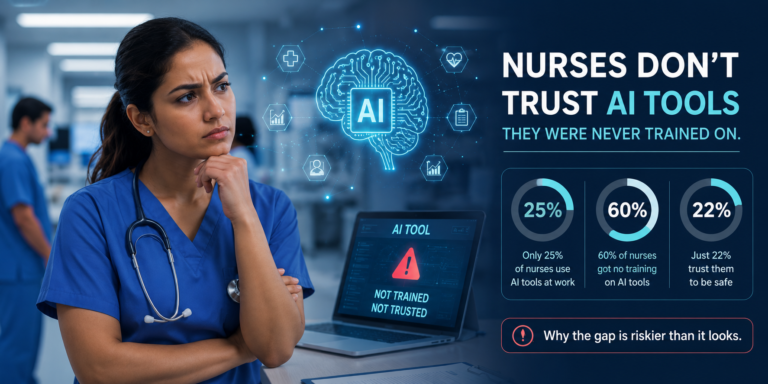
A major 2026 workforce survey found that only 25% of nurses had personally used AI-powered tools at work in the past 30 days. Most nurses aren’t working alongside these systems daily yet, whatever the headlines suggest.
But look at the nurses who do have AI tools in their workplace. Sixty percent said their employer hadn’t given them adequate training. Researchers also asked whether nurses have real input into which AI tools get chosen and how they’re set up. Only 19% said yes. Roughly 40% said no. The rest weren’t sure.
That gap matters clinically, not just professionally. A nurse without training on a documentation AI may not catch it when the output is wrong. A nurse who doesn’t understand a decision-support tool’s limits might over-trust a flawed recommendation. Or they might dismiss a genuinely useful alert because no one taught them when to trust it. The technology itself isn’t the real threat here. Rolling it out with no voice in the decision, and no training to use it safely, is.
What this actually means for your career
Nursing isn’t disappearing under AI. But the nurses who do best over the next five years won’t ignore these tools. They won’t blindly defer to them either. They’ll get fluent enough to use AI as a genuine time-saver — for documentation, for literature lookups, for flagging what to double-check — while keeping clinical judgment squarely in their own hands.
Three things are worth doing now, regardless of your specialty.
Ask your unit or facility whether formal training exists for any AI tool you use. Push for it if it doesn’t. You have more standing to ask than you might think, given how many nurses report the same gap.
Get familiar with at least one clinical-grade AI tool on your own terms, before your employer mandates one. That way you’re evaluating it, not just adapting to it.
And if you’re choosing a specialty or weighing advanced practice, the data currently favors roles built on direct, ongoing patient relationships and complex judgment. Nurse practitioner and other advanced-practice paths score among the highest AI-resistance ratings of any profession measured in 2026 — degree requirement and all.
Frequently Asked Questions
Will AI replace registered nurses?
No credible 2026 data supports this. Goldman Sachs puts healthcare task-automation potential at around 17%, one of the lowest of any major industry. McKinsey estimates fewer than 10% of nursing tasks are fully automatable with current technology. AI automates specific tasks within nursing — documentation, triage flags, monitoring — not the role itself.
Which nursing tasks are most likely to be automated first?
Documentation and charting are moving fastest. Early-warning alerts, like sepsis detection, come next, along with administrative scheduling. Physical patient care, clinical judgment calls, and anything requiring accountability to a patient or family stay firmly human.
Should I avoid learning AI tools if I don’t trust them yet?
No. The 2026 workforce data shows the bigger risk is inadequate training on tools you’re already required to use, not the tools themselves. Build basic fluency on your own terms. That gives you more control than waiting for a mandate with no orientation.
Are advanced practice roles like NP safer from automation than bedside RN roles?
Current scoring models rate NP and PA roles slightly higher — 88 to 93 out of 100 on Careery’s 2026 framework — than the healthcare field’s already-strong average. Independent diagnostic judgment and prescribing authority carry legal accountability that no AI tool currently holds, and that pushes the score up.
Disclaimer:
This article is for informational purposes only. It does not constitute career, legal, or financial advice. AI Resistance Score data comes from third-party research (Careery Research, 2026), which combines Bureau of Labor Statistics projections with automation models from Goldman Sachs, McKinsey, and Oxford’s Frey & Osborne research. Methodologies and projections vary by source and aren’t guarantees for any individual employer or role. GlobalNurseGuide.com isn’t affiliated with any AI vendor, hospital system, or research firm named in this article. Information current as of July 2026.
Author

Discover more from Global Nurse Guide
Subscribe to get the latest posts sent to your email.