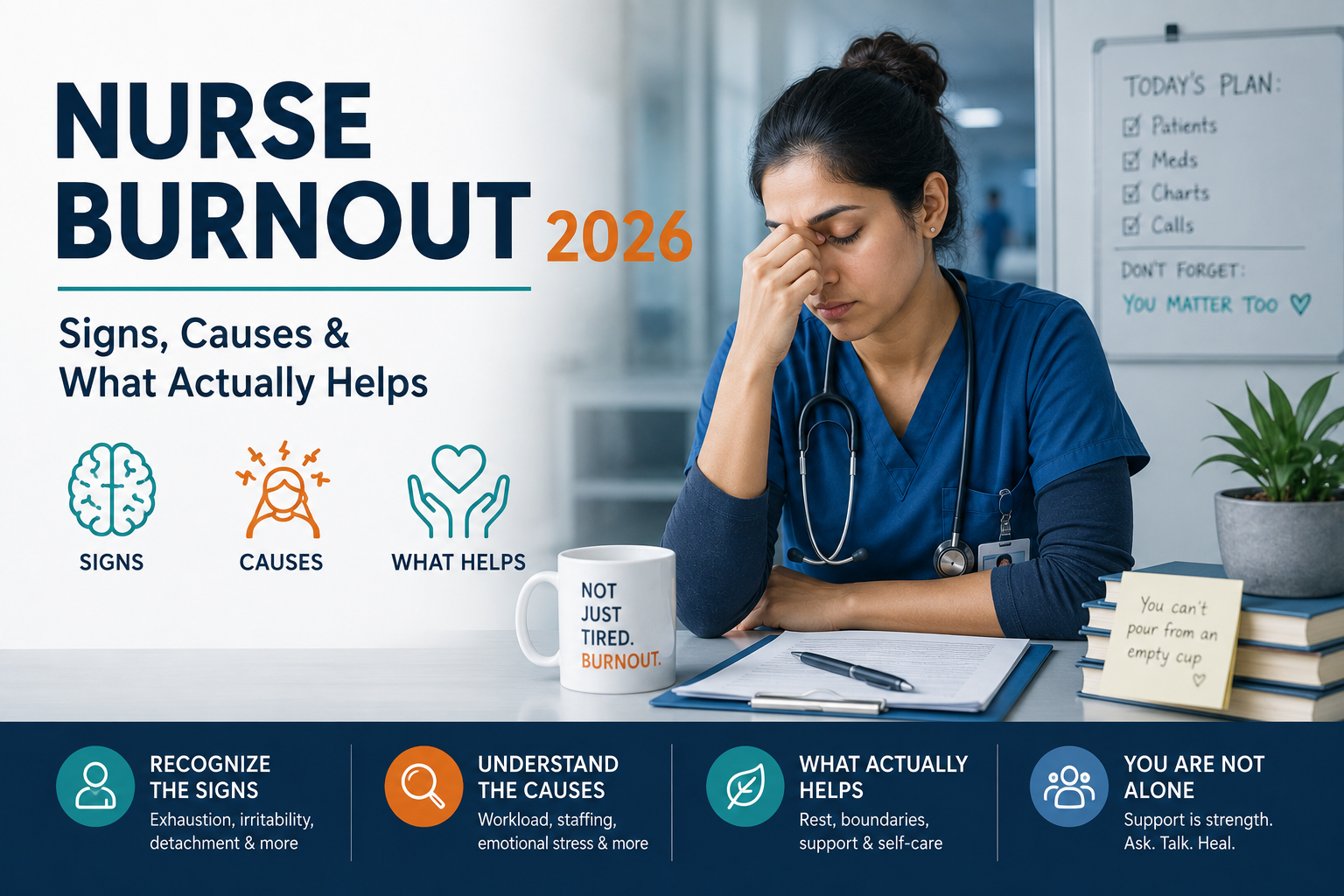
Nurse Burnout 2026: Signs, Causes & What Actually Helps
Updated June 8, 2026 • Reading Time: ~15 Minutes
You are driving to your third consecutive 12-hour shift. Somewhere on the route, you notice that you have not thought about your patients as people in the past week. You have thought about them as room numbers. The woman in 4B with the failing kidneys. The man in 7A who is not going home. They have stopped being people and become problems to manage. That shift — from person to problem — is not callousness. It is not laziness. It is not a character flaw. It is what happens to a human nervous system that has absorbed more than it was designed to absorb, for longer than any training prepared you for.
According to AMN Healthcare’s 2025 Survey of over 12,000 registered nurses, 58 percent report feeling burned out most days. A global meta-analysis published in 2025 found emotional exhaustion in a third of nurses worldwide. Generation Z nurses under 27 — the nurses who entered the profession during and after the pandemic — report the highest rates of burnout, moral injury, and compassion fatigue of any generational group. This is not a minority problem or a personal weakness distributed unevenly across the nursing workforce. It is a systemic response to a systemic situation.
🩺 Going to the US as a nurse?
Get weekly vacancy alerts, EB-3 visa updates & daily NCLEX prep on WhatsApp — FREE.
📲 Follow the ChannelThis article covers the clinical distinction between burnout, compassion fatigue, and moral injury — because the word burnout is used to describe all three and they need different responses. It covers the early signs that are specific to nursing rather than general work stress. The real causes. And what the research says actually helps — not the wellness apps and free yoga that hospitals offer instead of fixing the staffing, but the interventions that the evidence supports.
⚠️ Nurse Burnout 2026 — Verified Data
Burned out most days: 58% of nurses (AMN Healthcare, 2025 — 12,000+ RNs)
Emotional exhaustion globally: 33.45% (PMC meta-analysis, 2025)
Depersonalisation globally: 25% (PMC meta-analysis, 2025)
Report symptoms of burnout: >50% (American Nurses Foundation, 2023)
Feel emotionally tired several times per week: ~75% (Joyce University, 2025)
Highest burnout group: Gen Z nurses (under 27) — Nurse.com 2024
Also feel satisfied with career: 75% (AMN Healthcare, 2025)
Burnout is: a systemic response — not a personal failure
1. Three Conditions, Not One
The word burnout has become a catch-all for everything nurses feel when the work has become too much. Using one word for three different conditions matters because each responds to different interventions. Treating moral injury with a mindfulness app is like treating a fracture with paracetamol — it may dull the pain but it does not address the injury.
Burnout
Burnout is defined through the Maslach Burnout Inventory (MBI) — the gold standard assessment tool in the research literature — as a syndrome with three dimensions: emotional exhaustion (feeling depleted of emotional resources), depersonalisation (developing a detached or cynical attitude toward patients), and reduced personal accomplishment (feeling ineffective or that your contributions do not matter). It develops gradually from sustained exposure to work demands that exceed available resources. It is chronic, not acute. It does not resolve with a weekend off.
Compassion fatigue
Compassion fatigue is physical, emotional, and spiritual exhaustion from caring for people who are suffering. Where burnout is exhaustion by the job itself, compassion fatigue involves absorbing the suffering within the job — sitting with a patient receiving a terminal diagnosis, holding the hand of someone who is dying alone, hearing the same story of loss repeated across different patients until the weight of accumulated grief becomes its own burden.
Compassion fatigue can develop more rapidly than burnout, sometimes after a single traumatic event. It carries an element of secondary traumatic stress — the trauma transferred from patient to nurse through the act of witnessing and caring. The capacity that makes a nurse good at their job — the ability to genuinely feel what patients feel — is also what creates vulnerability to compassion fatigue. This is not a character flaw. It is the cost of empathy deployed at high intensity for long periods.
Moral injury
Moral injury is a different wound entirely. It occurs when a nurse knows the right thing to do for a patient and is prevented from doing it. Not by their own limitations but by the system around them: insufficient staffing that means a patient does not receive the care they need, resource constraints that force clinical compromises, institutional policies that prioritise throughput over care quality, being instructed to discharge a patient who is not ready to go home. Moral injury is the wound to the conscience that accumulates from these moments.
The distinction matters clinically because moral injury does not respond to individual wellness interventions. A nurse whose conscience is wounded by systemic failure is not helped by resilience training or a mindfulness app. The source of the injury is systemic, and the meaningful response is systemic change — better staffing, institutional accountability, a culture where nurses can raise concerns without fear.
2. The Early Signs Specific to Nursing
General burnout literature describes signs that apply to any profession. Nurses recognise burnout through a slightly different set of signals — ones that are specific to what the nursing role asks of you:
Patients become room numbers. You catch yourself referring to patients by their bed number or diagnosis rather than their name. You notice you have stopped asking about their life outside the hospital. This is depersonalisation — one of the three clinical dimensions of burnout — and it is the sign most nurses identify when they reflect on when things shifted.
The errors start. Small ones at first. Forgetting to document something you know you did. Reaching for the wrong dose and catching yourself. Near-misses that would not have happened six months ago. Burnout impairs cognitive function, and cognitive impairment in a clinical setting means patient safety risk.
You stop asking questions. A nurse at the bedside who is fully present asks questions. They notice things and investigate. Burnout produces a kind of clinical passivity — you do what the protocol requires and nothing more, because the energy to be curious is no longer available.
The dark humour crosses a line. Nursing has always used humour to process difficulty. When the humour becomes contemptuous — when it turns on patients rather than the situation — that is a signal that depersonalisation has deepened beyond normal coping.
The body starts speaking. Sleep disruption that does not improve on days off. Headaches that appear before work and resolve on rest days. Gastrointestinal symptoms without a clear cause. The body registers chronic stress before the mind fully acknowledges it.
You dread going in. Not the ordinary tiredness of a long shift ahead. Something different — a heaviness that starts the evening before, a reluctance that sits in the chest. Most nurses describe knowing the difference between normal fatigue and this feeling, even if they do not immediately name what it is.
3. The Real Causes
The research is unambiguous about the primary drivers of nursing burnout, and they are not individual failures. The AMN Healthcare 2025 survey, the American Nurses Foundation data, and the peer-reviewed literature consistently identify the same structural causes:
Staffing. The single most documented driver of burnout across every nursing specialty and every country. When nurse-to-patient ratios are unsafe, every element of the work becomes harder: assessment suffers, communication suffers, error rates increase, and the moral distress of knowing that patients are not receiving adequate care accumulates. A nurse assigned seven patients when four is safe is not experiencing a wellness problem. They are experiencing a staffing problem.
Mandatory overtime. Being required to stay beyond a 12-hour shift because the next nurse did not arrive, or being called in on a scheduled day off, compounds exhaustion in ways that voluntary overtime does not. The loss of control over time — the inability to plan rest — is itself a stressor independent of the hours worked.
Administrative burden. Documentation requirements that bear little relationship to patient care but consume clinical hours. EHR systems designed for billing rather than clinical efficiency. The growing gap between what a nurse trained to do and how their shift time is actually spent.
Moral distress. Being required to discharge patients before they are clinically ready. Being unable to provide the care a patient needs because the resource is unavailable. Witnessing or being party to care decisions that conflict with the nurse’s own values. These experiences accumulate as moral injury even when each individual instance feels manageable in the moment.
Leadership and culture. Research consistently finds that the immediate supervisor relationship is among the strongest predictors of burnout. A nurse who feels supported, heard, and fairly treated by their manager is substantially more resilient to workload stress than one who does not. A culture of psychological safety — in which nurses can raise concerns about patient safety without fear of retaliation — is protective. Its absence is corrosive.
4. What Actually Helps — The Evidence
The nursing and medical literature has decades of research on burnout interventions. The honest summary: individual-level interventions help, but they cannot compensate for systemic causes. Both matter. The question is which ones are worth your time and energy.
What the evidence supports at the individual level
Mindfulness-based interventions (MBI). The strongest individual-level evidence base. Multiple randomised controlled trials have found that structured mindfulness programmes — not passive app notifications but genuinely practised mindfulness — reduce emotional exhaustion in nurses. The effect is real. It is not a cure and it does not address the causes of burnout, but it builds a capacity for response rather than reaction that has measurable impact on the emotional exhaustion dimension.
Reflective practice groups. Structured peer groups in which nurses process difficult cases together. Research published in BMC Nursing in January 2026 found that moral resilience and moral courage — both built through reflective practice and ethics-focused group discussion — were significant protective factors against burnout in ICU nurses. The act of naming what happened, with peers who understand the context, reduces the weight of what is carried alone.
Debriefing after critical events. Structured, facilitated debriefs after traumatic events — a patient death that was unexpected, a code that did not go as hoped, a near-miss — reduce the secondary traumatic stress component of compassion fatigue. This works when it is genuinely facilitated, not when it is a five-minute conversation in a corridor.
Exercise. A dose-response relationship between physical activity and burnout reduction is documented across the healthcare worker literature. This is not about fitness culture. It is about the neurological and hormonal reset that sustained physical activity produces. The optimal form is less important than the regularity.
Shift boundaries. Research supports the protective effect of not checking work communications — email, clinical messaging, staff group chats — during scheduled time off. The cognitive and emotional capacity to restore requires actual disconnection, not intermittent monitoring. This is easier to describe than to practise in many nursing environments, but the evidence for it is solid.
What the evidence does not support
Wellness apps without engagement. Resilience training that teaches nurses to cope better with an unsafe environment rather than making the environment safer. Free food and yoga on the ward during lunch breaks that nurses cannot actually take. These interventions are not ineffective because the activities are bad — mindfulness and movement have value — but because they are deployed as substitutes for systemic change rather than complements to it. The nursing literature has a name for this: wellness washing. It describes an institutional response that offers individual coping tools without addressing the structural causes of burnout, and it has been explicitly criticised in peer-reviewed nursing journals.
What needs to change at the institutional level
Individual nurses reading this cannot unilaterally fix their hospital’s staffing ratio or institutional culture. That does not make these factors irrelevant to discuss. Naming what is and is not within your control is itself useful.
The institutional changes with the strongest evidence for reducing burnout are: legislated or negotiated nurse-to-patient ratios; scheduling that gives nurses genuine control over their time; psychological safety systems that allow staff to report concerns about patient safety without professional consequence; meaningful recognition that goes beyond appreciation pins; and investment in the immediate supervisor relationship, because a supportive manager mediates the impact of workload stress more than almost any other single variable.
Nurses who work in environments without these protections are not failing at burnout prevention. They are experiencing the predictable consequences of working in a system that has not provided the conditions for sustainable nursing practice.
5. When to Seek Professional Support
There is a point at which burnout has progressed beyond what peer support, reflective practice, and lifestyle adjustment can address. These are the signals that professional support — from a therapist or counsellor with experience in healthcare worker burnout — is appropriate:
Burnout symptoms are affecting patient care — not near-misses driven by fatigue, but a genuine inability to be present with patients in a way you know is clinically necessary. Mood changes that extend significantly beyond working days into your personal life. Use of alcohol or other substances to decompress from shifts, particularly if this use is escalating. Symptoms consistent with depression or post-traumatic stress, including persistent low mood, intrusive thoughts about clinical events, emotional numbness, or difficulty functioning in daily life.
Seeking professional support for burnout is not a disqualifier from nursing practice. It is not a licensing risk in most jurisdictions when handled appropriately. It is precisely the action you would recommend to any patient who presented with the same symptoms. Applying different standards to yourself is both common and worth examining.
If your employer has an Employee Assistance Programme (EAP), it typically provides confidential short-term counselling at no cost. These services are under-utilised in nursing, partly because of stigma and partly because the confidentiality is not always trusted. In most EAP arrangements, the employer receives only aggregate utilisation data — not individual names or presenting issues. The confidentiality, for most programmes, is genuine.
6. A Note on Leaving
Some nurses reading this are beyond wondering whether they are burned out. They are wondering whether to leave nursing entirely. This question deserves a straight answer rather than a motivational one.
Leaving a specialty that is burning you out is not the same as leaving nursing. A nurse who leaves the ICU after five years of trauma-adjacent work and moves into community health, telehealth, education, or clinic nursing is not failing or retreating — they are making a career decision that protects both themselves and their future patients. The belief that a nurse must tolerate suffering without limit because nursing is a vocation is both clinically harmful and professionally unsustainable. The bedside needs nurses who are present. Presence requires capacity. Capacity requires restoration.
If leaving nursing entirely is the question on the table, it is worth separating whether the nursing itself — the clinical work, the patient relationships, the role — has become intolerable, or whether the environment in which you are doing that nursing has become intolerable. These are different problems with different solutions. A therapist or counsellor with healthcare experience can help make that distinction more clearly than burnout alone allows.
For income and career options that reduce bedside exposure: Telehealth Nursing Jobs 2026. For advanced practice pathways: Nurse Practitioner Career Guide 2026.
7. Frequently Asked Questions
How many nurses are burned out in 2026?
58% report burning out most days (AMN Healthcare, 2025, 12,000+ nurses). Over 50% reported symptoms of burnout in the American Nurses Foundation 2023 survey. Global emotional exhaustion rate: 33.45% (PMC meta-analysis, 2025).
What are the signs of nurse burnout?
Referring to patients by room number not name. Increasing near-misses. Dreading work in a way that is qualitatively different from ordinary tiredness. Loss of curiosity. Dark humour that turns on patients. Physical symptoms (sleep disruption, headaches) tied to work schedule. Difficulty remembering why you chose nursing.
What is the difference between burnout and compassion fatigue?
Burnout = exhaustion from the chronic demands of the job. Compassion fatigue = exhaustion from absorbing the suffering within the job. Both can be present simultaneously. Compassion fatigue develops faster and carries secondary traumatic stress. Burnout builds gradually.
What is moral injury?
The wound to the conscience that comes from being prevented from doing what you know is right for a patient. Caused by unsafe staffing, resource constraints, institutional failures. Does not respond to individual wellness interventions. Requires systemic change.
Does individual wellness practice actually help?
Yes — mindfulness-based interventions, reflective practice, exercise, and shift boundaries all have evidence behind them. But they cannot compensate for an unsafe or unsupportive work environment. Both individual and systemic responses are needed.
What is wellness washing?
Institutional responses to burnout (apps, yoga, free food) offered as substitutes for structural change (staffing, culture, scheduling). Widely criticised in the nursing literature as insufficient and sometimes counterproductive.
Is leaving nursing wrong?
No. Protecting your capacity to practise safely is clinically and professionally valid. Leaving an environment or specialty that is causing harm is a reasonable career decision. Leaving nursing entirely may be right for some nurses and worth a proper evaluation — ideally with professional support — rather than a crisis decision made at the peak of burnout.
The Bottom Line
Fifty-eight percent of nurses burning out most days is not a statistic about individual failure. It is a statistic about a workforce under structural pressure that exceeds what human beings can sustain indefinitely — regardless of their vocational commitment, their resilience, their self-care practices, or their love of nursing.
The early signs of burnout are recognisable before the situation becomes a crisis, and recognising them is the first step toward a response. The distinction between burnout, compassion fatigue, and moral injury matters because each needs a different response. The individual-level interventions with the strongest evidence — mindfulness, reflective practice, peer support, exercise, genuine disconnection from work on days off — are worth using while also being honest that they are not sufficient when the environment itself is the primary cause of harm.
You entered nursing because patient care matters to you. That same capacity for care needs to be directed, at some point, toward yourself. Not as a luxury or a reward, but as a precondition for continuing to be safe and present for the patients who need you.
If you are in crisis right now, please speak to your GP, a mental health professional, or contact a helpline in your country. You do not have to be managing this alone.
Related articles on GlobalNurseGuide.com:
Telehealth Nursing Jobs 2026 — Work from Home Options
Salary Negotiation for Nurses 2026
Nurse Practitioner Career Guide 2026
How to Maximize Income as an ICU or ER Nurse
Your First Nursing Clinical Rotation
Disclaimer:
This article is for informational and educational purposes only and does not constitute medical, mental health, or professional career advice. If you are experiencing a mental health crisis, please contact a qualified mental health professional or a crisis helpline in your country. Burnout statistics are sourced from AMN Healthcare Registered Nurse Survey 2025, the American Nurses Foundation Pulse on the Nation’s Nurses Survey 2023, Joyce University nursing survey 2025, PMC global meta-analysis (Plos One, 2025), and Nurse.com 2024 generational report. The Maslach Burnout Inventory framework is the intellectual property of Christina Maslach and Michael Leiter. Individual experiences of burnout vary significantly. Information in this article is current as of June 8, 2026.
© 2026 GlobalNurseGuide.com — Empowering Nurses Worldwide with Real Opportunities
Author

Discover more from Global Nurse Guide
Subscribe to get the latest posts sent to your email.