Nurse Case Manager Career Guide 2026: CCM, ACM-RN and the ANCC Exam That Is Ending
Nurse Case Manager Career Guide 2026: CCM, ACM-RN and the ANCC Exam That Is Ending
By Abirami Arumugam, RN, Chief Editor, GlobalNurseGuide.com
“Can I stay a nurse and stop doing twelve-hour shifts on my feet?” Case management is one of the most common answers to that question. A nurse case manager plans and coordinates a patient’s care across settings, arranges what the patient needs after discharge, and deals with the insurer about what will be paid for. The work is mostly weekday, often desk-based, and sometimes remote. One fact changes the planning for anyone entering the field now. The American Nurses Credentialing Center is closing its Nursing Case Management exam to new applicants. Applications end on December 31, 2026. That leaves two main credentials for anyone building a nurse case manager career, and they suit different jobs.
Three employers, three different jobs
The title is the same everywhere. The daily work is not.
🩺 Join FREE WhatsApp Channel for Trusted Guide
Get weekly vacancy alerts, EB-3 visa updates & daily NCLEX prep on WhatsApp — FREE.
📲 Follow the ChannelHospital case management
Hospital case managers work on the units. They review each admission, plan the discharge, and arrange what follows: home health visits, equipment, a rehabilitation bed, a nursing home place. Federal rules sit behind this. Under 42 CFR 482.43, hospitals that take Medicare patients must have an effective discharge planning process. The evaluation must be developed by, or under the supervision of, a registered nurse, social worker, or other qualified person.
Many hospital roles also include utilisation review. The nurse checks whether a stay meets the insurer’s criteria and supplies clinical information to support payment.
Insurance and managed care
Health insurers employ large numbers of nurses. Some review requests for treatment before it happens. Others manage members with complex or costly conditions by telephone, checking on medicines, appointments, and warning signs. Many of these posts are remote, which is why they attract so many applicants.
Community, workers’ compensation, and clinics
Case managers also work for home health agencies, physician groups, and workers’ compensation insurers. In workers’ compensation the nurse follows an injured employee from the first treatment through to the return to work, and liaises with the employer, doctor, and insurer.
A day in a hospital role
The morning starts with the census. The case manager reads the overnight admissions and picks out patients who will need help leaving: the older man who lives alone, the patient with no insurance, the woman whose family cannot manage her care at home.
Rounds follow. Doctors, nurses, therapists, and the case manager go through each patient and agree an expected discharge date. Then the phone calls begin. A rehabilitation unit needs clinical notes before it will accept a transfer. An insurer wants more information to approve another day. A family needs someone to explain why their mother cannot stay longer.
By afternoon, plans made that morning have changed. A patient’s condition worsens. A nursing home bed falls through. The work is constant rearranging, and the nurse’s clinical judgment is what makes the rearranging safe.
The certification picture in 2026
Three credentials matter to nurses. One of them is closing.
| Credential | Body | Experience asked for | Exam fee | Renewal |
|---|---|---|---|---|
| CCM | Commission for Case Manager Certification | 12 months supervised by a board-certified case manager, or 24 months unsupervised, or 12 months as a supervisor | USD 235 application plus USD 195 exam | Every 5 years, 80 CE hours including 8 in ethics |
| ACM-RN | American Case Management Association | 2,080 hours of supervised paid work as a case manager in a health delivery system | USD 359 for quarterly testing, USD 405 to schedule at once | Every 4 years, 40 CE hours |
| CMGT-BC | American Nurses Credentialing Center | 2 years as an RN, 2,000 hours in case management in the last 3 years, 30 CE hours | USD 395, or USD 295 for ANA members | Renewal continues for current holders |
The ANCC exam is ending
In an April 2026 programme update, ANCC said the Nursing Case Management certification is moving to renewal only. Applications are accepted through December 31, 2026. Testing is available through December 31, 2027. Nurses who hold an active certification on January 1, 2028 can keep renewing it.
A nurse who already meets the requirements and whose employer values this credential still has a short window. For anyone further from eligibility, it is no longer a realistic target.
CCM, the broad credential
The CCM is open to several professions, including nurses and social workers. Applicants need a current licence or certification in a health or human services discipline, or a relevant degree, plus one of the three experience routes in the table.
The exam has 180 multiple-choice questions, 150 of them scored, with three hours allowed. Care management makes up 30% of the scored questions. Psychosocial concepts account for 20%, and ethical, legal and practice standards for 18%. Reimbursement methods take 12%. Quality and outcomes, and rehabilitation concepts, take 10% each. The Commission runs the exam three times a year and reports a 74% pass rate across its 2025 sittings.
Because it covers insurance, workers’ compensation, and community practice as well as hospitals, the CCM travels well between employers.
ACM-RN, the hospital credential
The ACM-RN is built around hospital and health system practice. The exam has two sections, a multiple-choice core and a simulation section that tests decisions in clinical scenarios. It lasts four years. Thirty of the forty renewal hours must be specific to case management in a health delivery system.
A nurse who expects to stay in hospital case management will find the ACM-RN closest to the daily work.
Which one to choose
Ask the employer first. Job postings usually name the credential they prefer, and some pay the fee. With the ANCC exam closing, the practical choice for most new case managers is between the CCM and the ACM-RN. Hospital-focused nurses lean toward the ACM-RN. Nurses who may move to an insurer or into community work lean toward the CCM.
None of these can be earned before the job. All three ask for case management experience first.
What the work pays
The Bureau of Labor Statistics does not publish a separate wage for nurse case managers. Its benchmark for all registered nurses was a median of USD 97,550 per year in May 2025.
Case management posts are usually salaried, with weekday hours. There are no night differentials and overtime is rare. A bedside nurse who relies on extra shifts may earn the same or slightly less at first. What changes is the schedule and the physical strain.
What the job advertisements leave out
You stand between the patient and the money. The hospital wants shorter stays and the insurer wants lower costs. The patient wants to be well before going home. A case manager hears all three every day and has to stay honest with each.
Performance is measured in numbers. Length of stay, readmissions, and denied claims are tracked, and case managers are asked to explain them.
Caseloads can be heavy. A case manager in a busy hospital may cover many patients across several units, and time with each one is short.
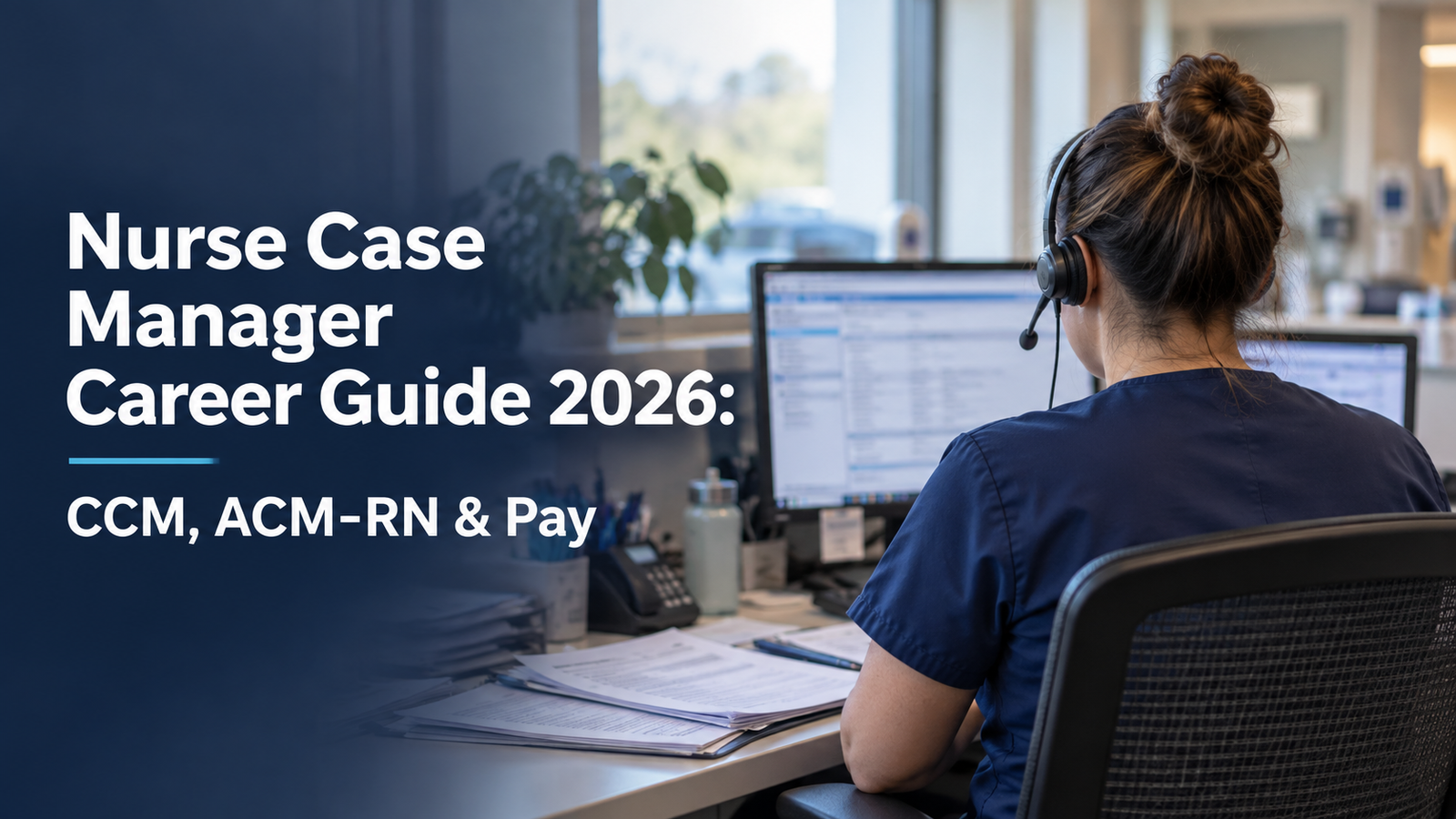
Telephone roles can be isolating. Insurer work often means a headset, a script of required questions, and call targets. Some nurses enjoy the calm. Others miss colleagues and patients within months.
Remote jobs are the hardest to get. They draw applicants from across the country, and most ask for prior case management or utilisation review experience.
Getting the first case management job
Employers usually ask for clinical experience first, often several years. Medical-surgical, intensive care, emergency, oncology, and home health backgrounds all transfer well, because the nurse already knows how patients move through the system.
Start where you are. Take an interest in discharge planning on your own unit. Learn what the case managers ask for and why. Volunteer for committees that deal with readmissions or length of stay. When an internal post opens, a nurse the case management team already knows has a clear advantage.
Hospital roles are the usual entry point. Insurer and remote roles tend to come later, once there is experience to show.
For nurses trained outside the United States
A US licence comes first. The CCM guide states that licences granted by countries outside the United States, Puerto Rico, or US territories are not accepted, and that case management practised in other countries does not count unless it took place in a US government facility. Experience abroad still helps at interview, but certification has to wait until you are licensed and working in the US.
What discharge looked like where I trained
In the government hospital where I worked, there was no case manager. Discharge planning was whatever the ward nurse could fit in before the next admission. We explained the medicines, wrote the follow-up date on the card, and hoped the family understood. It was common to see patients return soon afterwards. Often the cause was simple. Nobody had checked whether the medicine was available near their village, or whether anyone at home could change a dressing. The nurses knew this. We had no time and no role that made it our job. When I read about case management now, I recognise the work we were trying to do in the last ten minutes of a shift. Here it is a full-time post, with its own training and its own credential. That seems right to me.
Sources:
American Nurses Credentialing Center, Nursing Case Management Certification page, Program Update April 2026, nursingworld.org; Commission for Case Manager Certification, Certification Guide for the CCM Examination, February 2026, and certification FAQ and renewal pages, yourcommission.org; American Case Management Association, ACM Certification FAQ, acmaweb.org; Electronic Code of Federal Regulations, 42 CFR 482.43, ecfr.gov; Bureau of Labor Statistics, Occupational Outlook Handbook, Registered Nurses, May 2025 wage data, bls.gov.
This article gives career information about nurse case management in the United States. BLS does not report case manager pay separately, so the figure shown is the national median for all registered nurses, and actual salaries vary by employer, setting, and location. Certification fees, eligibility rules, and dates are set by ANCC, CCMC, and ACMA and can change; check each organisation’s website before applying. Nothing here is legal, insurance, or clinical advice. Information current as of October 2026.
Author

Discover more from Global Nurse Guide
Subscribe to get the latest posts sent to your email.