Infection Control Nurse Career Guide 2026: CIC, a-IPC and the Work Behind the Title
Infection Control Nurse Career Guide 2026: CIC, a-IPC and the Work Behind the Title
By Abirami Arumugam, RN, Chief Editor, GlobalNurseGuide.com
An infection control nurse does not carry a patient load. The job is to stop infections from spreading inside a hospital, nursing home, or clinic, and to prove with data that the prevention is working. In the United States the role is usually called infection preventionist. The main credential is the CIC from the Certification Board of Infection Control and Epidemiology, known as CBIC. Two things matter for anyone planning an infection control nurse career in 2026. The CIC does not require a US nursing licence, so nurses outside the US can earn it. And the exam outline is changing: CBIC lists November 10, 2026 as the last date to apply under the current one.
Why hospitals cannot run without this role
Infections picked up during care are common enough to be measured nationally. The Centers for Disease Control and Prevention reports that 1 in 38 hospital patients has at least one healthcare-associated infection on any given day. That figure comes from its 2023 hospital prevalence survey, which found 2.6% of hospitalised patients affected.
🩺 Join FREE WhatsApp Channel for Trusted Guide
Get weekly vacancy alerts, EB-3 visa updates & daily NCLEX prep on WhatsApp — FREE.
📲 Follow the ChannelFederal rules make the role mandatory. Hospitals that take Medicare patients must appoint an infection preventionist who is qualified through education, training, experience, or certification. The requirement sits in 42 CFR 482.42. Nursing homes fall under 42 CFR 483.80, which requires an infection preventionist who works at least part-time at the facility, has completed specialised training, and sits on the quality committee.
Those two rules explain the job market. Every hospital and every nursing home needs at least one person doing this work.
What the work looks like across a week
The role has no fixed bedside routine. Most infection preventionists divide their time among five kinds of work.
Surveillance
This is the core. The nurse reviews laboratory results, patient records, and device use to find infections linked to care. Central line infections, catheter-associated urinary tract infections, surgical site infections, and Clostridioides difficile cases are counted against strict definitions. US hospitals report many of these to the CDC’s National Healthcare Safety Network. A case either meets the definition or it does not, and deciding which can take real investigation.
Rounds and audits
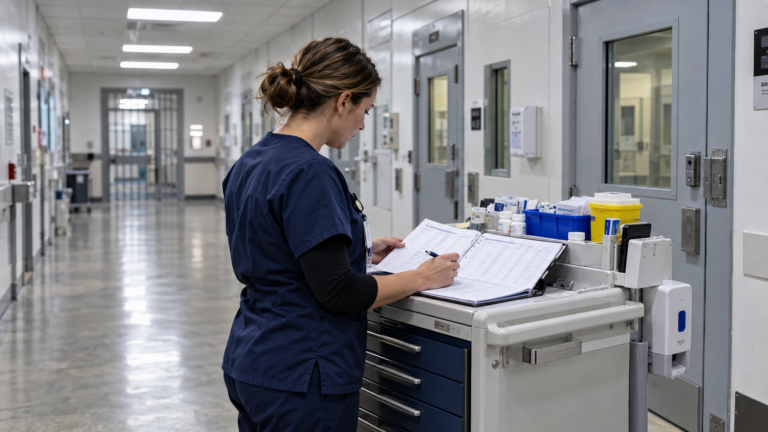
Infection preventionists walk the units. They watch hand hygiene, check how isolation precautions are followed, look at how equipment is cleaned, and inspect storage of sterile supplies. Findings go back to unit managers.
Outbreak response
When several patients on one unit develop the same organism, routine work stops. The nurse maps cases, looks for a common source, and recommends control measures. These days are long and unpredictable.
Teaching
New staff orientation, annual training, and on-the-spot coaching all fall to this role. Much of the job is explaining why a step matters to people who are busy and have heard it before.
Committees, construction, and policy
Infection preventionists write and update policies, report to the quality committee, and advise on building work. Renovation inside a hospital releases dust that can harm vulnerable patients, so the preventionist assesses the risk before work starts. They also work with sterile processing teams, employee health, and the pharmacists and physicians who lead antibiotic stewardship.
Two certifications, and who each one suits
CBIC offers an entry credential and a full one. Knowing the difference saves money.
a-IPC, the entry credential
The a-IPC is built for beginners. CBIC states there are no job-specific or education requirements, only an interest in the field. The exam has 100 multiple-choice questions, 85 of them scored, with a two-hour limit. Candidates cannot go back to earlier questions. The application costs USD 335. CBIC reports a 63% pass rate for 2025. An updated outline applies to a-IPC exams taken on or after May 22, 2026.
This credential suits a bedside nurse who wants to move into infection prevention but has not held the job yet.
CIC, the full credential
The CIC is for people already doing the work. CBIC’s handbook asks for post-secondary education in a health-related field such as nursing, medicine, laboratory technology, public health, or biology. Experience can be shown three ways: at least one year of full-time infection prevention work, two years part-time, or 3,000 hours earned in the previous three years.
The exam has 150 multiple-choice questions, with 135 used for scoring. It runs in two 90-minute sections with a break between them. A scaled score of 700 on a 300 to 900 scale is needed to pass. The fee is USD 445. In 2025, CBIC reports, 2,007 candidates sat the CIC and 64% passed. Anyone who fails must wait 90 days before a new eligibility period.
The current outline covers eight domains. The largest are surveillance and epidemiologic investigation, identifying infectious diseases, and preventing transmission. Smaller domains cover occupational health, programme management, education and research, environment of care, and cleaning, disinfection and sterilisation.
The 2026 changes to plan around
Three dates matter.
First, recertification changed on January 1, 2026. CIC holders renew every five years. They can now do so by earning 40 infection prevention units or by retaking the proctored exam. The open-book, untimed renewal exam that many older guides describe is no longer offered.
Second, the CIC outline is being updated. CBIC says candidates who want to test under the current outline must apply by November 10, 2026. It lists November 24, 2026 for the start of the beta process for the updated outline, with beta exams administered from March 1 to April 9, 2027. CBIC describes the changes as shifts in how questions are distributed across the content domains.
Third, anyone buying study materials should check which outline they follow. A book written for the current outline will not match the question distribution of the 2027 exam.
For a nurse who is already eligible and has been studying, applying before November 10 keeps the exam aligned with existing preparation. Confirm every date on cbic.org before paying, because CBIC sets the schedule and can revise it.
The route in for a bedside nurse
The CIC needs experience, and the experience needs the job. That circle frustrates many nurses. It can be broken in steps.
Start on your own unit. Many hospitals have infection control link nurses or unit champions who run hand hygiene audits and pass on updates. Volunteer for that role. Ask to attend the infection control committee as an observer.
Build the knowledge next. The a-IPC gives a structured syllabus and a credential that shows intent to a hiring manager.
Then apply for infection preventionist posts. Nursing homes are a realistic first employer, since federal rules require each one to have a trained preventionist. Some hospitals also hire nurses without the CIC and ask them to earn it later. Ask about that expectation at interview.
Clinical background helps. Nurses from intensive care, operating theatres, dialysis, and medical-surgical units already understand lines, catheters, wounds, and sterile technique, which is where most surveillance work concentrates.
Pay, and why BLS cannot tell you
The Bureau of Labor Statistics has no separate category for infection preventionists. Its closest benchmark is the national median for all registered nurses, which was USD 97,550 per year in May 2025. BLS projects 6% employment growth for registered nurses from 2025 to 2035.
Infection prevention posts are usually salaried weekday roles. That means no night differentials and little overtime pay. A bedside nurse who earns well through nights and extra shifts may not see a rise in the first year. The gain is in schedule, in physical load, and in a path toward quality, patient safety, and leadership roles.
What nobody mentions at the interview
You will be a team of one in many places. Small hospitals and nursing homes often employ a single preventionist, sometimes with other duties attached.
The work is persuasion without authority. An infection preventionist rarely manages the staff whose practice needs to change. Results depend on relationships, data, and patience.
Numbers are a large part of the day. Rates, denominators, and trend charts are central to the job. Nurses who dislike spreadsheets find the first year hard.
You will miss patients. Some nurses feel the loss of direct care sharply. Others are glad of it. It is worth knowing which you are before you leave the bedside.
Outbreaks do not respect office hours. The schedule is regular until the week it is not.
For nurses outside the United States
Many US nursing specialty credentials require a US licence. The CIC does not, which opens it to internationally educated nurses. CBIC treats candidates outside the US and Canada as international, and exams are delivered through Prometric, including remote proctoring. Check availability for your country when you apply.
India has its own framework. The Ministry of Health and Family Welfare’s National Guidelines for Infection Prevention and Control in Healthcare Facilities, published in January 2020, call for a minimum of one full-time infection control nurse per 250 beds. A nurse who holds that post in an Indian hospital is building the same experience the CIC asks for.
What I saw on the wards
In the government hospital where I worked, the infection control nurse was the person everyone recognised and few were pleased to see. She arrived with a clipboard, watched how dressings were done, and asked when the last hand wash was. Staff straightened up when she appeared and relaxed when she left. What struck me over the years was how much her influence depended on manner. Those who lectured were avoided. A few would stop to help with a difficult dressing and then mention the missed step quietly, and they changed how a whole ward worked. Knowledge is essential in this specialty. Whether it gets used depends on being able to correct a colleague without making an enemy.
Sources:
Centers for Disease Control and Prevention, HAI Hospital Prevalence Survey, 2023 data, cdc.gov; Electronic Code of Federal Regulations, 42 CFR 482.42 and 42 CFR 483.80, ecfr.gov; Certification Board of Infection Control and Epidemiology, CIC About the Examination page, Exam and Certification FAQ, a-IPC pages, and Candidate Handbook revised June 2025, cbic.org; Bureau of Labor Statistics, Occupational Outlook Handbook, Registered Nurses, May 2025 wage data, bls.gov; Ministry of Health and Family Welfare, Government of India, National Guidelines for Infection Prevention and Control in Healthcare Facilities, January 2020.
This article is career information for nurses and does not give clinical or infection control guidance for patient care. BLS does not report pay for infection preventionists separately, so the figure shown is the national median for all registered nurses and actual salaries depend on employer and location. CBIC fees, eligibility rules, exam dates, and outlines can change; confirm each one on cbic.org before applying. Follow your facility’s policies and your regulator’s standards in practice. Information current as of October 2026.
Author

Discover more from Global Nurse Guide
Subscribe to get the latest posts sent to your email.