CGFNS vs Josef Silny for Nurses 2026: Which Credential Evaluation Do You Need?
Updated May 17, 2026 • Reading Time: ~12 Minutes
You have passed the NCLEX. Your transcripts are ready. Now you are staring at two invoices: roughly $485 from CGFNS and $400 from Josef Silny. Both evaluate your nursing credentials for US licensure. Both produce a report your state board says it needs. One costs more. Both claim to be accepted. And nobody has clearly explained what happens if you pick the wrong one – which is that your state board rejects the report entirely, you start the process over with a new agency, pay a second fee, request new documents from your nursing school, and lose months.
That is the real cost of this decision, and it is why the comparison matters. CGFNS is accepted by every US state board of nursing. Josef Silny is accepted by approximately 26 to 32 state boards. If your target state is not on Josef Silny’s list, the evaluation is useless regardless of price or speed. This article gives you the full comparison – fees, processing times, state acceptance, the VisaScreen versus Visa4Nurses immigration certificate, and a clear decision matrix so you pay once and get it right.
🩺 Join FREE WhatsApp Channel for Trusted Guide
Get weekly vacancy alerts, EB-3 visa updates & daily NCLEX prep on WhatsApp — FREE.
📲 Follow the Channel📋 CGFNS vs Josef Silny – 2026 Quick Comparison
CGFNS CES Professional Report: ~$485 | accepted by ALL state boards
Josef Silny Course-by-Course: $400 | accepted by ~26–32 state boards
CGFNS Expedited Review: +$425 for 7-business-day processing
Josef Silny Rush: +$100 (10-day) or +$200 (5-day)
CGFNS VisaScreen: ~$540 (immigration certificate)
Josef Silny Visa4Nurses: comparable (immigration certificate)
NOT accepted by Josef Silny: California, New York, and others
Real bottleneck (both): 4–12 weeks for third-party documents
Rule: Verify your target state’s accepted evaluators BEFORE you pay
1. What Each Service Actually Does
Both CGFNS and Josef Silny perform the same fundamental function: they evaluate your non-US nursing education and credentials and produce a report that a US state board of nursing can use to determine whether your qualifications meet American standards. The report typically includes verification of your nursing degree, a course-by-course analysis comparing your curriculum to US requirements, and validation of your nursing licences.
CGFNS (Commission on Graduates of Foreign Nursing Schools) is the dominant evaluator in this space. Founded in 1977, it is a non-profit that specialises exclusively in healthcare credentials. Its CES Professional Report is accepted by every US state board of nursing. CGFNS also administers the VisaScreen certificate – the federal immigration screening required by Section 343 of the IIRIRA for nurses seeking US work visas. If you use CGFNS for both your CES report and your VisaScreen, the documents are already in their system, which speeds up the immigration certificate.
Josef Silny & Associates is a private credential evaluation firm based in Miami. It offers Nursing Course-by-Course evaluations for licensure and the Visa4Nurses certificate for immigration purposes. Visa4Nurses is recognised by USCIS as equivalent to VisaScreen. Josef Silny evaluates credentials for approximately 26 to 32 state boards – a substantial number, but not all of them.
The reports are not interchangeable. A state board that requires CGFNS will not accept a Josef Silny report, and vice versa. Using the wrong evaluator means paying twice and losing months. Always verify your target state’s accepted evaluators directly with the state board before you pay either agency.
2. The Cost Comparison
| Service | CGFNS | Josef Silny |
|---|---|---|
| Credential evaluation (licensure) | ~$485 (CES Professional Report) | $400 (Course-by-Course) |
| Additional state board report | Additional fee per state | $400 per additional state |
| Expedited/rush processing | +$425 (7 business days) | +$100 (10-day) / +$200 (5-day) |
| Immigration certificate | ~$540 (VisaScreen) | Comparable (Visa4Nurses) |
| State acceptance | All 50 states + DC + territories | ~26–32 state boards |
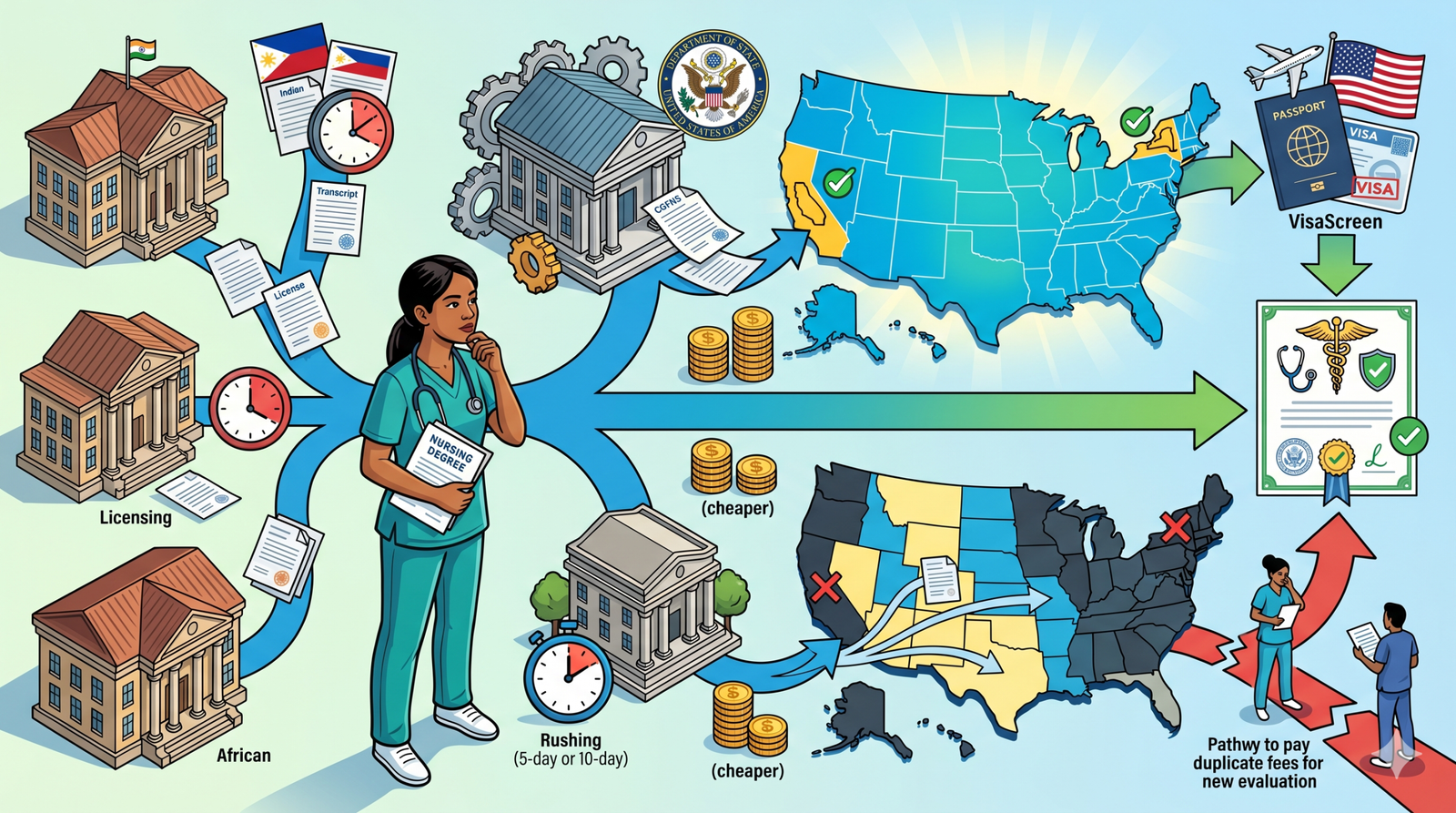
On paper, Josef Silny is slightly cheaper for the initial evaluation: $400 versus roughly $485. The rush options are also cheaper – $100 to $200 versus $425 for CGFNS expedited review. But the savings only matter if your target state accepts Josef Silny. If it does not, the $400 is wasted money and you pay CGFNS anyway – making the “cheaper” option the most expensive mistake you can make in this process.
One cost consideration that is easy to miss: if you plan to use CGFNS for both the CES report and the VisaScreen, documents already verified for the CES report carry over to the VisaScreen process. That saves you from requesting duplicate documents from your nursing school and licensing authority – which saves weeks, not just money. If you use Josef Silny for the CES and then need CGFNS for VisaScreen, you are submitting documents to two separate agencies and managing two separate timelines.
3. Processing Times – The Real Story
Both CGFNS and Josef Silny have improved their internal processing speeds significantly in recent years. CGFNS now processes CES reports within 7 business days once all required documents are received and verified. Josef Silny offers 5-day and 10-day rush options on top of standard processing.
Here is the part that matters more: neither agency controls the actual bottleneck.
Both require your nursing school to send official transcripts directly to the evaluator, and your home country’s nursing licensing authority to send licence verification directly. You cannot mail these yourself. The evaluator’s clock does not start until those documents arrive.
How long does that take? From Indian nursing schools: 4 to 12 weeks. From Philippine universities via postal service: 4 to 8 weeks. From Nigerian institutions: similar or longer. From UK or Australian regulators: typically faster, often 2 to 4 weeks.
The implication is stark: whether you choose CGFNS or Josef Silny, the total end-to-end timeline is dominated by how quickly your home institutions respond. Choosing a “faster” evaluator saves you days. Getting your document requests submitted early saves you months. Submit your transcript and licence verification requests the same day you open your evaluation application – not after.
4. Which States Accept Which – The Critical Map
This is the section that determines your choice. It is not about cost or speed. It is about whether your target state will accept the report.
CGFNS: accepted everywhere
Every US state board of nursing, plus DC and US territories, accepts the CGFNS CES Professional Report. There is no state where a CGFNS report will be rejected. This is the universal option.
Josef Silny: accepted in approximately 26–32 states
The following states have been reported as accepting Josef Silny evaluations (as of mid-2026, sourced from Josef Silny, IPASS Processing, and IntelliStaff Medical):
Alabama, Arizona, Arkansas, Colorado, District of Columbia, Florida, Hawaii, Idaho, Illinois, Indiana, Kentucky, Louisiana, Massachusetts, Michigan, Missouri, Montana, Nebraska, Nevada, New Hampshire, New Mexico, North Dakota, Oklahoma, Oregon, Pennsylvania, Puerto Rico, South Carolina, Texas, Utah, Vermont, Virginia, Washington, Wyoming.
States that do NOT accept Josef Silny (use CGFNS)
The notable exclusions include California and New York – two of the largest nursing markets and two of the most common gateway states for international nurses. Other states not on the Josef Silny list must be verified individually.
⚠️ Critical Warning
State acceptance lists change. A state that accepted Josef Silny last year may not accept it this year, and vice versa. Always verify directly with your target state board of nursing before paying for any evaluation. Call or email the board. Do not rely solely on the evaluator’s own website or on third-party lists – including this one. The board’s current policy is the only source that matters.
Special cases
New York does not use the standard CES Professional Report at all. New York requires the CGFNS Credentials Verification Service (CVS) – a separate product where CGFNS verifies documents and sends the report directly to the New York State Education Department (NYSED). The applicant does not receive a copy. Josef Silny is not accepted.
Texas – the Texas Board of Nursing’s own “Approved Credential Evaluation Service Providers” page lists CGFNS specifically. Some third-party sources list Josef Silny as accepted for Texas, but the safest approach is to verify directly with the BON at bon.texas.gov. If in doubt, CGFNS is the safe choice.
5. VisaScreen vs Visa4Nurses – The Immigration Certificate
Separate from the credential evaluation for state licensure, US immigration law (Section 343 of IIRIRA) requires internationally educated nurses to obtain a Certificate for Health Care Workers before receiving an occupational visa. Two agencies issue this certificate:
VisaScreen (issued by CGFNS): the original and most widely known healthcare worker screening certificate. Covers education verification, licence validation, English proficiency, and NCLEX pass verification. Standard processing cost is approximately $540. If you already completed a CES report through CGFNS, the VisaScreen process is significantly faster because the documents are already in their system.
Visa4Nurses (issued by Josef Silny): equivalent to VisaScreen and recognised by USCIS. Covers the same four domains. Priced comparably. Josef Silny has been developing a digital version of the certificate, following USCIS confirmation that digital certificates are accepted.
Both certificates are legally equivalent for immigration purposes. The practical advantage of VisaScreen is document reuse if you already went through CGFNS for your CES report. The practical advantage of Visa4Nurses is potentially faster turnaround if you used Josef Silny for your evaluation and your state accepts it.
For the full VisaScreen process: CGFNS VisaScreen Guide for Nurses.
6. The Decision Matrix – Which One to Use
Strip away the marketing and the decision is straightforward:
Use CGFNS if:
- Your target state is California, New York, or any state not on Josef Silny’s list
- You are not sure which state you will ultimately practise in (CGFNS works everywhere)
- You want both your credential evaluation and your VisaScreen handled by one agency with one document set
- You are applying to multiple states and want one report accepted by all of them
Use Josef Silny if:
- Your target state is confirmed on Josef Silny’s accepted list AND you have verified this directly with the state board
- You need rush processing (5-day or 10-day options are cheaper than CGFNS expedited)
- You are targeting a single state and are confident you will not need to change states later
The safe default: if you are unsure, CGFNS is always the safer choice. It is accepted everywhere, it feeds directly into the VisaScreen process, and it eliminates the risk of choosing an evaluator your state board later rejects. The $85 premium over Josef Silny is insurance against a mistake that costs $400 and months of your time.
One scenario where both agencies are involved: some nurses use Josef Silny for a state that accepts it (faster, slightly cheaper), then later decide to move to a state that only accepts CGFNS. In that case, you need a new evaluation from CGFNS – the Josef Silny report does not transfer. If there is any chance you will move states during your career, starting with CGFNS avoids this problem entirely.
7. Frequently Asked Questions
What is the difference between CGFNS and Josef Silny?
Both evaluate international nursing credentials for US licensure. CGFNS is accepted by all state boards; Josef Silny is accepted by approximately 26–32. CGFNS also offers VisaScreen; Josef Silny offers Visa4Nurses. Both immigration certificates are recognised by USCIS.
How much does each cost?
CGFNS CES: ~$485. Josef Silny Course-by-Course: $400. CGFNS expedited: +$425. Josef Silny rush: +$100 (10-day) or +$200 (5-day). VisaScreen: ~$540. Visa4Nurses: comparable.
Which is faster?
Internal processing is similar (CGFNS 7 days once docs received; Josef Silny offers 5-day rush). The real bottleneck is your home institution sending documents – typically 4–12 weeks from India, Philippines, Nigeria. That timeline is the same regardless of which evaluator you choose.
Does California accept Josef Silny?
No. California requires CGFNS.
Does New York accept Josef Silny?
No. New York requires the CGFNS CVS (Credentials Verification Service) – a separate product from the standard CES report.
Can I switch from Josef Silny to CGFNS later?
You can apply to CGFNS at any time, but you will need to pay the full fee and have your documents sent again. The Josef Silny report does not transfer to CGFNS. If there is any chance you will change states, starting with CGFNS avoids this.
Do I need both a credential evaluation AND a VisaScreen/Visa4Nurses?
Yes – they serve different purposes. The credential evaluation is for state licensure. The VisaScreen/Visa4Nurses certificate is for US immigration. You need both, but they can come from the same agency.
Which English tests are accepted?
Both agencies accept IELTS, TOEFL, OET, PTE Academic, Cambridge, MET, and TOEIC. CGFNS does not accept at-home versions of English tests. Always confirm the specific test your state board accepts – some boards are more restrictive than the evaluator.
The Bottom Line
The CGFNS versus Josef Silny decision is not really about cost or speed. It is about acceptance. CGFNS is accepted everywhere. Josef Silny is accepted in roughly two-thirds of US states. If your target state is on Josef Silny’s list and you have verified that directly with the state board, Josef Silny is a legitimate, slightly cheaper option with good rush processing. If your target state is not on the list, or if you are not certain which state you will end up in, CGFNS is the only safe choice.
The most expensive outcome is choosing the wrong evaluator and paying twice. The most avoidable delay is waiting to request documents from your nursing school. Whichever agency you choose, submit your transcript and licence verification requests on the same day you open your application. That is the step that actually determines how long this takes.
Related articles on GlobalNurseGuide.com:
CGFNS VisaScreen Guide for Nurses
Fast-Track US Nursing License for International Nurses 2026
NCLEX-RN Guide for Indian Nurses 2026
NCLEX Guide for Filipino Nurses
Nursing Jobs with Visa Sponsorship in USA 2026
UK vs Canada vs Australia for Nurses 2026
Disclaimer: This article is for informational purposes only and does not constitute professional, immigration, or licensing advice. Fees, processing times, and state board acceptance policies change frequently. The state acceptance list for Josef Silny is compiled from IPASS Processing, IntelliStaff Medical, and BridgeWay Firm as of mid-2026 and may not reflect the most current policies. Always verify accepted credential evaluation agencies directly with your target state board of nursing before paying for any evaluation. CGFNS fee schedule sourced from cgfns.org. Josef Silny fee information sourced from published third-party data. Consult an immigration attorney for visa-related decisions. GlobalNurseGuide.com is not affiliated with CGFNS, Josef Silny & Associates, or any credential evaluation agency. Information current as of May 17, 2026.
© 2026 GlobalNurseGuide.com – Empowering Nurses Worldwide with Real Opportunities
Author

Discover more from Global Nurse Guide
Subscribe to get the latest posts sent to your email.