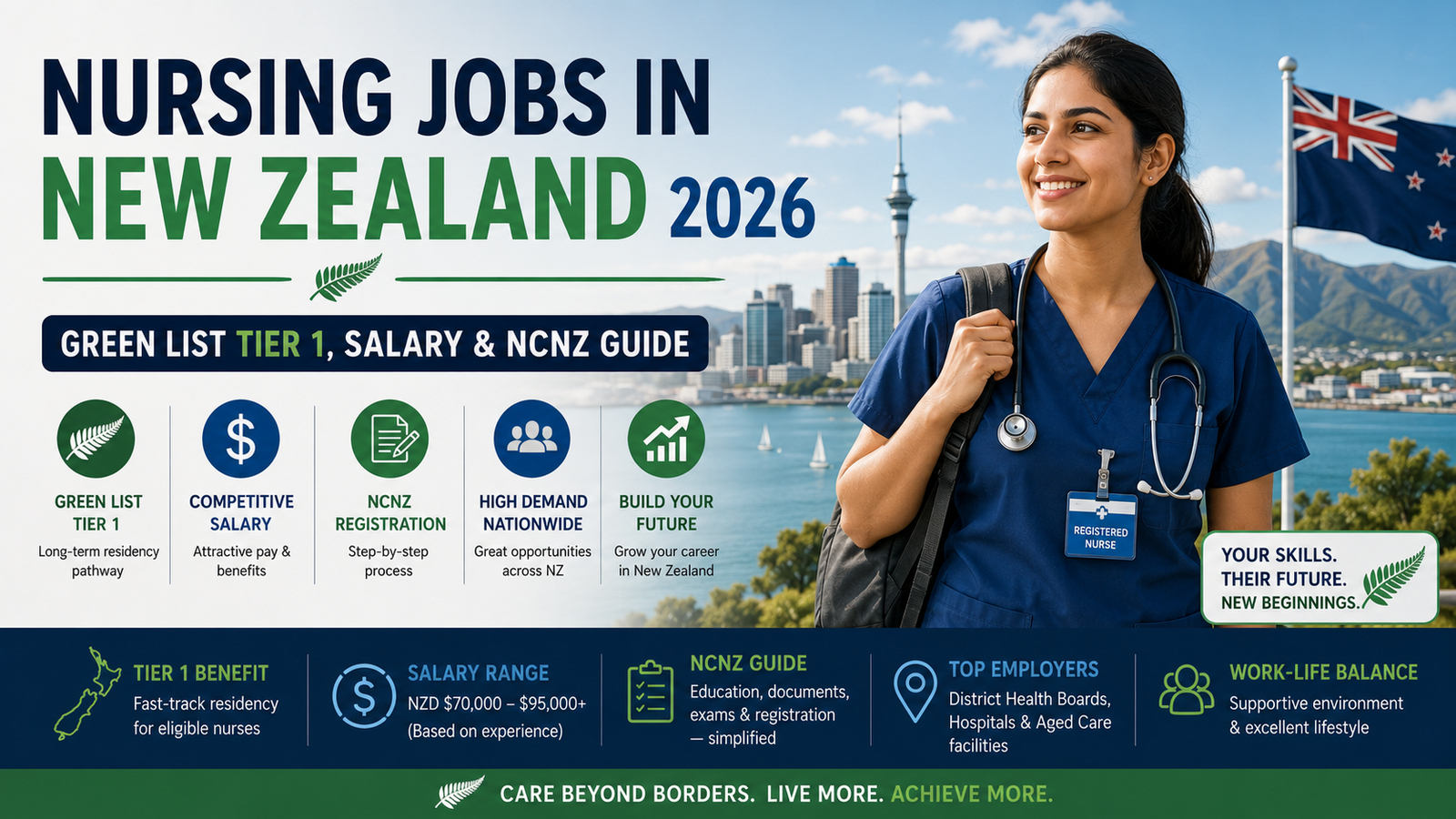
Nursing Jobs in New Zealand 2026: Green List Tier 1, Salary & NCNZ Guide
Updated June 8, 2026 • Reading Time: ~17 Minutes
Every destination guide for international nurses talks about pathways to permanent residency. Most of them mean a work visa that converts to PR after two years (Ireland), a points-based queue that takes 18 to 24 months (Canada), or a visa subclass lottery dependent on state nominations (Australia). New Zealand does something none of them do: Registered Nurse is a Green List Tier 1 occupation, which means that once you meet NCNZ registration requirements and secure a job offer from an accredited New Zealand employer, you can apply directly for residence — not a work visa, not a temporary permit, but residence from the start. No two-year wait. No points queue. No quota cap applying specifically to nurses.
That single fact makes New Zealand one of the most direct formal immigration pathways available to internationally educated nurses anywhere in the English-speaking world. The country also has a shortage of over 4,800 nurses, a standardised pay system set by collective agreement that gives every health board nurse the same rates, and a healthcare system that is actively building its international recruitment infrastructure. The trade-offs are real: Auckland’s cost of living competes with Dublin and Sydney, the registration process requires CGFNS verification and in most cases a supervised competency assessment, and the English standard (IELTS 7.0 with no band below 7.0) is stricter than the UK or Ireland. This guide covers all of it — what the Green List means in practice, the NCNZ registration steps, what nurses actually earn, and the honest comparison with Australia that most guides avoid making directly.
🩺 Going to the US as a nurse?
Get weekly vacancy alerts, EB-3 visa updates & daily NCLEX prep on WhatsApp — FREE.
📲 Follow the Channel🇳🇿 New Zealand Nursing 2026 — Verified Data
Nurse shortage: 4,800+ (ongoing, growing)
Green List status: Tier 1 — direct residence pathway (ANZSCO 254411)
Graduate RN salary: NZD $74,000–$76,000 (MECA rate, Te Whatu Ora)
Mid-career RN (4–9 yrs): NZD $79,000–$107,000
Senior/charge nurse: NZD $111,000–$163,000
Graduate salary in INR: ~₹37 lakh/year at June 2026 rates
Regulator: Nursing Council of New Zealand (NCNZ)
English requirement: OET Grade B all bands OR IELTS Academic 7.0 (no band <7.0)
CGFNS verification: Required before NCNZ application
Working week: 40 hours | generous annual leave
AEWV wage threshold: NZD $29.66/hour (~$61,700/year) as of April 2026
Realistic total timeline: 8–12 months to working and resident
1. The Green List Tier 1 — What It Actually Means
New Zealand’s immigration system uses a Green List to identify occupations the country needs urgently. The list has two tiers. Tier 2 occupations can apply for a work visa and then apply for residence after two years. Tier 1 occupations — including Registered Nurse — can apply for residence directly, without the two-year work-visa stage, as soon as they have an offer of full-time employment from an accredited employer and meet the relevant registration requirements.
The practical effect: a nurse who completes NCNZ registration and receives a job offer from a New Zealand public health employer can submit a residence application immediately. If the residence application is approved, they arrive in New Zealand as a resident from day one — not as a temporary worker building toward eventual permanence.
Compare this to the alternatives:
Ireland: Stamp 4 permanent status after two years on a Critical Skills Employment Permit. Two years minimum, then application. New Zealand: direct residence from the first job offer if requirements are met.
Canada: Express Entry healthcare draws at CRS 462 to 476, 18 to 24 months end-to-end from NNAS to ITA to PR processing. New Zealand: shorter timeline if NCNZ registration proceeds cleanly.
Australia: Subclass 189 (independent) requires points testing and has quota constraints; 190 requires state nomination; 482 is temporary and converts to 186 after two to three years. New Zealand: Tier 1 is a direct residence pathway with no quota applying specifically to nurses.
The honest caveat: the residence application itself takes time to process, and meeting the requirements — particularly NCNZ registration, which takes three to four months with complete documents — is the prerequisite. The Tier 1 advantage is in removing the work-visa stage, not in eliminating the registration requirements or eliminating processing time entirely.
2. The NCNZ Registration Process — Step by Step
Registration with the Nursing Council of New Zealand is the gateway. All applications from internationally educated nurses go through the IQN (International Qualifications in Nursing) portal.
Step 1 — CGFNS credential verification. Before applying to NCNZ, you must have your credentials verified by CGFNS. NCNZ requires this as a primary-source verification of your nursing qualification, licensure, and clinical experience. Cost: approximately $300 USD. Processing: 4 to 8 weeks once your university and home regulator send documents directly to CGFNS. The same delay pattern applies as for the US pathway: the bottleneck is not CGFNS but how quickly your institution responds to the document request. Submit transcript and registration verification requests on the day you open your CGFNS application.
Step 2 — NCNZ qualification assessment. Submit your CGFNS verification report, academic transcripts, clinical hour documentation, and registration history to NCNZ through the IQN portal. Fee: approximately NZD $400 to $600. NCNZ assesses your education against New Zealand entry-to-practice competency standards. Two outcomes are possible: your qualification is assessed as meeting the standards (you progress to Step 4) or NCNZ identifies gaps and requires a Competency Assessment Programme (Step 3).
Step 3 — CAP (if required). The Competency Assessment Programme is a supervised clinical placement at an approved New Zealand healthcare facility, typically lasting 8 to 12 weeks. An NCNZ-approved assessor observes your practice and determines whether you meet New Zealand competency standards. Most employers who recruit internationally will arrange and fund the CAP as part of the employment offer — you receive a salary during the CAP period. Completing the CAP successfully leads to full registration. It is the standard pathway for the majority of internationally trained nurses entering the New Zealand system, not a rare exception.
Step 4 — English language verification. NCNZ requires OET Grade B in all four components (listening, reading, writing, speaking) or IELTS Academic 7.0 with no individual band below 7.0. This is stricter than the NMC (UK) standard, which allows 6.5 in writing. Take the test early. NCNZ does not accept at-home test formats.
Step 5 — Culturally safe nursing courses. New Zealand requires all internationally educated nurses to complete two specific free online courses before registration is granted: one on culturally safe practice in New Zealand’s healthcare context, and one focused on Te Tiriti o Waitangi (the Treaty of Waitangi) and its relevance to nursing. Both are available at no cost and can be completed online before you arrive in New Zealand. Upload the completion certificates to the NCNZ IQN portal.
Step 6 — International Criminal History Check (ICHC). Facilitated through Fit2Work, an accredited agency. Checks your criminal history in every country you have lived in for 12 or more months. This is a standard clearance requirement and takes 1 to 4 weeks depending on the countries involved.
Step 7 — Registration granted. Once all requirements are met, NCNZ issues your Annual Practising Certificate (APC). You are now able to work as a Registered Nurse in New Zealand and eligible to apply for the Green List Tier 1 residence pathway.
Total NCNZ timeline: 3 to 4 months with complete documentation. The same advice applies as for every credential evaluation process: the document collection stage is where time is lost. Start your CGFNS verification before you apply to any employer. Everything else can run in parallel.
3. What You Will Earn — The MECA Rates
New Zealand public health nursing pay is governed by the MECA (Multi-Employer Collective Agreement), negotiated by NZNO (New Zealand Nurses Organisation) and Te Whatu Ora (Health New Zealand). Every public hospital and health board pays the same standardised rates. There is no variation between Auckland City Hospital and a rural hospital in Southland — the pay scale is identical. The differences are in cost of living and scope of practice, not in the pay rate itself.
| Experience Level | Annual Salary (NZD) | Approx. INR/year |
|---|---|---|
| Graduate RN (0–3 years) | NZD $74,000–$76,000 | ₹37–38 lakh |
| Mid-career RN (4–9 years) | NZD $79,000–$107,000 | ₹39.5–53.5 lakh |
| Senior RN (10+ years) | NZD $111,000–$163,000 | ₹55.5–81.5 lakh |
| Nurse Practitioner | NZD $133,000–$163,000 | ₹66.5–81.5 lakh |
The base rate is supplemented by: weekend and public holiday premiums, night-shift allowances, on-call payments, and rural location supplements for nurses working in remote areas. Most full-time nurses working a standard rotating roster take home notably more than the base figure after premiums.
New Zealand has a progressive income tax system (called PAYE). On NZD $74,000, the effective tax rate is approximately 23 to 25 percent after the low-income earner rebate. Take-home pay on a NZD $74,000 salary is approximately NZD $56,000 to $57,000 per year, or NZD $4,700 per month. That is the number to measure against rent.
4. The Auckland Reality — and the Regional Alternative
Auckland is New Zealand’s largest city and its primary economic and healthcare centre. Auckland City Hospital, Middlemore Hospital, Starship Children’s Hospital, and the Waitematā and Counties Manukau district health services are all in or near Auckland. The clinical variety and career development opportunities are the best in the country.
The cost is proportional. Rent for a one-bedroom apartment in Auckland commonly runs NZD $2,000 to $2,800 per month in desirable areas. On a graduate nurse take-home of NZD $4,700 per month, that leaves NZD $1,900 to $2,700 for everything else — food, transport, student loan repayments, savings, and any remittances to family abroad. It is manageable, particularly with flatmates, but it is not the comfortable financial margin that the salary headline suggests.
Outside Auckland, the picture changes meaningfully. Christchurch, the country’s second largest city, has strong healthcare infrastructure (Canterbury District Health Board, Christchurch Hospital) and rents of NZD $1,400 to $1,900 per month. Hamilton (Waikato), Wellington, Dunedin, Tauranga, and Nelson all offer the same MECA pay rates with rents 30 to 45 percent below Auckland levels. For an internationally trained nurse arriving in New Zealand, the financial case for starting in a regional centre rather than Auckland is strong — and the clinical experience at regional hospitals is substantive, not a compromise.
Rural and remote areas offer additional premiums on top of MECA rates and often provide employer-arranged accommodation. For nurses willing to work in rural primary healthcare, some community health centres, and district nursing roles, the total compensation package can exceed what a hospital position in a main centre provides.
5. Major Employers
Health New Zealand (Te Whatu Ora). The unified public health system, formed in 2022 from the merger of 20 district health boards. The largest employer of nurses in New Zealand, operating public hospitals in every region. Te Whatu Ora runs an international nurse recruitment programme and provides structured support for overseas-trained nurses including CAP coordination.
Counties Manukau and Waitematā District Services (Auckland). The largest clinical environments in the country for specialist and high-acuity nursing. Auckland City Hospital is a Level 1 trauma centre and teaching hospital.
Canterbury District Health Services (Christchurch). Strong academic medical centre, home to Christchurch Hospital, and one of the most active regions for internationally recruited nurses.
Waikato District Health (Hamilton). Active international recruitment. Waikato Hospital is a tertiary referral centre for the Waikato and Bay of Plenty regions.
Private employers and aged care. A significant portion of the nursing workforce works in private hospitals and residential aged care. Private employers are not bound by MECA rates and pay varies, but they often recruit faster than the public system and may provide relocation support. Aged care facilities in particular face acute shortages and have lower competition for positions.
6. New Zealand vs Australia — The Honest Comparison
Most internationally trained nurses considering Australasia compare these two destinations, and most comparisons favour Australia on salary. The full picture is more nuanced.
| Factor | New Zealand | Australia |
|---|---|---|
| Graduate salary | NZD $74,000 | AUD $85,000 |
| PR pathway speed | Direct residence (Tier 1) | 482→186 (2–3 yrs) or 189/190 |
| Registration pathway (non-comparable) | NCNZ (3–4 months + CAP) | AHPRA OBA (can be longer) |
| Cost of living (regional) | Lower outside Auckland | Higher in most metros |
| English requirement | IELTS 7.0 (no band <7.0) | IELTS 7.0 (no band <7.0) |
| 189 visa status (Australia) | — | Quota exhausted 2025–26; Tier 1 priority |
The summary: Australia pays more in absolute salary terms. New Zealand offers a faster direct route to permanent residence and has a registration process that, while rigorous, does not include the same two-stage CBT+OSCE model as the UK or the IQRN comparable-jurisdiction bifurcation of Australia’s AHPRA. For nurses from countries whose qualifications are not on AHPRA’s comparable-jurisdiction list — India, Nigeria, the Philippines — New Zealand’s NCNZ CAP pathway may actually be faster than AHPRA’s outcomes-based assessment. This is the comparison most guides miss.
For the full Australia guide: Nursing Jobs in Australia 2026. For the broader multi-country comparison: UK vs Canada vs Australia for Nurses 2026.
7. The Honest Trade-Offs
The salary is lower than Australia. NZD $74,000 is not AUD $85,000. The currency difference and the absolute salary gap are real. For nurses whose primary goal is the highest possible early-career income, Australia or the Gulf still hold advantages in raw financial terms.
Auckland will pressure your budget. The MECA rate is the same everywhere. Auckland rents are not. If Auckland is your target, go in knowing the numbers: NZD $2,000 to $2,800 per month is the reality, not an outlier. Budget accordingly, consider flatmates, and know that regional centres offer a substantially better financial quality of life on the same salary.
The CAP is the norm, not the exception. Most internationally trained nurses from India, the Philippines, Nigeria, and other non-comparable-jurisdiction countries are directed to complete a CAP before full registration. This is standard, employer-funded, and salaried. It adds 8 to 12 weeks to the timeline. Plan for it rather than being surprised by it.
New Zealand is a smaller country. With a population of 5.3 million, the healthcare system is smaller and less diverse than Australia’s, the UK’s, or the US’s. Sub-specialist nursing roles and narrow clinical niches are concentrated in Auckland and to a lesser degree Christchurch and Wellington. If your goal is a highly specialised career in paediatric cardiac surgery or level-four cancer research nursing, check whether that specific role exists in the New Zealand context before committing.
The lifestyle advantage is genuine. New Zealand consistently rates among the highest countries globally for natural environment, social wellbeing, and quality of life. Nurses who have relocated there describe work-life balance that compares favourably with the UK, Ireland, and most US urban markets. This is not a marketing claim — it is reflected in staff retention rates that outpace most comparable destinations.
8. Frequently Asked Questions
What is the Green List Tier 1 for nurses?
Registered Nurse is Tier 1 on New Zealand’s Green List — meaning direct residence with a job offer from an accredited employer and NCNZ registration. No two-year work-visa stage. Fastest formal PR pathway in the English-speaking world for nurses.
How much do nurses earn in New Zealand?
NZD $74,000–$76,000 starting (MECA rate); NZD $79,000–$107,000 mid-career; NZD $111,000–$163,000 senior. Standardised across all public employers. ~₹37 lakh/year at graduate entry.
How long does NCNZ registration take?
3–4 months with complete documentation. Start CGFNS verification first — it runs concurrently with NCNZ but takes 4–8 weeks for documents from your university and home regulator.
Do I need IELTS or OET?
OET Grade B all four components or IELTS Academic 7.0 with no band below 7.0. Strict standard. No at-home test formats accepted. OET vs IELTS comparison here.
Is New Zealand better than Australia for Indian nurses?
Australia pays more. New Zealand offers faster direct residence and may have a simpler registration pathway for nurses from non-comparable-jurisdiction countries. The right answer depends on which you prioritise: salary or residence speed.
What is the Competency Assessment Programme?
An 8–12 week supervised clinical placement at an approved NZ facility, required if NCNZ identifies gaps between your training and NZ standards. Standard pathway for most IENs. Paid by your employer. Leads directly to full registration.
Is Auckland expensive?
Yes — NZD $2,000–$2,800/month for a one-bedroom. Same MECA salary applies in Christchurch, Hamilton, Wellington, Dunedin at NZD $1,200–$1,800 rent. Strong case for starting regionally.
The Bottom Line
New Zealand offers something unique among English-speaking destinations: the combination of an acute nurse shortage, a standardised and fair pay system, and a direct-to-residence immigration pathway that does not require nurses to spend years in temporary status. The Green List Tier 1 status means that once you hold NCNZ registration and a job offer, you are not building toward permanence — you are applying for it from day one.
The path to get there requires CGFNS credential verification, NCNZ registration (which in most cases includes a CAP placement), a strict English test, and culturally safe nursing coursework. The total timeline for a prepared, well-documented applicant is 8 to 12 months — comparable to Ireland and faster than Canada and most Australian permanent residence pathways for nurses from non-comparable-jurisdiction countries.
Start CGFNS verification first. Take OET early. Research the regional centre that best suits your life alongside your nursing career. New Zealand rewards nurses who arrive prepared and flexible about location. The Auckland premium is real; the regional advantage is equally real. And the direct-to-residence pathway that most guides underreport is the most compelling reason to take this destination seriously.
Related articles on GlobalNurseGuide.com:
Nursing Jobs in Australia 2026
UK vs Canada vs Australia for Nurses 2026
NCLEX-RN Guide for Indian Nurses 2026
NCLEX Guide for Filipino Nurses
Disclaimer: This article is for informational purposes only and does not constitute immigration, legal, or career advice. NCNZ registration requirements, Green List immigration rules, and MECA salary rates are subject to change and are determined by NCNZ, Immigration New Zealand, and Te Whatu Ora (Health New Zealand) respectively. Salary figures are sourced from Te Whatu Ora MECA rates (April 2026) and kiwifern.com salary data. Cost of living figures are indicative estimates as of June 2026. Currency conversions are approximate at June 2026 rates. Always verify current immigration rules at immigration.govt.nz, registration requirements at ncnz.org.nz, and MECA rates with your prospective employer before making decisions. GlobalNurseGuide.com is not affiliated with NCNZ, Immigration New Zealand, Te Whatu Ora, or any recruitment agency. Information current as of June 8, 2026.
© 2026 GlobalNurseGuide.com — Empowering Nurses Worldwide with Real Opportunities
Author

Discover more from Global Nurse Guide
Subscribe to get the latest posts sent to your email.