Home Health Nursing Career Guide 2026: Salary, OASIS, and What Autonomy Actually Means
Home Health Nursing Career Guide 2026: Salary, OASIS, and What Autonomy Actually Means.
By Abirami Arumugam, RN, Chief Editor, GlobalNurseGuide.com
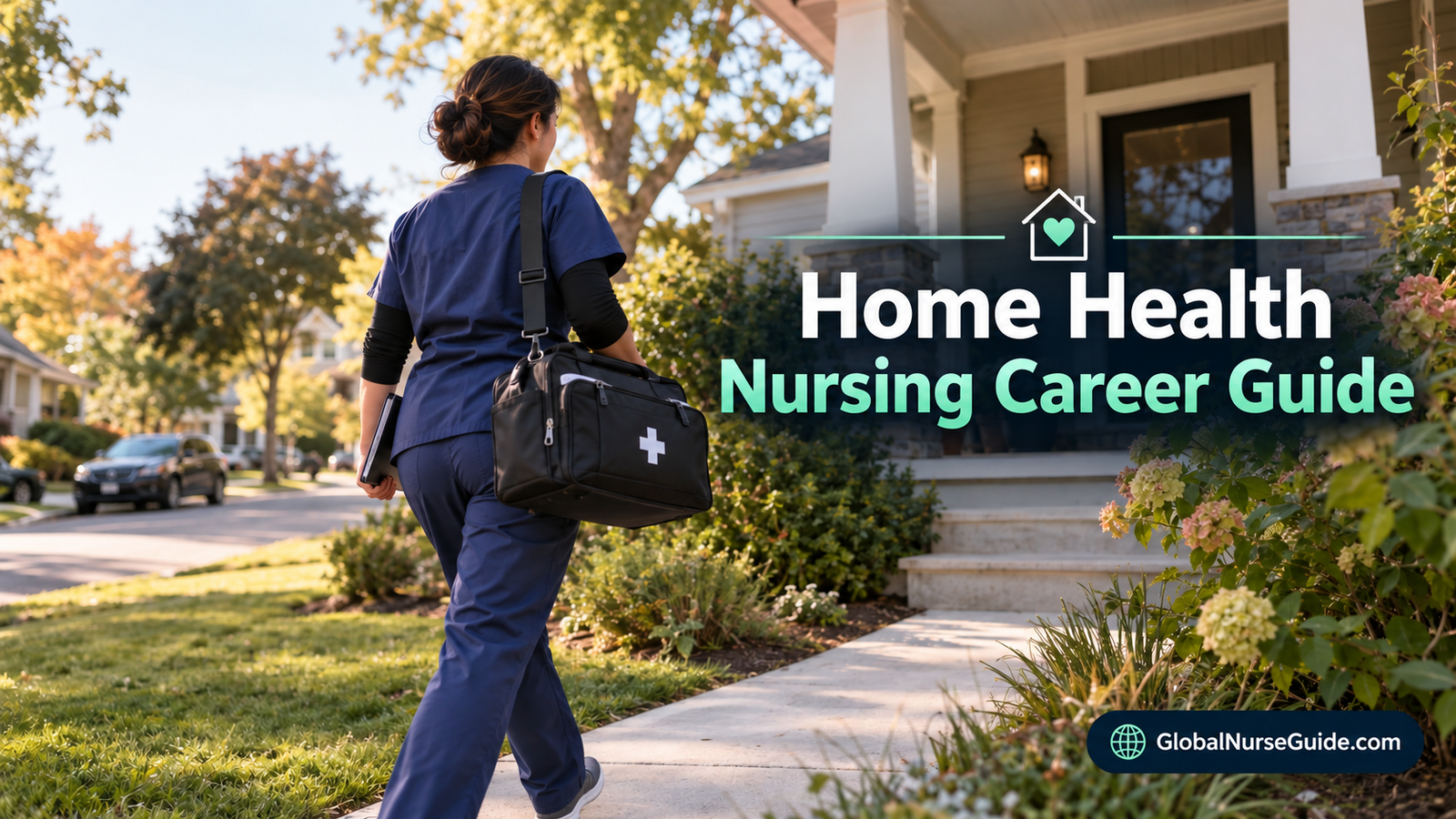
Home health nursing offers something few hospital nursing roles do: complete clinical autonomy. When a home health nurse walks into a patient’s house, there is no charge nurse down the corridor. No attending physician three floors up. No rapid response team within reach. The assessment happens, the clinical decision happens, and the documentation happens, all of it driven by one nurse in a residential setting. That autonomy is the reason experienced nurses move into home health and stay for decades. It is also the reason the role requires a foundation of acute care experience before it is safe to take on independently. This guide explains what home health nursing actually involves and why the OASIS documentation requirement is more significant than most nurses expect. The pay structure and the CMS regulatory framework that shapes every visit follow.
What home health nurses do, and for whom
A home health nurse provides skilled nursing care to patients who are medically homebound. That is a specific CMS-defined status, not a general description. The patient must also require skilled services that cannot reasonably be obtained in an outpatient setting. The patient population is predominantly older adults recovering from surgery, managing chronic conditions, or requiring post-acute care after a hospital discharge. It also includes adults of any age with wound care needs, IV therapy requirements, complex medication regimens, or new diagnoses requiring intensive education.
🩺 Going to the US as a nurse?
Get weekly vacancy alerts, EB-3 visa updates & daily NCLEX prep on WhatsApp — FREE.
📲 Follow the ChannelA standard home visit runs 45 to 90 minutes depending on the visit type and patient complexity. A skilled nursing visit for a post-surgical wound covers wound assessment, dressing change, documentation of wound dimensions, patient and caregiver education, medication review, and vital signs. If timing requires it, OASIS data collection falls within the same visit. Each component is clinical. The education component requires assessing what the patient and caregiver retained from the previous visit. Barriers to adherence need identifying. The teaching approach adjusts accordingly.
Wound care is the dominant clinical skill in home health nursing. Nurses from medical-surgical or acute care backgrounds quickly find their wound care knowledge tested in ways a busy hospital shift rarely required. No wound care nurse is down the hall to consult. Assessment, dressing selection, the decision to escalate to the physician, and the documentation supporting that decision are all made by one nurse. In the patient’s home. With what is in the visit bag.
IV therapy management in home health covers infusion therapy for antibiotics, hydration, and total parenteral nutrition. Patients who have completed their inpatient course and are continuing infusion treatment at home are increasingly common as hospital length of stay has shortened. The home health nurse assesses the access site and troubleshoots infusion problems. Monitoring for complications continues between visits, as does educating the patient or caregiver on home infusion management.
The OASIS-E requirement: why it matters more than most nurses expect
OASIS stands for Outcome and Assessment Information Set. It is a standardised patient assessment tool required by the Centers for Medicare and Medicaid Services for all Medicare and Medicaid-certified home health agencies. OASIS-E, the current version effective January 1, 2023, contains more than 100 data items covering functional status, clinical condition, service utilisation, and discharge information.
The OASIS is completed at the start of care, at every 60-day recertification, and at discharge. It is also triggered by hospitalisation, return from hospitalisation, and other significant status changes. A home health nurse completes multiple OASIS assessments per week.
The reason OASIS matters beyond documentation compliance is financial. CMS’s Patient-Driven Groupings Model replaced the older home health payment system on January 1, 2020. Each 30-day billing period is paid based on the patient’s clinical grouping and functional level. Both are derived from OASIS data. Both of those are derived from the OASIS data the nurse documents. Section GG of OASIS-E, which covers self-care and mobility, directly influences the functional level that determines payment. A nurse who documents Section GG inaccurately, whether too conservatively or too generously, produces a payment that does not match the patient’s actual clinical picture.
CMS audits home health agencies on OASIS accuracy. Agencies with consistently inaccurate OASIS documentation face recoupment of Medicare payments and potential exclusion from the programme. That makes OASIS training a compliance and financial issue for the agency, not merely a documentation skill for the individual nurse.
Home health nurses who come from hospital backgrounds find OASIS one of the steeper learning curves in the specialty. Hospital nurses document in EHR systems built around orders and charting. OASIS is a structured assessment tool with specific definitions for each data item that differ from conversational clinical description. A patient who states that they “sometimes” need help getting out of bed maps to a specific OASIS code, not to a nursing judgment call. Learning the OASIS definitions precisely, and applying them consistently, takes deliberate practice.
What CMS requires before a home health visit can be covered
Medicare covers home health nursing under specific conditions set by CMS. Every home health nurse needs to understand these conditions because they determine whether the care is billable and whether the documentation supports continued authorisation.
Homebound status means the patient has a condition that restricts their ability to leave home and that leaving home requires considerable effort. CMS defines this precisely. A patient who can walk to the mailbox freely is not homebound. A patient who can only leave home with significant assistance and has a medical reason that makes leaving an effort meets the standard. The home health nurse documents homebound status at every visit. Missing or insufficiently documented homebound status is one of the most common reasons for Medicare claim denial.
The face-to-face encounter requirement means a physician or allowed non-physician practitioner must have seen the patient in person for the condition requiring home health. The encounter must occur within 90 days before or 30 days after the start of care. The physician certifies that the patient qualifies for home health and documents the clinical need. The home health nurse does not make this certification. The nurse verifies it is in place and that the physician’s clinical documentation supports what the nurse sees in the patient’s home.
Skilled care requirement means Medicare pays only for care that requires the skill of a licensed professional. Custodial care, such as helping a patient with bathing, dressing, or meals when no skilled clinical need is present, is not Medicare-covered home health. Every nursing visit note must demonstrate a skilled service. A visit confirming only that vital signs are stable and the medication regimen unchanged, with no clinical need requiring skilled assessment, is not a skilled visit. Claims without documented skilled services face denial. Claims for visits without documented skilled services are subject to denial.
Salary: what the numbers actually show
BLS OES May 2024 puts the national median annual wage for registered nurses at USD 93,600 across all settings and industries. BLS does not publish a separate figure specifically for home health nursing. Nurses in the home health care services sector historically earn wages below the hospital RN mean. Hospital pay structures reflect shift differentials, acute care complexity, and union agreements that home health employment typically does not carry.
Industry data from 2026 sources places home health RN compensation between USD 70,000 and USD 100,000 annually. Agency type, location, patient volume, and pay structure all move the figure. Those figures are from employer job postings and compensation surveys, not from a BLS primary source with home-health-specific methodology.
The pay structure itself deserves specific attention. Many home health agencies compensate nurses on a per-visit basis rather than hourly or salary. A standard skilled nursing visit might be paid at USD 55 to USD 80. A nurse completing six visits per day earns USD 330 to USD 480 for that day’s work. At full capacity across a five-day week, that produces USD 1,650 to USD 2,400 weekly. The per-visit model rewards efficiency. It does not pay for windshield time, documentation completed outside the patient’s home, or hours spent on calls with physicians and care coordinators. Nurses evaluating per-visit employment should ask specifically how the agency handles documentation time, travel reimbursement, and missed or cancelled visits.
Salaried and hourly home health positions also exist, particularly at hospital-affiliated home health agencies and larger national home health companies. These positions typically carry benefits and a predictable income structure. The trade-off is lower total compensation ceiling compared to a high-volume per-visit nurse. Signing bonuses of USD 5,000 to USD 10,000 are common at agencies facing recruitment pressure. Retention bonuses tied to visit hour thresholds follow for nurses who stay beyond the first six to twelve months.
The experience requirement and who is ready for this role
Home health nursing is not a first nursing job. The autonomy that makes the specialty appealing is the same feature that makes it unsafe for a nurse without a foundation in acute clinical assessment.
Most home health agencies require one to two years of acute care experience before hire. Medical-surgical experience is the most commonly cited baseline. ICU, telemetry, and wound care experience are valued for the clinical skills they develop. A nurse fresh from nursing school is not positioned for home health’s independent clinical demands. The ability to recognise what is wrong before the data confirms it develops in settings where colleagues and supervisors can catch early misreads. Home health removes that safety net.
The exception is experienced nurses from other countries who hold documented acute care experience and are transitioning into the US healthcare system. Home health agencies in areas with nursing shortages sometimes place internationally educated nurses with verified acute care backgrounds into structured home health orientation programmes. OASIS training, the CMS regulatory framework, and US documentation standards are unfamiliar to every nurse new to the US home health environment. Clinical background does not change this. Orientation that covers these specifically, not assuming prior knowledge, is a necessary feature of any credible agency’s onboarding.
What working alone in a patient’s home actually looks like
The practical realities of home health nursing are specific and worth stating plainly, because they do not appear in most job descriptions.
The visit environment is not controlled. Patient homes vary from well-maintained suburban houses to apartments with narrow access, difficult parking, and unpredictable conditions. Pets are present in a significant portion of home visits, and not all of them are secured. Safety protocols for home visiting are part of professional practice in this specialty. How to assess a visit environment before entering, when to leave, and how to report a safety concern should be covered in every agency’s orientation.
Documentation happens in real time during the visit, in the car before the next visit, or at the end of the day. Agencies that use point-of-care tablet or mobile documentation systems expect documentation to be completed before the nurse moves to the next patient. Incomplete or next-day documentation is a compliance risk. Nurses who work in high-volume per-visit roles in this specialty are often completing documentation across twelve-hour windows that include evening and weekend catch-up. The flexibility in scheduling that draws many nurses to home health does not always translate to shorter working days.
Case coordination is a significant component of the role that new home health nurses often underestimate. After each visit, the home health nurse communicates findings to the supervising physician or nurse practitioner. Coordination with physical and occupational therapists follows. The care coordinator gets a status update. Where a family caregiver is involved, they get a call too. That coordination is clinical work. It is unpaid in most per-visit structures.
Career directions beyond home health bedside nursing
Home health case management is the most common first career step beyond direct-visit nursing. Case managers coordinate care across a caseload of patients, manage authorisations, and supervise field nurses. The role requires less travel and more phone and EHR work. Many experienced home health nurses move into case management after five or more years of field practice.
Wound care specialisation is a natural direction for nurses who find the clinical complexity of wound management engaging. The Wound, Ostomy and Continence Nursing Certification Board offers board certifications including the CWOCN for nurses with advanced wound care competencies. Home health experience provides the clinical foundation. The certification adds credential and in most agencies a direct pay differential.
Director of Nursing positions at home health agencies manage clinical quality, regulatory compliance, OASIS accuracy, and staff oversight. These roles require clinical experience in home health and are often the endpoint of the case management track. They carry a different skill set from bedside nursing and are appropriately positioned as management rather than clinical roles.
Some home health nurses move toward hospice nursing. The practical realities are similar: autonomous home visits, family education, documentation intensity. The focus shifts specifically to end-of-life care. The crossover is natural, and the CHPN credential from the Hospice and Palliative Nurses Association applies to nurses working in both settings.
What this specialty takes from a nurse over time
I encountered home health nurses most often when they returned to acute care for short contracts. Over more than two decades in hospital nursing, that pattern repeated. Those who had left for home health described the move the same way: they had chosen to practice nursing on their own terms. Years in a system that made that difficult had preceded it. What I noticed in the ones who thrived was not just clinical confidence. It was a specific relationship with documentation. An accurate clinical note is the only thing standing between a patient’s covered care and a retroactive denial. Home health nurses who treat documentation as a formality do not last in the specialty. The ones who understand that the note is the visit build sustainable careers there. What cannot be documented cannot be defended. It cannot be billed. In regulatory terms, it did not clinically occur.
Sources:
Bureau of Labor Statistics Occupational Employment and Wage Statistics, May 2024, Registered Nurses (29-1141), bls.gov; Centers for Medicare and Medicaid Services, OASIS-E implementation effective January 1, 2023, cms.gov; CMS Home Health Conditions of Participation, 42 CFR Part 484, cms.gov; CMS Patient-Driven Groupings Model (PDGM), cms.gov; Hospice and Palliative Nurses Association, hpna.advancingexpertcare.org, CHPN certification requirements; Wound, Ostomy and Continence Nursing Certification Board, wocncb.org.
Salary figures from BLS OES May 2024 represent the national median for registered nurses across all industry sectors. BLS does not publish a separate home health nursing salary category. Industry compensation data cited above from third-party employment platforms is indicative and based on active job postings and self-reported figures; actual compensation varies by agency type, pay structure, geographic location, patient volume, and individual experience. Per-visit pay rates reflect market ranges and will vary by employer and region. This article is for career information purposes only. For regulatory guidance specific to your state, consult your state Board of Nursing and your agency’s compliance officer.
Author

Discover more from Global Nurse Guide
Subscribe to get the latest posts sent to your email.