Nurses Are Being Asked to Use AI Tools They Don’t Trust – and Were Never Trained On
Nurses Are Being Asked to Use AI Tools They Don’t Trust – and Were Never Trained On
Here’s the short version: hospitals are rolling out AI faster than nurses can evaluate it, trust it, or get trained on it. This isn’t a feeling. It’s what nurses said directly, in the largest workforce surveys of 2026. If your unit just got a new AI tool with a ten-minute demo and no real orientation, you’re not alone — you’re the majority.
What the 2026 data actually shows
Nurse.org’s 2026 State of Nursing Survey asked nurses about AI at work for the first time. The results describe a rollout happening around nurses, not with them.
🩺 Join FREE WhatsApp Channel for Trusted Guide
Get weekly vacancy alerts, EB-3 visa updates & daily NCLEX prep on WhatsApp — FREE.
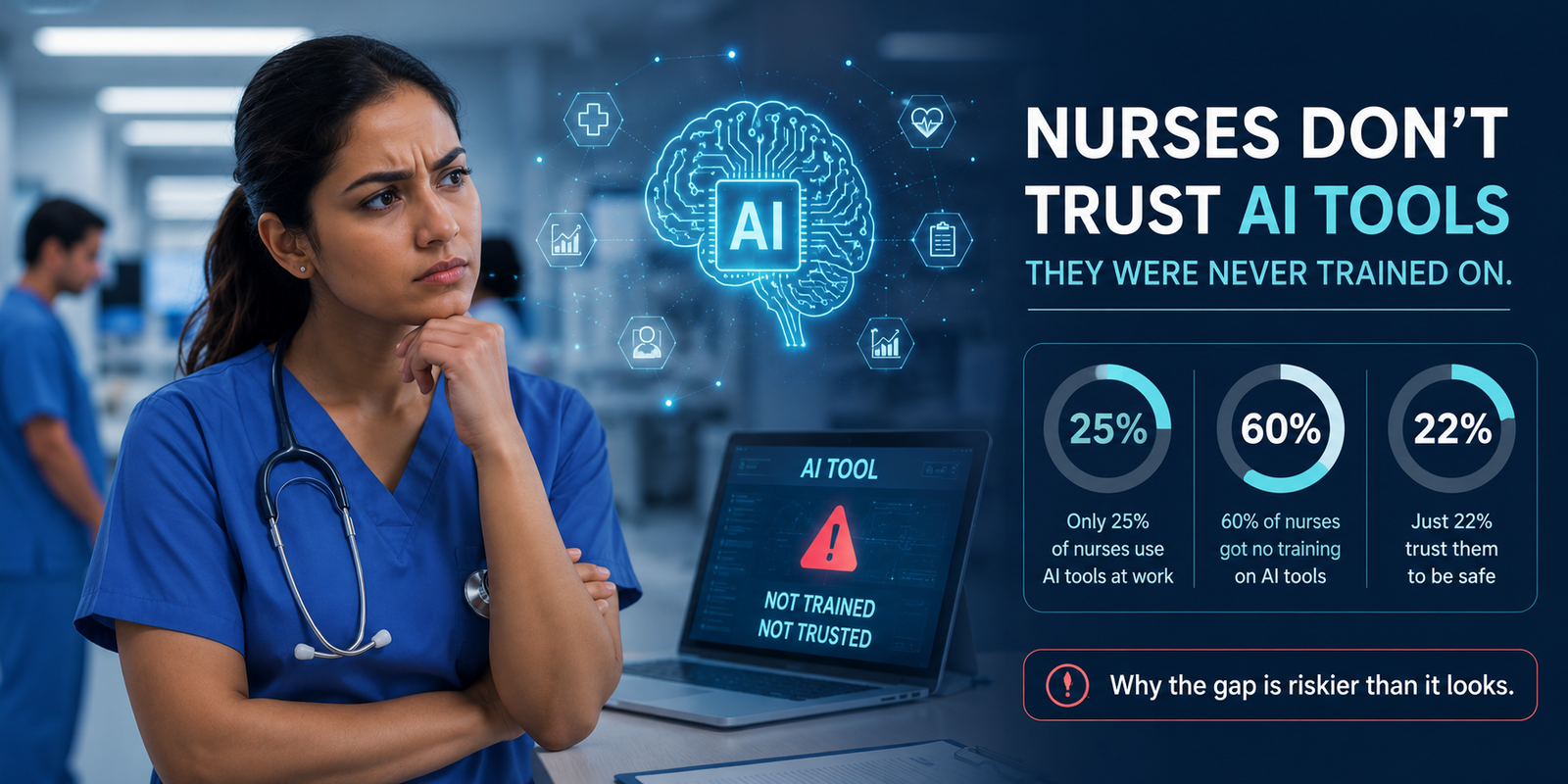
📲 Follow the ChannelOnly 25% of nurses say they’ve personally used an AI-powered tool at work in the past 30 days. Among those who have, 60% say their employer gave them no adequate training. Just 22% trust AI tools to support safe patient care in their current workplace. And when researchers asked whether nurses have real input into which AI tools get chosen, only 19% said yes. Forty percent said no. The rest weren’t sure.
Read those numbers together and a pattern emerges. Adoption is still low. Trust is lower. And the people actually using these tools at the bedside have almost no say in picking them.
This isn’t unique to the US
A separate global report backs this up. Elsevier’s Clinician of the Future 2026: Nurses Edition surveyed 692 nurses and 2,065 doctors across 118 countries. Only 41% of nurses reported using AI at work, compared to 57% of doctors. Just 42% of nurses called AI tools trustworthy.
The gap goes beyond usage. Forty-one percent of nurses said their views are rarely or never represented in their organization’s decisions. Only 19% of doctors said the same about their own views. Nurses aren’t just using AI less. They’re being consulted about it less, too — everywhere, not just in American hospitals.
Why the timing makes this riskier
Here’s the part most coverage of this story misses. In January 2026, the FDA changed its guidance in a way that reduced premarket oversight for many AI-assisted clinical tools. That happened as part of a broader deregulatory push.
In plain terms: the rules got looser right as adoption sped up. Fewer tools need to clear a high bar before reaching your unit. That makes the training-and-input gap more than an inconvenience. It’s a safety question, and it’s landing on nurses at exactly the moment oversight is loosening.
Nursing’s professional bodies are pushing back
Nursing leadership noticed this gap before most hospitals did anything about it.
The American Academy of Nursing approved a comprehensive AI position statement on February 25, 2026. It lays out 13 policy recommendations covering data privacy, algorithmic bias, federal regulation, and workforce training. Its core demand is simple: AI should support nursing judgment, not replace it.
The American Nurses Association went further. On April 22, 2026, it convened its first AI in Nursing Practice Think Tank. The consensus findings call for nurse-led guardrails on how AI gets built, deployed, and evaluated in clinical settings — not decisions made about nurses without them.
What “human-in-the-loop” actually means for you
Both organizations use the same core phrase: human-in-the-loop oversight. It means a nurse stays in the decision chain whenever an AI system generates a clinical recommendation. It also means your workplace should have a clear path to escalate when an AI tool’s output conflicts with your own judgment.
If your facility can’t tell you what that escalation path looks like, that’s a real gap. It’s worth naming as one directly.
The data is more nuanced than simple fear
It would be easy to read all this as nurses rejecting AI outright. The actual picture is more interesting than that.
A separate 2025-2026 survey published in American Nurse Journal found 76% of nurses believe AI might or will help healthcare. At the same time, nearly one in five — 19% — said AI shouldn’t be used in patient care at all. Most nurses aren’t anti-AI. They’re conditionally open, and the condition hasn’t been met yet.
McKinsey’s own 2026 survey of 521 frontline nurses found something similar. Belief in AI’s potential is strong. Actual use remains limited. McKinsey’s own conclusion: the fix isn’t dropping more tools into hospitals. It’s redesigning how nursing work actually happens, with nurses involved from the start.
Even where AI has helped, the benefit is narrower than the marketing suggests. Only 18% of nurses say AI has meaningfully cut their documentation or admin time. For every nurse who saw that benefit, more than three saw no real change at all.
What this looks like from the floor
I’ve sat through more “here’s your new system” trainings than I can count over twenty-six years, and the pattern rarely changes. A vendor demo runs for twenty minutes. Someone hands out a one-page cheat sheet. Then the tool goes live on nights, when the unit is short-staffed and nobody has time to ask a real question. AI rollouts are following that exact script right now, just with higher stakes than a new charting system ever carried. The nurses I know aren’t refusing to use these tools. They’re asking, reasonably, to understand what a tool actually does before their license is the one on the line when it’s wrong.
What you can actually do about this
You have more standing here than the survey numbers might suggest, precisely because the gaps are this well documented now.
Ask your facility directly whether formal AI training exists for any tool you’re expected to use, and ask what the escalation path is when the tool’s output doesn’t match your judgment. Reference the ANA’s position statement, “The Ethical Use of Artificial Intelligence in Nursing Practice,” if you need something concrete to point to — it exists precisely for this conversation.
Ask, too, whether frontline nurses have any seat on the committee that selects or evaluates AI tools before they reach your unit. If the answer is no, that’s worth raising with your unit council or union representative, not just accepting as how things are done.
And document it when an AI tool’s recommendation conflicts with your own clinical judgment, along with what you did instead. That record protects you, and it’s exactly the kind of real-world data that professional bodies are asking hospitals to start collecting.
Frequently Asked Questions
What percentage of nurses actually use AI tools at work?
About 25% in the US, per Nurse.org’s 2026 survey, and 41% globally, per Elsevier’s 2026 Clinician of the Future report. Both figures are lower than most coverage of “AI in healthcare” implies.
Do nurses trust the AI tools they’re given?
Not widely. Only 22% of US nurses trust AI tools to support safe patient care, and only 42% globally consider them trustworthy. Distrust is highest where training was inadequate, not where nurses reject the technology outright.
What does “human-in-the-loop” mean in nursing AI policy?
It means a nurse stays part of the decision whenever an AI system generates a clinical recommendation, with a clear path to escalate if the AI’s output conflicts with clinical judgment. Both the American Academy of Nursing and the American Nurses Association have made this a formal policy demand in 2026.
Did AI oversight get stricter or looser in 2026?
Looser, for many tools. A January 2026 FDA guidance change reduced premarket oversight requirements for many AI-assisted clinical tools, as part of a broader deregulatory push, even as hospital adoption accelerated.
What should I do if my hospital gives me an AI tool with no training?
Ask directly for formal training and for the escalation process when the tool’s output conflicts with your judgment. Reference the ANA’s ethical AI position statement if you need a professional standard to cite, and raise the lack of nurse input with your unit council or union representative.
Disclaimer:
This article is for informational purposes only and does not constitute legal, employment, or clinical practice advice. Survey data is drawn from third-party research (Nurse.org’s 2026 State of Nursing Survey, Elsevier’s Clinician of the Future 2026: Nurses Edition, the American Nurse Journal’s 2025-2026 Nursing Trends Survey, and McKinsey’s 2026 Nursing AI Insights Survey); methodologies, sample sizes, and regions vary by source. Policy positions referenced from the American Nurses Association and American Academy of Nursing reflect those organizations’ published statements as of their respective release dates in 2026 and may be updated. GlobalNurseGuide.com is not affiliated with any organization named in this article. Information current as of July 2026.
Author

Discover more from Global Nurse Guide
Subscribe to get the latest posts sent to your email.