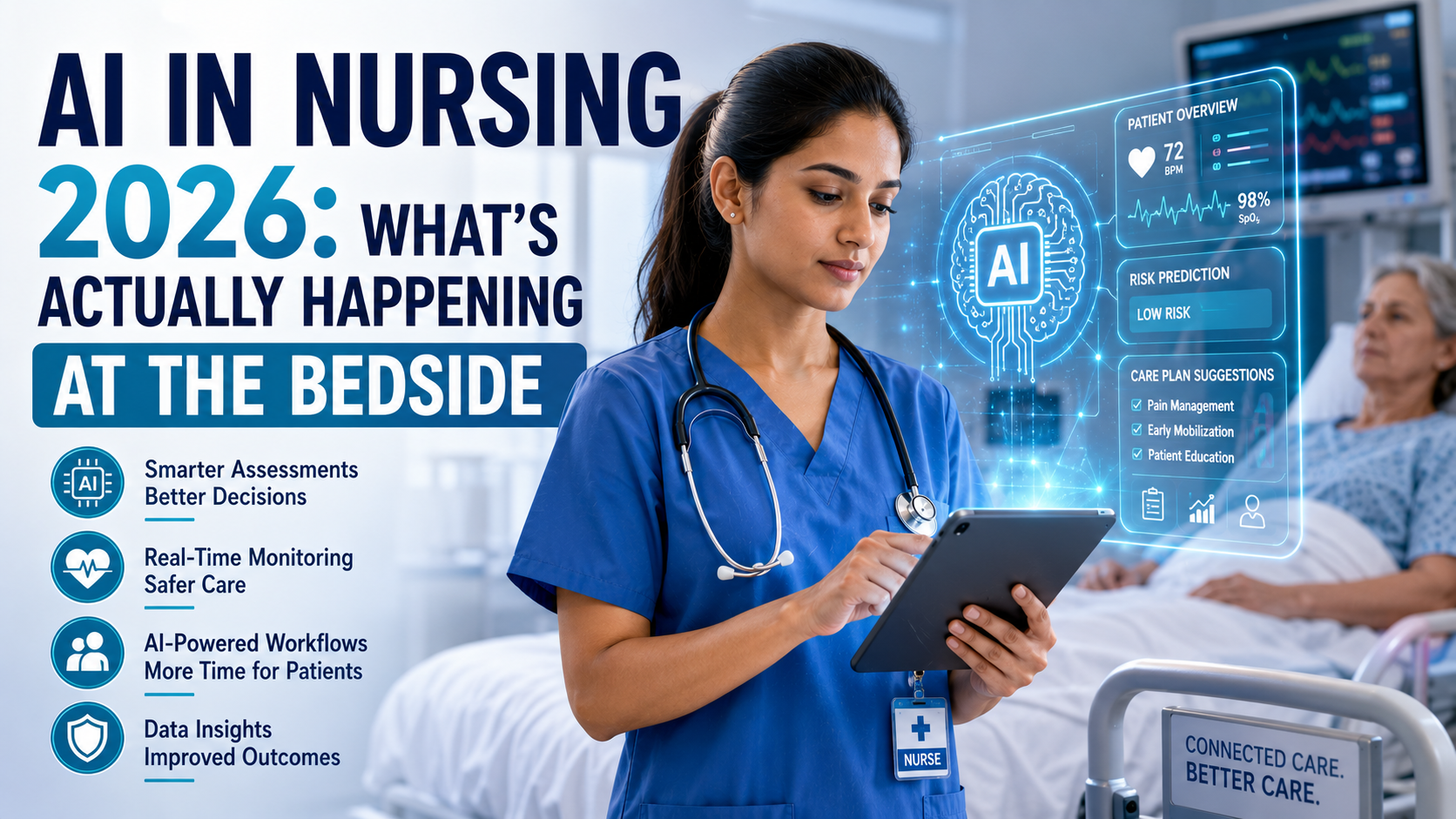
AI in Nursing 2026: What’s Actually Happening at the Bedside
Updated June 20, 2026 • Reading Time: ~14 Minutes
Nurses spend approximately 25 to 40 percent of every shift on documentation. Not on patient care. Not on assessment. On charting. That single fact is more useful for understanding what AI is actually doing in nursing in 2026 than any amount of coverage about robots and job losses — because it identifies the problem AI is being deployed to solve. The question AI is answering in hospitals right now is not “how do we replace nurses?” It is “how do we get nurses back to patients?”
Three specific tools are spreading through hospitals as of 2026: ambient AI documentation scribes that generate EHR notes from clinical conversations, virtual nurse assistants that handle routine information retrieval, and clinical decision support systems that flag patient deterioration patterns earlier than a nurse monitoring several patients simultaneously can catch manually. A 2026 consensus review involving the ANA, AACN, NLN, and AANP found strong agreement on one principle: AI should augment, not replace, professional nursing judgment. Connected care — the AI-assisted virtual and remote nursing sector — grew 33 percent year-over-year in 2026. AI is creating new nursing roles faster than it is eliminating existing ones.
🩺 Join FREE WhatsApp Channel for Trusted Guide
Get weekly vacancy alerts, EB-3 visa updates & daily NCLEX prep on WhatsApp — FREE.
📲 Follow the ChannelThis is not reassurance. It is the actual picture. The rest of this article explains specifically what AI is doing, what it is not doing, and what nurses need to know to work with it intelligently rather than react to it anxiously.
🤖 AI in Nursing 2026 — What’s Verified
Documentation burden: 25–40% of nursing shift time currently spent on charting
Three spreading tools: Ambient scribes, virtual nurse assistants, clinical decision support
Connected care growth: +33% year-over-year (Nurse.org 2026)
Physician AI adoption: 66% now using some form of AI in clinical practice (PMC 2024)
ANA/AACN/NLN/AANP 2026 consensus: AI should augment, not replace, nursing judgment
AACN mandate: AI literacy and informatics are now core competencies for entry-level nurses
What AI cannot do: Physical assessment, therapeutic presence, complex ethical judgment
New roles AI is creating: Virtual monitoring nurse, AI implementation nurse, telehealth RN
1. The Three Tools Actually in Hospitals Right Now
The ViVE 2026 conference, where health system executives and technology companies present what is being deployed in clinical environments, identified three specific AI tools that are moving from pilot programmes to full-scale hospital rollouts in 2026. These are not theoretical or three years away. They are in hospitals now, and they are affecting how nurses work.
Ambient AI documentation scribes
An ambient scribe listens to clinical conversations during patient interactions — assessments, handovers, medication education, family discussions — and generates structured documentation in the EHR in the background. The nurse does not have to click through hundreds of flowsheets or write free-text notes manually. The AI produces a draft. The nurse reviews it, corrects anything inaccurate or incomplete, and approves it for the record.
The nursing implication is significant: if documentation currently consumes 25 to 40 percent of your shift, and ambient AI reduces that burden by even half, you have recovered an hour or more of shift time that can go back to the patient. This is the most immediately meaningful AI application for bedside nurses, and it is the one most likely to reach a hospital near you in the next 12 to 24 months regardless of your specialty.
The honest complexity: you remain legally and professionally responsible for every entry in the patient record, whether you generated it or an AI did. Reviewing AI-generated documentation requires active engagement, not passive approval. A nurse who clicks “accept” on AI notes without reading them is not relieved of their documentation responsibility. The tool changes the input method; the professional accountability stays with the nurse.
Questions to ask if your hospital introduces ambient scribing: What is the accuracy rate of the tool? What patient consent process is in place? How does the system handle situations where the conversation contains sensitive information? What is the escalation process when the AI generates an inaccurate clinical note?
Virtual nurse assistants
A virtual nurse assistant is an AI tool that handles routine information retrieval and workflow support tasks — pulling up medication reference information, flagging upcoming assessment due times, surfacing care protocol reminders, generating handover summaries from shift data. It has been described as an AI version of the paper “brain sheet” many nurses use to track patient status through a shift.
Unlike ambient scribes, virtual nurse assistants do not replace nursing activities — they accelerate the information-gathering that precedes nursing decisions. A nurse still assesses the patient; the assistant surfaces the relevant context faster. The practical effect is shorter time between data review and clinical action, particularly when a nurse is managing several patients simultaneously.
Clinical decision support systems
Clinical decision support AI analyses real-time patient data – vital signs trends, laboratory results, medication history, nursing assessments entered in the EHR – and generates alerts when patterns suggest risk. The best-known example is early sepsis warning: the AI detects combinations of vital sign changes, lactate trends, and white blood cell counts that together suggest sepsis developing, and alerts the clinical team before the patient becomes visibly unstable.
Other clinical decision support applications include fall risk algorithms that trigger preventive measures, pressure injury risk flagging based on patient mobility and skin assessment data, and medication interaction alerts integrated into medication administration workflows.
Critically: the AI generates the alert. The nurse assesses the patient, applies clinical judgment, and decides the action. This distinction is not bureaucratic fine print. It is the reason nurses are not being replaced by these systems. An algorithm can detect that a vital sign pattern matches a sepsis signature. It cannot assess whether the patient was just ambulating and their heart rate is elevated for that reason, cannot hear the quality of their breathing, cannot ask how they feel and observe their facial expression. The AI provides a signal. The nurse provides the interpretation.
2. What AI Is Not Doing — The Part Most Coverage Gets Wrong
Media coverage of AI in healthcare tends toward two extremes: either AI will save everything or AI will replace everyone. Both are wrong in ways that are unhelpful to nurses trying to understand their actual situation.
AI is not, in 2026, doing any of the following:
Making independent clinical decisions.
Every AI tool deployed in nursing environments in 2026 produces outputs — flags, alerts, documentation drafts, recommendations — that require human clinical review before any action is taken. This is both a technical reality (current AI does not have the contextual judgment to act safely without human oversight in clinical settings) and a regulatory and legal reality (clinical accountability rests with the licensed clinician).
Replacing bedside care.
The physical presence of a nurse at the patient’s side — the assessment, the touch, the observation of subtle changes in condition, the therapeutic relationship — has no AI substitute. Virtual nursing expands where nurses can care from, not what nursing actually is. A nurse monitoring patients from a central station using AI-assisted alerts is still doing nursing. The patient in the room still needs a bedside nurse to place an IV, assess a wound, reposition them, have a conversation about what their diagnosis means.
Eliminating most nursing jobs.
The roles under pressure are specific and largely non-bedside: some utilisation review and prior authorisation functions, some administrative care coordination tasks, some data entry roles. These represent a subset of the nursing workforce. Bedside nursing, which employs the majority of nurses globally, is not being displaced. The ANA, AACN, NLN, and AANP said so collectively in 2026. This is not spin — it reflects the genuine limits of current AI in clinical contexts.
Operating flawlessly.
AI clinical tools have error rates. Ambient scribes occasionally mishear or misinterpret clinical language. Decision support systems generate false positives that burden nurses with unnecessary alerts. Virtual assistants surface incorrect reference information if the underlying database is not current. A nurse who treats AI output as authoritative without critical evaluation is a nurse who will act on incorrect information. Critical appraisal of AI-generated content is now a clinical skill alongside critical appraisal of research evidence.
3. The New Roles AI Is Creating
Connected care grew 33 percent year-over-year in 2026. The Washington State Nurses Association notes that AI-related nursing positions typically pay at or above traditional nursing rates and frequently offer remote or hybrid arrangements. These roles are filling faster than they are being publicised.
Virtual monitoring nurse.
Manages AI-flagged patient alerts across large panels from a central monitoring station. Reviews AI-generated alerts, contacts bedside nurses to intervene, coordinates care across multiple units or facilities. One of the fastest-growing telehealth positions in 2026. Requires strong rapid assessment skills and clinical confidence — you are making judgment calls on limited information and escalating efficiently.
AI implementation and validation nurse.
Helps hospitals implement EHR-integrated AI tools. Brings frontline clinical expertise to the question of whether AI tools are functioning accurately in real clinical conditions. Demand is strong as hospitals navigate large-scale AI rollouts that fail without nursing input. Wolters Kluwer’s 2026 expert panel identified this as one of the clearest areas of new nursing employment growth.
Telehealth and remote patient monitoring nurse.
Oversees patients monitored through connected devices at home or in community settings, with AI flagging abnormal readings for nurse review. Distinct from virtual hospital nursing but growing rapidly driven by hospital-at-home programmes and chronic disease management.
Nurse informaticist specialising in AI.
Works at the intersection of clinical nursing and health information systems, specifically focused on AI tool evaluation, data quality, and clinical workflow integration. The AACN now identifies informatics competency as a core skill for entry-level nurses, and more advanced informatics roles — particularly those involving AI systems — command salaries above the general nursing median.
For telehealth nursing roles: Telehealth Nursing Jobs 2026.
For nurse informatics as a career path: Nursing Specialty Salaries 2026.
4. What Nurses Should Ask When AI Comes to Their Unit
The ANA’s position is that nurses must be involved in the design, implementation, and evaluation of AI tools in clinical settings. This is a professional responsibility, not just a workplace preference. When your hospital introduces an AI tool, these are the questions that protect patients and nurses simultaneously:
What data was this trained on?
AI tools trained primarily on data from one patient population may perform less accurately for different populations. A fall risk algorithm trained on US academic medical centre data may not apply accurately to a rural community hospital, a paediatric unit, or patients from different demographic backgrounds.
What is the error rate, and how is it monitored?
Every clinical AI tool has false positive and false negative rates. False positives in alert systems create alarm fatigue. False negatives in decision support systems create missed conditions. Both have patient safety implications. Ask for the published accuracy data and the monitoring protocol.
Was clinical nursing staff involved in building it?
The ViVE 2026 conference consensus was explicit: technology solutions fail when nurses are not involved in building them. An AI documentation tool that does not reflect how nurses actually chart will produce inaccurate records. An alert system calibrated without nursing input will generate thresholds that do not match clinical reality.
Who is accountable when AI contributes to a patient harm event?
This is not asked often enough. When a nurse acts on an AI recommendation and the outcome is a patient harm event, the liability question is legally and professionally complex. Your facility should have a clear policy on this. If it does not, that is itself a significant concern.
What is the consent process for patients?
Patients receiving care where ambient AI is documenting conversations, or where AI is monitoring their vital signs and generating clinical recommendations, should understand this and consent to it. If your hospital is deploying ambient scribing without patient consent, that is a patient rights issue.
5. The Skills That Actually Matter Now
The AACN identifies virtual health literacy and informatics competency as core skills for entry-level nurses as of 2026. The NLN’s 2025 AI Vision Statement established national standards for AI literacy in nursing curricula. These are not optional electives — they are becoming foundational.
What nurses actually need to develop is not programming knowledge or data science training. It is a set of critical thinking skills applied to a new context:
Critical appraisal of AI-generated content.
The same skill you apply to evaluating a research paper or a medication reference source applies to AI outputs. Is the source reliable? Is the output consistent with clinical reality? What is the error rate? The answer “the computer says so” is not clinically sufficient, just as “the textbook says so” has never been clinically sufficient.
Understanding what AI can and cannot do in your specific context.
A sepsis early warning system validated in adult ICU settings may not apply to your paediatric oncology unit. An ambient documentation tool calibrated for physician encounters may produce inaccurate nursing assessment notes. Context-specific critical evaluation is different from blanket scepticism — the goal is knowing when to trust the tool and when to override it.
Advocacy when AI gets it wrong.
As clinical decision support systems become more embedded in hospital workflows, the pressure to follow AI-generated recommendations will increase — both implicitly (the system flags something; there is documentation that you were notified) and sometimes explicitly. The nurse who overrides an AI recommendation needs the clinical knowledge and professional confidence to document why. Developing that articulation ability is a professional skill.
Basic data literacy.
Not statistics. Basic understanding of what the data flowing through clinical AI systems represents, where it comes from, what its limitations are. A nurse who understands that the AI sepsis score is built on specific vital sign inputs will notice when one of those inputs is erroneously charted and the score is therefore unreliable. Data literacy at this level is clinical nursing skill, not IT skill.
6. Frequently Asked Questions
Will AI replace nurses?
No. ANA, AACN, NLN, AANP 2026 consensus: AI augments, does not replace, professional nursing judgment. The physical, relational, and judgment-intensive aspects of nursing have no current AI substitute. Bedside nursing is not being displaced.
What AI tools are in hospitals right now?
Three spreading to full scale: ambient documentation scribes (generate EHR notes from clinical conversations), virtual nurse assistants (information retrieval and workflow support), clinical decision support (sepsis early warning, fall risk, medication alerts). All require nurse review before action.
Can AI do nursing documentation?
Ambient scribes can draft documentation. The nurse must review, correct, and approve all AI-generated records before they are finalised. Professional and legal accountability for documentation remains with the nurse.
Are there new nursing jobs because of AI?
Yes. Virtual monitoring nurse, AI implementation/validation nurse, telehealth and remote patient monitoring nurse, and nurse informaticist specialising in AI. Connected care grew 33% in 2026. These roles often pay above traditional nursing rates and offer remote/hybrid arrangements.
What should nurses do to prepare for AI?
Develop critical appraisal skills for AI outputs (same as for research evidence). Understand your specific tools’ accuracy and limitations. Ask the right questions when new AI tools are introduced. Advocate for nursing involvement in AI design and implementation. You do not need to become a programmer.
Which nursing jobs are most affected by AI?
Utilisation review, prior authorisation, and some administrative care coordination roles face the most pressure from AI automation. Bedside clinical nursing, which employs the majority of nurses, is not being displaced.
What does the ANA say about AI?
Technology should serve human dignity, not compromise it. Nurses must be involved in design, implementation, and evaluation of AI tools. AI should augment, not replace, professional nursing judgment. (ANA Code of Ethics and Principles for Nurse Staffing; confirmed in 2026 multi-organisation consensus.)
The Bottom Line
The anxiety that nurses feel about AI in 2026 is proportionate to the speed of change and the quality of the conversation around it. Most coverage is either catastrophising about job replacement or uncritically celebrating AI as the solution to healthcare’s problems. Neither serves nurses who need to understand what is actually happening in their clinical environments.
What is actually happening: AI is tackling the documentation burden that has consumed nursing time for decades. It is creating central monitoring roles that extend where experienced nurses can provide oversight. It is flagging clinical deterioration earlier and reducing the cognitive load of tracking large patient panels. And it is requiring nurses to develop a new category of critical thinking skill — not programming knowledge, but the same evaluative rigour applied to AI outputs that good nurses have always applied to clinical information.
The nursing profession is not threatened by AI. It is being asked to absorb a new tool into a framework of values, judgment, and patient-centred care that has existed for as long as the profession has. Nurses have absorbed the defibrillator, the electronic health record, and telemedicine. AI is the next tool in a long line of them. The question is not whether to accept or resist it. The question is how to use it in ways that serve patients better than the current arrangement — and how to push back when it does not.
Related articles on GlobalNurseGuide.com:
Nursing Specialty Salaries 2026
Nurse Practitioner Career Guide USA 2026
How to Maximize Income as an ICU or ER Nurse
Nurse Burnout 2026: Signs, Causes & What Helps
Disclaimer:
This article is for informational and educational purposes only. AI tool capabilities, deployment status, and clinical accuracy vary by product, health system, and clinical context. The ANA, AACN, NLN, and AANP positions cited reflect published statements and the 2026 consensus review. Connected care growth data from Nurse.org 2026 industry outlook. Physician AI adoption data from PMC 2024 survey cited in NursesEducator.com. ViVE 2026 conference reporting from Nurse.org. AI tool descriptions reflect technology categories as described by Wolters Kluwer expert panel 2026 and ViVE 2026 conference coverage — specific products vary by vendor and health system. Nurses should verify the specific capabilities, consent requirements, and accountability policies for any AI tool deployed in their clinical environment. GlobalNurseGuide.com is not affiliated with any AI vendor, health system, or technology company. Information current as of June 20, 2026.
© 2026 GlobalNurseGuide.com — Empowering Nurses Worldwide with Real Opportunities
Author

Discover more from Global Nurse Guide
Subscribe to get the latest posts sent to your email.