Nevada & Idaho: Two Underrated States to Start Your Nursing Career in 2026
Updated May 17, 2026 • Reading Time: ~15 Minutes
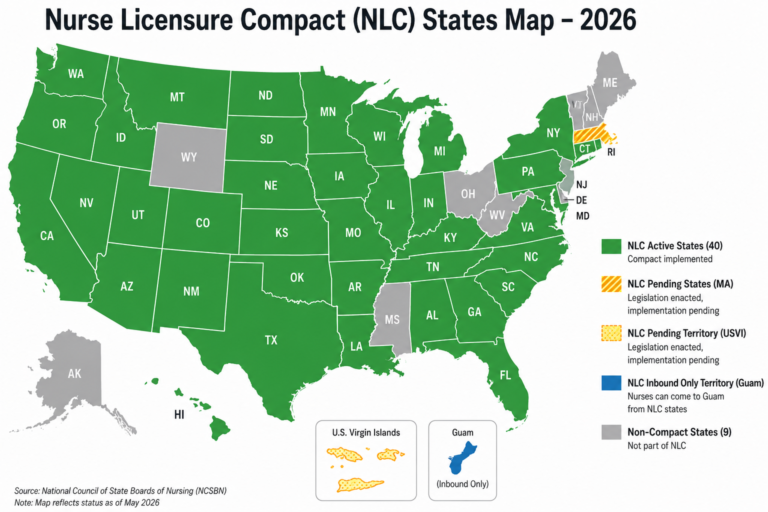
When adjusted for cost of living, Nevada ranks 10th nationally for RN purchasing power and Idaho ranks 17th. Neither state appears on the typical “best states for nurses” lists that are dominated by California, New York, and Massachusetts. That is the opportunity. Nevada pays an average of $101,810 with zero state income tax. Idaho pays $83,090 but stretches it further than almost any state in the West, with a cost of living 8.8% below the national average. Both are NLC compact states – if you already hold a multistate licence, you can start working immediately without a separate state application. Both have genuine nursing shortages. And both are hiring new graduates right now.
This guide makes the case for two states that most new nurses overlook. Nevada for the nurse who wants the highest possible starting pay in a fast-paced, high-acuity market. Idaho for the nurse who wants purchasing power, less new-grad competition, and a smaller-city quality of life. Same region, very different career propositions – and both stronger than the default choices many graduates make.
🩺 Join FREE WhatsApp Channel for Trusted Guide
Get weekly vacancy alerts, EB-3 visa updates & daily NCLEX prep on WhatsApp — FREE.
📲 Follow the Channel📊 Nevada vs Idaho for Nurses – 2026 Verified Data
| Average RN salary: | NV $101,810 | ID $83,090 |
| Salary range (10th–90th): | NV $77,960–$132,990 | ID $62,210–$105,300 |
| State income tax: | NV None | ID 5.8% flat |
| Cost of living vs national: | NV ~average | ID 8.8% below |
| RNs employed: | NV ~27,570 | ID ~14,060 |
| NLC compact state: | NV Yes | ID Yes |
| New grad RN salary: | NV ~$73,000 | ID ~$69,000 |
| NP salary: | NV $146,800 | ID $131,494 |
Source: BLS OEWS 2024, Idaho Center for Nursing 2024 Report
1. Nevada: High Pay, No Tax, High Intensity
Nevada’s average RN salary of $101,810 ranks roughly 10th nationally – ahead of states like Colorado, Oregon, and New Jersey. Add the zero state income tax and a nurse in Nevada takes home substantially more than a nurse earning the same gross pay in California (where state income tax runs 6 to 10+ percent). That single fact changes the math for every nurse comparing job offers across western states.
Where the jobs are
Las Vegas / Henderson / North Las Vegas. This is where the vast majority of Nevada’s nursing jobs sit. The Las Vegas metro employs roughly 22,000 of the state’s 27,570 RNs. The city is anchored by several major systems: HCA Healthcare operates Sunrise Hospital and Medical Center (the largest hospital in Nevada), MountainView Hospital, and Southern Hills Hospital. Dignity Health runs the St. Rose Dominican hospital group across Henderson and Las Vegas. University Medical Center of Southern Nevada (UMC) is the state’s only public hospital and its only Level 1 trauma centre – if you want the highest-acuity new-grad experience in the state, UMC is where to find it.
Reno / Sparks / Carson City. Northern Nevada’s primary market, smaller and slower-paced than Las Vegas. Renown Health is the dominant system, operating Renown Regional Medical Center and several specialty facilities. Reno offers competitive RN pay (some sources report higher-than-Las-Vegas averages due to a smaller sample) with noticeably lower housing costs than the Las Vegas metro.

Why Nevada works for new graduates
Nevada’s nursing shortage is real and growing. The state’s population has expanded rapidly, driven by retirees relocating from California, tech-industry growth, and a strong hospitality economy that supports a large working-age population. Healthcare infrastructure has not kept pace, and nursing programmes produce fewer graduates per capita than most western states. The result: new-grad hiring is active year-round, not limited to the spring and fall cohort windows common in larger states.
The clinical environment in Las Vegas is high-acuity and fast-paced. Trauma, cardiac emergencies, substance-related admissions, and a tourist population that generates unpredictable surges create a clinical mix that builds experience quickly. A new grad who spends two years in a Las Vegas ICU or ED develops clinical judgment that plays well anywhere in the country.
The Nevada trade-off
Las Vegas is not for everyone. The city’s identity revolves around hospitality and entertainment, which some nurses find energising and others find exhausting. Summer temperatures exceed 110°F. Housing costs have risen sharply (though they remain below California). And while the nursing salary is high, the cost of living in the Las Vegas metro is roughly at the national average – not the bargain that Idaho offers. Nevada is the play for the nurse who values raw take-home dollars and high-intensity clinical experience. It is not the play for the nurse who values a quiet, low-cost small-city life.
2. Idaho: Lower Pay, Higher Purchasing Power, Less Competition
Idaho’s headline salary of $83,090 looks unimpressive next to Nevada’s $101,810. But headlines lie when they ignore context.
Idaho’s cost of living is 8.8% below the national average. Housing in Boise, while rising, runs roughly half the cost of equivalent housing in Las Vegas and a fraction of California’s. When the cost-of-living adjustment is applied, Idaho’s effective RN salary is approximately $91,000 in purchasing power – 17th nationally and competitive with states that appear much higher on raw salary lists.
Idaho does have a flat 5.8% state income tax, which Nevada does not. That eats roughly $4,800 from an $83,000 salary. But the housing savings alone – often $500 to $1,000 per month less in rent or mortgage compared to Las Vegas or west-coast metros – more than compensate for the tax differential. The net outcome: an Idaho nurse’s actual standard of living is often comparable to or better than a nurse earning $95,000 to $100,000 in a higher-cost state.
Where the jobs are
Boise / Meridian / Nampa (Treasure Valley). Idaho’s primary nursing market. St. Luke’s Health System is the largest employer, operating multiple hospitals and clinics across the Treasure Valley and beyond. Saint Alphonsus Health System (part of Trinity Health) is the other major player, with facilities in Boise, Nampa, and Ontario (just across the Oregon border). Boise’s population growth has been among the fastest in the country, and healthcare infrastructure is expanding to match – new facilities, new programmes, and consistent new-grad hiring.
Coeur d’Alene / Post Falls. Northern Idaho, roughly 30 minutes from Spokane, Washington. Kootenai Health is the dominant employer and operates the region’s largest medical centre. Coeur d’Alene offers the highest RN salaries in Idaho and proximity to Spokane’s larger medical community. For a nurse who wants small-city living with access to a bigger market nearby, this is a strong combination.
Idaho Falls / Pocatello / Twin Falls. Eastern and south-central Idaho. Smaller markets with genuine rural-nursing opportunities. Eastern Idaho Regional Medical Center and Portneuf Medical Center are the main employers. These areas often offer sign-on bonuses and housing assistance for new nurses willing to commit to less-populated areas.
Why Idaho works for new graduates
The 2024 Idaho Nurse Workforce Report is explicit: despite adding 1,708 RNs since 2022, the state still falls short of healthcare demands. About 6.8% of Idaho’s RN workforce is at retirement age. New-graduate competition in Boise is significantly lower than in Las Vegas, Houston, Dallas, or any west-coast metro. Hiring managers in Idaho are more willing to accept ADN-prepared graduates and more likely to offer structured orientation programmes for new nurses, because the talent pool is smaller and they cannot afford to be as selective.
For a new grad who feels priced out of California, overwhelmed by the competition in major Texas and Florida markets, or just looking for a place where the cost of a house and the quality of daily life feel achievable in the first five years of a nursing career – Idaho is genuinely worth a serious look.
The Idaho trade-off
The absolute salary is below the national average. The state income tax is real. Boise’s cost of living has been rising steadily, though it remains well below most western metros. The healthcare market is smaller, which means fewer specialty options – if you want to work in paediatric cardiac surgery or a major cancer centre, Idaho does not have those resources the way Nevada or Texas does. Rural Idaho is genuinely remote, with long distances between facilities and limited cultural amenities. Idaho is the play for the nurse who values purchasing power, lifestyle, and work-life balance. It is not the play for the nurse who wants the highest raw salary or the widest specialty variety.
3. Side-by-Side Comparison
| Factor | Nevada | Idaho |
|---|---|---|
| Avg RN salary | $101,810 | $83,090 |
| State income tax | None | 5.8% flat |
| Cost of living | ~National average | 8.8% below national |
| New-grad competition | Moderate | Low |
| Clinical acuity | High (Level 1 trauma, diverse patient mix) | Moderate (community-focused) |
| NLC compact | Yes | Yes |
| Primary market | Las Vegas (22,000+ RNs) | Boise (growing rapidly) |
| Weather | Extreme summer heat (110°F+) | Four seasons, cold winters |
| Best for | Max take-home pay, urban clinical intensity | Purchasing power, work-life balance, outdoor lifestyle |
4. Licensing in Both States
Both Nevada and Idaho are members of the enhanced Nurse Licensure Compact (eNLC). If you hold a multistate licence from another compact state and are not changing your primary state of residence, you can begin working immediately in either state without obtaining a separate licence.
If you are relocating permanently:
Nevada Board of Nursing: apply for endorsement online, submit fingerprints for background check, provide licence verification through Nursys. Nevada also requires completion of a state-specific suicide prevention training (2 hours). Processing typically takes 4 to 6 weeks, but temporary permits can be issued to qualified applicants.
Idaho Board of Nursing: apply online, submit fingerprints, licence verification through Nursys. Idaho’s endorsement process is generally faster than Nevada’s, with some applicants receiving approval within 2 to 3 weeks.
Both states require continuing education for licence renewal. Nevada requires 30 contact hours per 2-year renewal period. Idaho requires a minimum of 200 practice hours and compliance with continuing competency requirements.
For a broader view of which states are hiring and how they compare: US Nursing Shortage 2026 – States Hiring RNs. For compact state details: NLC Map: Compact Nursing States 2026.
5. The New-Grad Decision
If you are about to graduate and deciding between these two states (or between these and the usual suspects like California, Texas, and Florida), here is the honest framing:
Choose Nevada if you want the highest possible starting salary in the West without California’s income tax or cost of living. You are comfortable with a fast-paced urban environment. You want high-acuity clinical exposure early in your career. You do not mind desert heat.
Choose Idaho if you want your first nursing salary to buy a real life – a house, savings, outdoor recreation – in your first five years. You prefer less competition and a less overwhelming first-job environment. You are drawn to community-oriented healthcare. You value the kind of daily life that a mid-sized western city offers.
Choose both – or at least consider both – if you hold a multistate NLC licence. You can pick up per diem shifts across the state line, or start in one and transition to the other as your priorities change. The states are geographically close and both NLC compact, which gives you flexibility that a California or New York licence does not.
For first-job preparation: Nursing Class of 2026: Your First 30 Days. For residency programme advice: Best Residency Programs for New Grad Nurses 2026. For income strategies once you’re established: How to Maximize Income as an ICU or ER Nurse.
6. Frequently Asked Questions
How much do nurses make in Nevada?
Average $101,810 (BLS 2024). Range $77,960–$132,990. No state income tax. New grads start ~$73,000. NPs earn $146,800 average.
How much do nurses make in Idaho?
Average $83,090 (BLS 2024). Range $62,210–$105,300. Flat 5.8% state income tax. Cost of living 8.8% below national average. New grads start ~$69,000. NPs earn $131,494 average.
Which state is better for a new nurse?
Nevada for highest pay and clinical intensity. Idaho for purchasing power and less competition. Both have genuine shortages and active new-grad hiring. Both are NLC compact.
Does Nevada have state income tax?
No. Nevada is one of nine states with zero state income tax.
Does Idaho have state income tax?
Yes. A flat 5.8%. However, the 8.8% lower cost of living more than offsets the tax in most scenarios.
Are both states NLC compact?
Yes. Both Nevada and Idaho are eNLC members. A multistate licence from any other compact state is valid in both.
What are the biggest hospitals?
Nevada: HCA (Sunrise, MountainView, Southern Hills), Dignity Health (St. Rose Dominican), UMC (Level 1 trauma), Renown Health (Reno). Idaho: St. Luke’s Health System, Saint Alphonsus (Trinity Health), Kootenai Health (Coeur d’Alene), Eastern Idaho Regional Medical Center.
Is housing affordable?
Idaho is significantly more affordable than Nevada for housing. Boise is rising but still below most western metros. Las Vegas housing has also risen but remains below California. Reno and Coeur d’Alene offer lower-cost alternatives within each state.
The Bottom Line
The “best state to start nursing” lists are dominated by states where the salary headline is high and the actual living experience is either unaffordable or brutally competitive for new graduates. Nevada and Idaho both belong in the conversation and rarely appear in it.
Nevada gives you a six-figure average salary, zero state income tax, and clinical exposure in one of the most diverse patient environments in the American West. Idaho gives you a salary that buys more than it looks like on paper, a new-grad market that is genuinely welcoming rather than gatekeeping, and a quality of life that many nurses in bigger cities describe as their long-term goal but never reach because they are always chasing the next cost-of-living increase.
Both states are next door. Both are NLC compact. Both have nursing shortages. The new nurse who considers them seriously – rather than defaulting to California or Texas because those are the states everyone talks about – is the one making a decision based on data rather than noise.
Related articles on GlobalNurseGuide.com:
US Nursing Shortage 2026: States Hiring RNs
NLC Map: Compact Nursing States 2026
Nursing Class of 2026: Your First 30 Days
Best Residency Programs for New Grad Nurses 2026
Maximize Income as ICU or ER Nurse 2026
Nursing Specialty Salaries 2026
Disclaimer: This article is for informational purposes only and does not constitute career or financial advice. Salary data is sourced from the US Bureau of Labor Statistics Occupational Employment and Wage Statistics (2024 estimates). Idaho workforce data from the Idaho Center for Nursing 2024 Nurse Workforce Report. Cost of living index from the Bureau of Economic Analysis Regional Price Parities. Licensing requirements sourced from the Nevada State Board of Nursing and the Idaho Board of Nursing. Employer information reflects publicly available data and is not an endorsement. Salaries, licensing requirements, and employment conditions change. Always verify current information directly with the relevant state board of nursing and employer. GlobalNurseGuide.com is not affiliated with any hospital system, government agency, or licensing body. Information current as of May 17, 2026.
© 2026 GlobalNurseGuide.com – Empowering Nurses Worldwide with Real Opportunities
Author

Discover more from Global Nurse Guide
Subscribe to get the latest posts sent to your email.