Telehealth Nursing Jobs 2026: Roles, Pay & How to Start Working from Home
Updated May 29, 2026 • Reading Time: ~16 Minutes
You can work from home as a registered nurse. The average remote nurse earns approximately $80,000, the biggest employers are health insurance companies, and the first thing you need is a compact multistate licence. Those three facts answer the questions most nurses are really asking when they search for telehealth jobs. Everything else — the role types, the salary ranges, the certifications, the home-office setup, and the honest trade-offs against bedside pay — is detail that matters but comes second.
Telehealth nursing in 2026 is no longer the pandemic-era experiment it started as. It is a structured employment category with defined roles, established employers, and real career pathways. It also pays less than bedside ICU or ER work, requires clinical experience you can only build at the bedside first, and is not as flexible as the job postings sometimes suggest. This guide covers all of it — what the roles actually are, what each pays, who is hiring, what you need to qualify, what the day looks like, and the honest answer to whether the work-from-home trade-off is worth the pay cut.
🩺 Join FREE WhatsApp Channel for Trusted Guide
Get weekly vacancy alerts, EB-3 visa updates & daily NCLEX prep on WhatsApp — FREE.
📲 Follow the Channel💻 Telehealth Nursing 2026 — Quick Reference
Average remote nurse salary: ~$80,321 (ZipRecruiter, March 2026)
Salary range by role: $65,000 (triage) to $115,000 (informatics)
Overall RN median (all settings): $93,600 (BLS)
Compact licence: Strongly preferred or required for most remote roles
NLC compact states: 43 jurisdictions (2026)
Experience required: 2–3 years bedside minimum
Top employers: UnitedHealth/Optum, Humana, Elevance, CVS/Aetna, Cigna, Centene
Fastest-growing areas: Remote patient monitoring, AI-assisted triage, hospital-at-home
Home-office setup cost: ~$300–$800 if starting from scratch
1. What Telehealth Nursing Actually Looks Like
“Telehealth nurse” is not a single job. It is a category that covers at least six distinct roles, each with different daily work, different clinical demands, and different pay. Understanding which role matches your background and your temperament is the first real decision.
Telephone triage nurse. You answer calls from patients who are sick, worried, or uncertain. You follow evidence-based triage protocols to assess their symptoms, determine urgency, and recommend the appropriate level of care — go to the ER, schedule a same-day appointment, manage at home with instructions. This is the most clinical of the remote roles. It requires fast decision-making, strong assessment skills built on real bedside experience, and the ability to evaluate a patient you cannot see. Salary: $65,000 to $90,000 plus performance bonuses. Many positions are available part-time or per diem.
Utilization review nurse. You review patient cases — hospital admissions, continued stays, procedures, medications — and determine whether they meet clinical criteria for insurance coverage. This is one of the most consistently fully remote roles available to RNs and one of the best-paid. It requires med-surg, ICU, or surgical background and a systematic approach to clinical documentation. Salary: $80,000 to $105,000.
Remote case management nurse. You coordinate care for patients with complex or chronic conditions. You track their care plans, connect them with community resources, follow up after hospital discharges, and work to prevent readmissions. This role combines clinical knowledge with problem-solving and advocacy. Salary: $70,000 to $95,000.
Clinical informatics nurse. You work at the intersection of clinical nursing and health information technology. You analyse EHR data, develop clinical workflows, train clinical staff on technology systems, and improve the tools nurses use every day. This is the highest-paid telehealth nursing role and the one most likely to grow as AI integration accelerates. Salary: $90,000 to $115,000.
Prior authorisation nurse. You review medication and procedure requests from providers and determine whether they meet insurance criteria for approval. Fast-paced, protocol-driven, and fully remote at most insurers. Salary: $70,000 to $90,000.
Remote patient monitoring (RPM) nurse. You monitor patient vital signs and health data transmitted from home devices — blood pressure cuffs, glucose monitors, pulse oximeters, cardiac monitors — and intervene when readings fall outside parameters. This is one of the fastest-growing telehealth roles in 2026, driven by hospital-at-home programmes and chronic disease management. Salary: $72,000 to $95,000.
For job boards that list these roles: Remote Nursing Job Boards 2026.
2. The Compact Licence Requirement
This is the single most important practical step for any nurse considering telehealth work, and it is non-negotiable for most employers.
Telehealth nursing means your patient may be in a different state from you. Under US nursing law, you must hold a licence in the state where the patient is located, not just where you are sitting. A nurse in Florida taking a triage call from a patient in Ohio must be licensed in Ohio — or hold a compact multistate licence that covers both.
The Nurse Licensure Compact (NLC) solves this. As of 2026, 43 jurisdictions participate. A compact licence from any member state lets you practise in all other member states under a single licence. For telehealth nursing, this is the difference between being eligible for hundreds of remote positions and being limited to patients in your one state.
If you live in a non-compact state — California, New York, Massachusetts, and a handful of others are the notable holdouts — your telehealth options are significantly narrower. You can still work remotely, but only serving patients in your own state unless you obtain individual licences in each additional state. Some employers will help fund multi-state licencing, but most prefer to hire compact-licensed nurses because it is simpler and cheaper.
Practical advice: if you are serious about telehealth and live in a non-compact state, consider whether relocating your primary state of residence to a compact state makes strategic sense. Texas, Florida, Arizona, Georgia, and North Carolina are popular choices for remote nurses because they are compact states with no or low state income tax and large healthcare markets.
For compact state details and the full map: NLC Map: Compact Nursing States 2026.
3. Who Is Hiring Remote Nurses in 2026
The largest employers of remote nurses are not hospitals. They are health insurance companies and managed care organisations. This surprises many bedside nurses, but it makes sense: insurers employ thousands of nurses for utilisation review, case management, prior authorisation, and quality management — all roles that require clinical judgment and are fully remote by design.
UnitedHealth Group / Optum. The single largest employer of remote nurses in the US. Hires for utilisation review, case management, clinical documentation, telephonic triage, and informatics. Remote positions across most states. Strong benefits.
Humana. Major Medicare Advantage insurer. Large remote nursing workforce for case management and utilisation review, particularly targeting nurses with geriatric or chronic-disease experience.
Elevance Health (formerly Anthem). Blue Cross Blue Shield affiliate. Hires remote RNs for utilisation management, appeals review, and care coordination.
CVS Health / Aetna. Offers RN-at-home positions for telehealth outreach, telephonic triage, and chronic condition management. Positions are state-specific — you must live in the designated state.
Centene. Medicaid managed care. Remote case management and utilisation review positions. Growing remote workforce.
Cigna. Remote utilisation review, prior authorisation, and clinical quality roles.
Kaiser Permanente. Integrated health system. Remote advice nurse and telephonic triage positions, primarily for nurses licensed in Kaiser states (California, Oregon, Washington, Colorado, and others).
Telehealth-focused companies: Teladoc Health, Amwell, Avel eCare, and Carenet Health hire remote RNs for telephonic and video-based patient triage, typically paying $35 or more per hour.
One pattern to know: many remote nursing positions are filled through direct recruiter outreach on LinkedIn before they are publicly posted. If you are actively looking, a LinkedIn profile that highlights your compact licence, bedside specialty, certifications (CCM, CPHQ), and “open to remote opportunities” will generate inbound recruiter interest that cold applications on job boards will not.
4. What You Need to Get Started
Clinical experience
Almost every telehealth employer requires 2 to 3 years of recent bedside clinical experience at minimum. Some roles (utilisation review for surgical cases, ICU-related case management) expect more. The reason is practical: you cannot effectively assess a patient you cannot see if you have never assessed one you can. Telephone triage depends on clinical intuition built through thousands of in-person patient encounters. Remote case management depends on understanding hospital workflows and discharge barriers from the inside. Telehealth nursing is a second-career step, not a first job.
Compact licence
Already covered above. If you do nothing else after reading this article, check whether your state is a compact member and, if so, whether your licence is multistate. If you hold a single-state licence in a compact state, you may need to convert it — the process varies by state but is typically straightforward.
Certifications
Not always required, but the ones that move your application to the top of the pile:
- Certified Case Manager (CCM) — for case management and utilisation review roles at insurers. The highest-impact credential for remote nursing pay.
- Certified Professional in Healthcare Quality (CPHQ) — for quality management, utilisation review, and performance improvement roles.
- Ambulatory Care Nursing certification — for telephone triage and outpatient care coordination.
- Nursing Informatics certification (ANCC) — for informatics roles. Strongest if combined with EHR-specific training.
A compact licence combined with a CCM credential makes you competitive for the highest-paying remote positions at major insurers. That combination is the telehealth equivalent of a CCRN for ICU nurses — it signals seriousness and specialist competence.
Home-office setup
Employers have specific requirements, and they are enforced. The standard:
- Private room with a door that closes — for HIPAA compliance. A kitchen table with a laptop does not qualify.
- Wired ethernet internet with at least 25 Mbps download speed. Wi-Fi alone is usually not accepted because it is less reliable.
- Computer meeting employer specs — some employers provide hardware, others require your own.
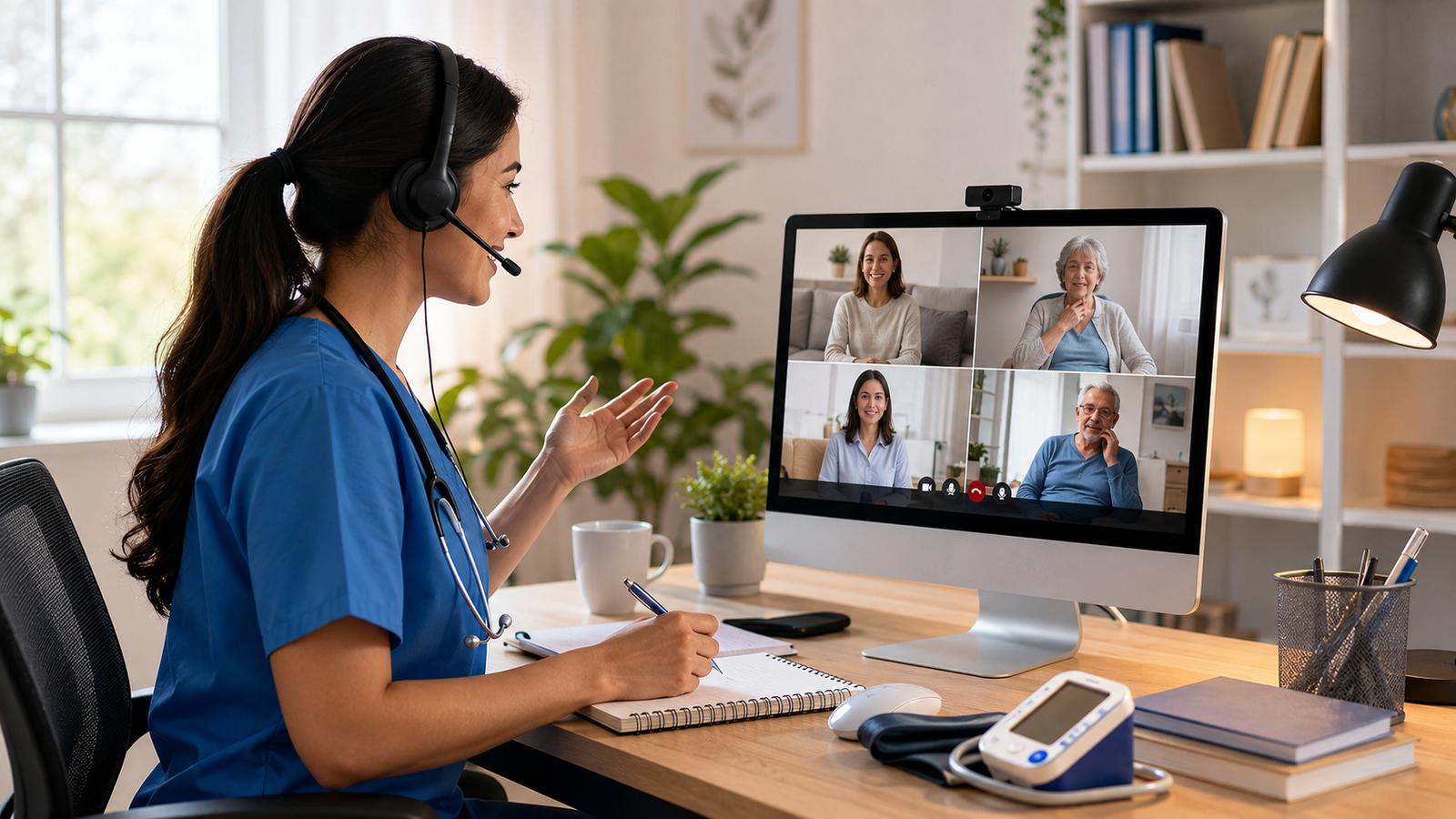
- Headset with microphone for calls and video consultations.
- Ergonomic desk and chair — you will sit for 8 to 12 hours. Invest in your back.
Budget $300 to $800 if you need to set up a compliant home office from scratch. Some employers reimburse a portion of setup costs.
5. The 2026 Landscape: AI, Hospital-at-Home, and Hybrid Roles
Telehealth nursing is not the same job it was during the pandemic. Three developments are reshaping the field in 2026:
AI-assisted triage. AI tools now help nurses prioritise patient calls by analysing symptom patterns, voice tone, and data inputs. The nurse still makes the clinical decision, but the AI surfaces relevant data and flags urgency indicators. Nurses who learn to work with these tools are faster and more accurate. Nurses who resist them are at a disadvantage in hiring. This is not about AI replacing you — it is about AI changing what the first 30 seconds of a triage call look like.
Hospital-at-home. Health systems are increasingly delivering acute-level care to patients in their own homes, with nurses monitoring remotely through high-fidelity vital-sign devices, video check-ins, and AI-flagged alerts. This is not traditional home health — it is ICU-level monitoring without the ICU. It creates demand for remote nurses with critical care backgrounds who can manage acutely ill patients through a screen and know when to escalate to in-person intervention.
Hybrid nursing roles. Many hospitals now offer positions that split time between physical bedside shifts and “virtual shifts” — remote monitoring, telehealth follow-ups, and virtual rounding. This hybrid model is being adopted partly as a retention strategy to reduce burnout: nurses who spend two days a week at the bedside and two days remote report higher job satisfaction than those doing either full-time. If your hospital offers hybrid positions, they are worth investigating before making a full jump to remote-only.
6. The Honest Trade-Offs
Remote nursing solves some problems and creates others. Decide with your eyes open.
The pay is lower. The average remote nurse earns roughly $80,000 compared to the overall RN median of $93,600 and ICU/ER averages above $91,000. You lose night shift differentials, overtime opportunities, and the acuity-based pay premiums that hospital nursing generates. The exception is clinical informatics, where salaries are competitive with bedside roles. For most other remote positions, you are trading roughly 5 to 15 percent of your income for the ability to work from home.
“Remote” does not always mean “flexible.” Many telehealth positions require you to work specific shift hours — often matching the time zone of the patient population you serve. A triage nurse working for a health system on the East Coast must be available during East Coast hours regardless of where they live. Some employers require state-specific residency. Read the job posting carefully before assuming remote equals flexible.
Isolation is real. Bedside nursing is a team sport. You see your colleagues, you debrief after a difficult case, you eat together. Remote nursing is a screen, a headset, and your own company. Some nurses find this liberating. Others find it lonely. If the camaraderie of the nursing floor is a meaningful part of why you do this work, a fully remote role may leave something missing that no salary can replace.
Career progression looks different. Bedside nursing offers a visible ladder: staff nurse, charge nurse, educator, manager, director, CNO. Remote nursing career paths are less established, though they are growing. Telehealth nurse manager, director of remote patient services, and virtual care specialist roles exist at the larger organisations, but they are fewer and more competitive. If you want a leadership career, plan your progression deliberately rather than assuming it will emerge the way it does in hospitals.
You need bedside experience first. This point cannot be overstated. New graduates who attempt to enter telehealth without clinical experience are doing themselves and their patients a disservice. The judgment that telehealth depends on is forged at the bedside. Get your 2 to 3 years of hospital experience, build your clinical foundation, and then transition to remote work from a position of competence.
For income strategies that combine bedside and remote: How to Maximize Income as an ICU or ER Nurse 2026.
7. Frequently Asked Questions
How much do telehealth nurses earn?
Average ~$80,000. Triage: $65,000–$90,000. Utilization review: $80,000–$105,000. Case management: $70,000–$95,000. Informatics: $90,000–$115,000. Top earners: $118,000+.
Can you really work from home as a nurse?
Yes. Thousands of RNs work fully remote in triage, utilisation review, case management, informatics, prior auth, and RPM roles. Requires compact licence, 2–3 years bedside experience, and a HIPAA-compliant home office.
Do you need a compact licence?
Strongly preferred and often required. 43 NLC jurisdictions as of 2026. Without compact, you are limited to patients in your one state.
Who are the biggest remote nursing employers?
UnitedHealth/Optum, Humana, Elevance (Anthem), CVS/Aetna, Centene, Cigna, Kaiser. Plus telehealth companies: Teladoc, Amwell, Avel eCare, Carenet Health.
Can new grads get telehealth jobs?
Very rarely. Nearly all employers require 2–3 years bedside clinical experience minimum. Build your foundation at the bedside first.
Is AI replacing telehealth nurses?
No. AI is augmenting, not replacing. AI-assisted triage and RPM tools handle data processing; the nurse handles judgment, communication, and escalation. Nurses who work with AI tools are more valuable, not less.
Is telehealth nursing pay lower than bedside?
Generally yes, by 5–15%. You lose differentials, overtime, and acuity premiums. The trade-off is working from home. Informatics is the exception — competitive with bedside at $90,000–$115,000.
What certifications help?
CCM (case management), CPHQ (quality/UR), ambulatory care certification (triage), nursing informatics (ANCC). CCM + compact licence is the strongest combination for high-paying insurer roles.
The Bottom Line
Telehealth nursing is a legitimate career path in 2026, not a pandemic stopgap. The roles are defined, the employers are established, and the technology is mature enough that remote patient care is no longer experimental. For a nurse with 2 or more years of bedside experience, a compact licence, and a willingness to work in a different clinical modality, the option to assess patients, coordinate care, or manage clinical quality from a home office is real and available.
The trade-off is real too. The pay is lower than bedside for most roles. The flexibility is not as unlimited as the marketing implies. And the clinical judgment that makes you effective on the phone or screen is judgment you can only build at the patient’s side first. Remote nursing rewards nurses who come to it with strong clinical foundations and clear expectations — and frustrates nurses who expect it to be easier than bedside work. It is not easier. It is different.
Get your compact licence. Build your bedside experience. Consider a CCM or informatics certification. Then apply to the employers who are genuinely hiring — not the agencies selling dreams on social media, but the UnitedHealths and Humanas and Teladocs that employ thousands of remote nurses right now and will employ more next year.
Related articles on GlobalNurseGuide.com:
Remote Nursing Job Boards 2026
NLC Map: Compact Nursing States 2026
How to Maximize Income as an ICU or ER Nurse 2026
Nursing Specialty Salaries 2026
Nurse Practitioner Career Guide USA 2026
Salary Negotiation for Nurses 2026
Disclaimer: This article is for informational purposes only and does not constitute career or employment advice. Salary data is compiled from ZipRecruiter (March 2026), PayScale, Glassdoor, and BLS (May 2024). Actual salaries vary by employer, role, location, experience, and certifications. Compact licence requirements are determined by the NLC Commission and individual state boards of nursing. Employer information reflects publicly available data and is not an endorsement. Remote nursing positions, requirements, and technology tools change frequently. Always verify current requirements directly with the employer and your state board of nursing. GlobalNurseGuide.com is not affiliated with any employer, insurer, staffing agency, or licensing body. Information current as of May 29, 2026.
© 2026 GlobalNurseGuide.com — Empowering Nurses Worldwide with Real Opportunities
Author

Discover more from Global Nurse Guide
Subscribe to get the latest posts sent to your email.