Nursing in Germany 2026: Triple Win Programme, Anerkennung & Salary Guide
Updated June 8, 2026 • Reading Time: ~18 Minutes
Every guide about nursing in Germany tells you the same thing: learn German to B2, complete Anerkennung, then work. Most of those guides have not been updated since March 2024, when Germany introduced the Anerkennungspartnerschaft (recognition partnership) visa — which allows nurses from bilateral partner countries to arrive with A2 German and complete both their language training and their professional recognition while employed in Germany. The old requirement, which obligated most nurses to reach B1 or B2 before the recognition process could begin, is no longer the full story.
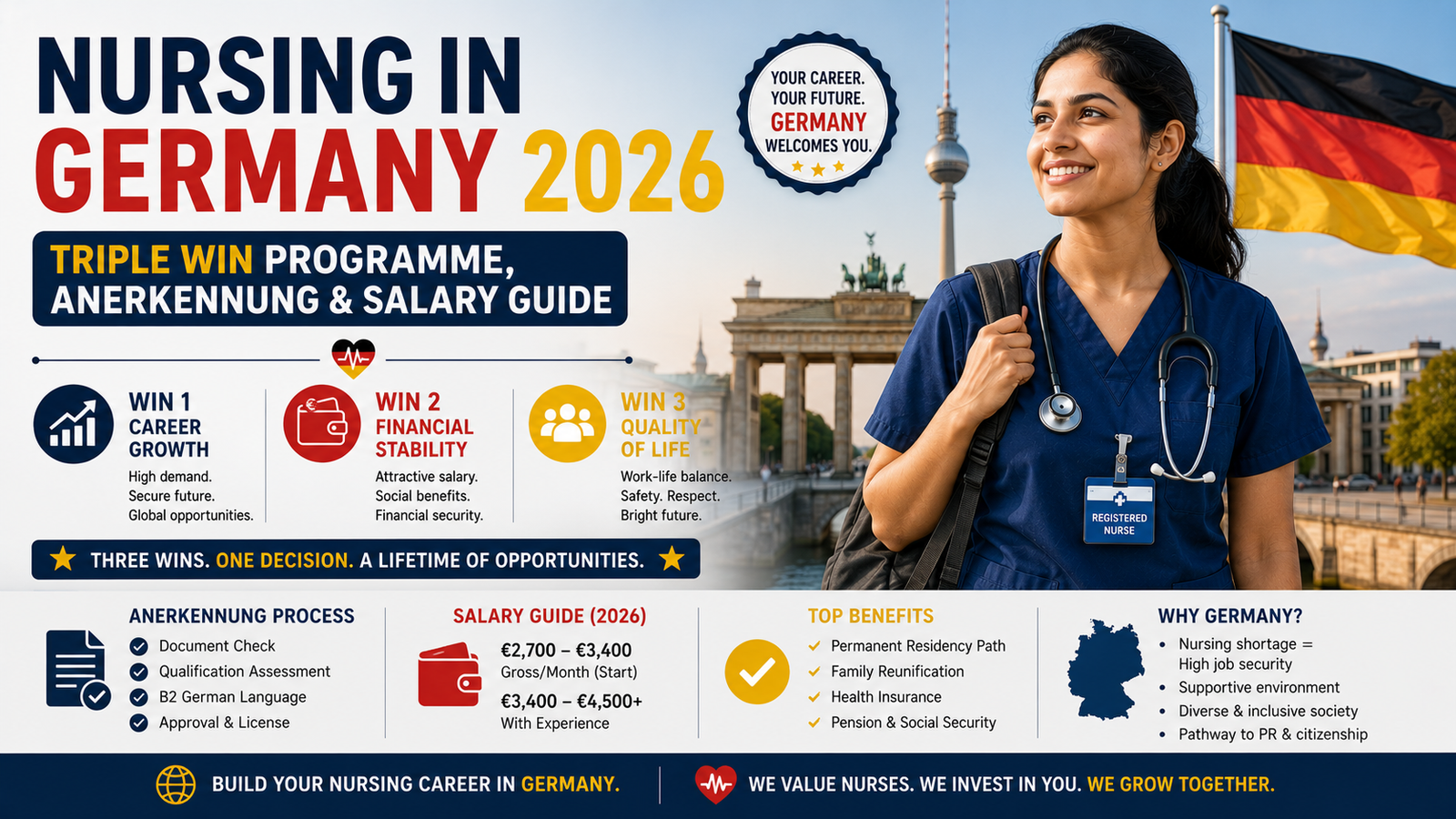
Germany needs nurses urgently: over 30,000 to 40,000 positions are unfilled right now according to the Federal Employment Agency, and projections run to 200,000 shortfall by 2030. More than 306,700 internationally recruited nursing staff are already working in German healthcare — one in five nurses in Germany is a foreign national. For Indian nurses from Kerala and Telangana, and for Filipino nurses, there is a free, government-run recruitment programme called Triple Win that has placed over 8,000 nurses since 2013 and which removes most of the financial barriers. This guide explains how it all works — the programme, the language requirement honestly, the Anerkennung process, the salary in both euros and rupees, and the honest case for and against a destination that rewards long-term investment but does not suit nurses seeking rapid deployment.
🩺 Going to the US as a nurse?
Get weekly vacancy alerts, EB-3 visa updates & daily NCLEX prep on WhatsApp — FREE.
📲 Follow the Channel🇩🇪 Nursing in Germany 2026 — Verified Data
Nurse shortage: 30,000–40,000 immediate; ~200,000 by 2030
Foreign nurses already working: 306,700+ (17.8% of total workforce)
Indian nurses in Germany: 8,800+ (as of 2024, growing fast)
Free government programme: Triple Win (GIZ + Federal Employment Agency)
Triple Win partner countries: India (Kerala + Telangana), Philippines, Indonesia, Tunisia
Language required: A2 to arrive (Anerkennungspartnerschaft visa, since March 2024); B2 for full licence
Salary during recognition: €2,200–€2,800/month (~₹2.02–2.57 lakh)
Salary after recognition: €2,800–€3,500/month (~₹2.57–3.22 lakh)
Anerkennung fee: €200–€600 (standard); €411 (accelerated — 2 months)
PR pathway: 5 years standard; 21 months via EU Blue Card with B1 German
Realistic total timeline: 12–14 months from start to first recognised shift
1. The Triple Win Programme — Germany’s Official Free Pathway
Triple Win is not a private recruitment agency. It is an official German government programme jointly run by the Federal Employment Agency (Bundesagentur für Arbeit / BA, through its international placement division ZAV) and the GIZ (Deutsche Gesellschaft für Internationale Zusammenarbeit — Germany’s international development cooperation agency). The programme has placed over 8,000 nurses and nursing trainees from partner countries in approximately 400 German hospitals and care facilities since 2013. More than 6,000 have already arrived. The post-placement satisfaction rate exceeds 90 percent.
The programme is entirely free for nurses. The costs of language course organisation, document coordination, job matching, and post-arrival integration support are borne by the German government and employers. No placement fee. No advance payment. No financial risk.
Which countries are eligible
Triple Win currently operates in four partner countries: India (specifically Kerala and Telangana), the Philippines, Indonesia, and Tunisia. Bosnia-Herzegovina is also a partner country. The programme specifically targets countries with a surplus of nursing professionals, which means it operates on an ethical recruitment model — it does not seek to strip source countries of their entire nursing workforce but works through state employment agencies with agreed quotas and mutual benefit frameworks.
For India: the partner authority is the employment agencies of Kerala and Telangana, who screen applications, verify credentials, and coordinate the process locally. For the Philippines: the Department of Migrant Workers (DMW) coordinates on the Philippine side. The partner authority checks your formal qualifications before you are selected, meaning your credentials are pre-vetted before you invest in language training.
What Triple Win provides
The programme organises language training up to B1 level in your home country, typically through a Goethe-Institut or a partner language school. It facilitates your job matching with a German hospital or care facility, conducts selection interviews in your country, coordinates the visa application and Anerkennung documentation, and provides support on arrival including help with bank accounts, health insurance registration, and navigating the initial German bureaucracy. GIZ field staff in Germany assist nurses throughout the first months of the adaptation period.
If you are from Kerala, Telangana, or the Philippines: apply to Triple Win first. Before you pay for German lessons, before you engage any private agency, before you start the Anerkennung process independently. The official website is triple-win-programm.de. The process is slower than some private agencies claim to be, but it is structured, fair, cost-free, and has a decade of verified outcomes behind it.
2. The Language Requirement — The Honest Version
B2 German is required for full professional registration as a nurse in Germany. This is non-negotiable. You cannot work independently as a registered nurse in a German hospital without B2 — it is the professional working standard, not a visa formality. Clinical assessments, handovers, medication communication, and patient conversations all happen in German, and patient safety depends on your ability to understand and be understood clearly.
What changed in March 2024 is the sequence, not the standard. The Anerkennungspartnerschaft visa allows nurses with A2 German and a binding job offer to arrive in Germany and complete their B1 and B2 training while employed in the adaptation phase. This removes the requirement to achieve B2 entirely before departure — instead you build A2 before arrival, continue to B1 while working in adaptation, and reach B2 on the path to full registration. The employer typically provides continued language course access or funding.
What does the language journey look like in practice?
A1 (beginner to basic): 2 to 3 months. Can be studied online or at a Goethe-Institut in India, Philippines, Nigeria. This level confirms you can form basic sentences and understand simple responses.
A2 (basic communication): 2 to 3 months. Required for the Anerkennungspartnerschaft visa. This is the level at which you can handle routine interactions but are not yet ready for a clinical environment independently.
B1 (intermediate): 2 to 3 more months. Required for simplified EU Blue Card PR (leads to 33-month permanent residence). You begin to hold clinical conversations at this level, understand instructions, and manage patient interactions with support.
B2 (upper intermediate — professional working standard): 3 to 4 more months. Required for full nursing licence and independent practice.
The total journey from zero to B2 is approximately 10 to 14 months of dedicated study. Through Triple Win, language courses are organised from the start, reducing the time-to-departure. Through the new Anerkennungspartnerschaft visa, the last stretch (B1 to B2) can happen in Germany while you are earning.
The honest framing: Germany is not suitable for a nurse who wants to begin working internationally within six months. The language is the price of entry to a destination that offers EU residence, stable employment, and a high-quality healthcare system. Nurses who have made it to B2 and full recognition consistently describe it as one of the more professionally rewarding environments they have worked in.
3. The Anerkennung Process — Professional Recognition
Anerkennung is Germany’s professional recognition procedure for non-EU nursing qualifications. It is conducted by the relevant state health authority (Landesbehörde) in the German state where your employer is located. The same qualification is assessed differently in different states — Bavaria and North Rhine-Westphalia may reach different conclusions about the same Indian nursing degree.
The application is submitted via anerkennung-in-deutschland.de or directly through the state portal. Required documents typically include: original nursing degree certificate with certified German translation, full academic transcripts, registration and licence verification from your home nursing council, professional experience letters, identity documents, and your language certificate.
Fee: €200 to €600 for standard processing, which takes 3 to 6 months. The Beschleunigtes Fachkräfteverfahren (accelerated skilled worker procedure) costs €411 and compresses recognition to approximately two months. For nurses who have an employer willing to initiate the procedure on their behalf, the accelerated route is usually worth the additional cost.
What happens after the assessment
Full recognition (Volle Anerkennung): your qualification is assessed as equivalent to a German nursing degree. Less common for non-EU nurses but happens when curriculum and clinical hours closely match German standards. You proceed directly to licensing.
Partial recognition (Teilanerkennung) — affects over 85 percent of non-EU nurses: the authority identifies differences between your training and German requirements. You must complete compensation measures:
Option A — Anpassungslehrgang (Adaptation Period). A supervised employment period of 3 to 36 months in a German healthcare facility, during which your clinical practice is assessed by a supervising nurse. You are employed and paid during this period: approximately €2,200 to €2,800 per month gross. At the end, if your assessor confirms competency, full recognition is granted. This is by far the more common and practical route — you earn while building your German clinical experience.
Option B — Kenntnisprüfung (Aptitude Test). A one-day examination consisting of written, oral, and OSCE-style practical components. Preparation courses cost €1,000 to €2,500 and take 3 to 6 months. Passing the Kenntnisprüfung leads directly to full recognition without the adaptation period. Some nurses prefer this route if they are confident in their clinical knowledge and want to bypass the supervision period. Most nurses choose Option A because the adaptation period carries less failure risk and provides income throughout.
4. Salary — Before and After Recognition
The German nursing salary is structured around collective bargaining agreements (Tarifvertrag), with TVöD (the public sector collective agreement) applying to hospital-employed nurses. The rate is not uniform across all employers — private care facilities sometimes pay below TVöD — but public hospitals and Triple Win placements typically follow the scale.
| Phase | Monthly Gross (EUR) | Approx. INR/month |
|---|---|---|
| Adaptation period (recognition phase) | €2,200–€2,800 | ₹2.02–2.57 lakh |
| After full Anerkennung (staff nurse) | €2,800–€3,500 | ₹2.57–3.22 lakh |
| Senior nurse / ICU / specialist | €3,500–€4,500+ | ₹3.22–4.13 lakh+ |
The employer deducts social security contributions (pension, health insurance, unemployment insurance, care insurance) from gross salary, typically around 20 to 22 percent. In Germany, this is not purely a cost to you — you are building pension entitlements and receiving comprehensive health insurance as part of it. The net take-home on €3,000 gross is approximately €2,300 to €2,400 per month. Germany’s cost of living varies significantly: Munich and Frankfurt are expensive; smaller cities in eastern Germany, North Rhine-Westphalia, and Bavaria outside Munich offer the same salary with meaningfully lower housing costs.
The comparison with India: a nurse earning ₹35,000 per month at home who reaches the adaptation phase in Germany at €2,200 per month is earning approximately six times as much, even before full recognition. The financial case is strong — but only after the language investment.
5. Visa and Permanent Residency
Getting there
Anerkennungspartnerschaft visa (since March 2024): requires A2 German, a binding job offer from a German employer who has agreed to support the recognition process. The visa allows you to work in a supervised nursing role, continue language training in Germany, and complete Anerkennung while employed. This is the most relevant visa for most nurses applying through Triple Win or similar employer-sponsored routes.
Fachkräftevisa (Skilled Worker Visa): the standard skilled worker visa, which requires a fully recognised qualification before application. Used by nurses who complete Anerkennung from their home country first — a slower process but one that results in a direct Skilled Worker Visa rather than the recognition partnership visa.
Permanent residence
Standard Niederlassungserlaubnis: after 5 years of legal employment and residence, with B1 German, a clean record, and pension contributions. You apply to your local Ausländerbehörde (immigration authority). The approval is not automatic but the criteria are clear and well-established.
EU Blue Card: nurses who meet the salary threshold for shortage occupations (approximately €43,000 per year, lower than the standard Blue Card threshold) can apply for an EU Blue Card after gaining full recognition. The Blue Card leads to permanent residence after 33 months — or 21 months if B1 German is demonstrated. Given that B1 is typically achieved before B2, many internationally recognised nurses become eligible for 21-month permanent residence via the Blue Card route. German citizenship follows after 8 years of legal residence (or 5 years for exceptional integration).
Germany is an EU member state. German residency is EU residency. German citizenship is EU citizenship — the same passport that opens 27 European Union countries, plus extensive visa-free access worldwide.
6. The Honest Trade-Offs
Germany is not a fast-deployment destination. The total timeline from beginning German language study to your first fully recognised nursing shift runs 12 to 14 months. Nurses who need income moving within six months should consider the UK, Ireland, or the Gulf first. Germany rewards nurses who plan ahead and invest in the language. It is genuinely unsuitable for those who cannot.
The language requirement is professional, not conversational. B2 German means the ability to function at a clinical working level — to understand handovers, to communicate with patients in distress, to document in German, to discuss medications. Nurses who arrive at B1 and plan to “pick up the rest quickly” often find clinical environments more demanding than language school prepared them for. The honest advice: reach B2 before clinical deployment even if the visa allows arrival at A2.
Over 85 percent receive partial recognition. The adaptation period is not an exception — it is the standard pathway for the vast majority of non-EU nurses. Plan for it. Budget for the adaptation salary (€2,200 to €2,800 per month), not the post-recognition salary, when calculating your first-year finances.
German bureaucracy is real. Registration requirements, Ausländerbehörde appointments, health insurance registration, and tax number applications are manageable but time-consuming. Triple Win nurses have GIZ support navigating these. Independent applicants need preparation and patience.
Germany is an exceptional long-term destination. Once established — language achieved, recognition complete, integration settled — Germany offers employment stability, comprehensive social benefits, a structured career ladder, strong trade union protections, and EU residence in one of the world’s most prosperous countries. Nurses who have gone through the full process consistently describe it as worth the investment. The path is long. The destination is real.
For the faster English-speaking alternatives: UK NHS Nursing Jobs 2026, Nursing in Ireland 2026. For the Gulf as a fast starting point: Nursing Jobs in the Gulf 2026. For the full multi-country comparison: UK vs Canada vs Australia for Nurses 2026.
7. Frequently Asked Questions
Can Indian nurses work in Germany?
Yes — and 8,800+ already do. Kerala and Telangana nurses have a dedicated Triple Win pathway: free, government-run, 8,000+ placed since 2013. Apply at triple-win-programm.de.
Can Filipino nurses work in Germany?
Yes. Philippines is a core Triple Win partner. Coordinate through the DMW in Manila. B.Sc. Nursing qualifies for assessment.
How much German do I need?
A2 to enter on the Anerkennungspartnerschaft visa (since March 2024). B2 for full professional registration. Learn A1+A2 before departure (~4-6 months), then B1+B2 while employed in Germany (~6-8 more months).
What is Anerkennung?
Germany’s professional recognition process. Applied via state health authority. Fee €200-€600 standard; €411 accelerated (2 months). 85%+ get partial recognition → adaptation period (paid, 3-36 months) or aptitude test.
How much is the salary?
Adaptation phase: €2,200-€2,800/month (~₹2-2.57 lakh). After recognition: €2,800-€3,500/month (~₹2.57-3.22 lakh). Approximately 6x Indian hospital nurse salary, even during adaptation.
How do I get PR in Germany?
Standard: 5 years + B1 German. EU Blue Card: 33 months (21 months with B1). Germany is EU — German residence is EU residence.
Is Germany worth it?
For nurses who want EU residence long-term and are willing to invest 12-14 months in German language: yes, genuinely. For nurses needing fast deployment: UK, Ireland, or Gulf first. Germany rewards depth of commitment, not speed.
The Bottom Line
Germany is the most demanding major nursing destination for internationally educated nurses — and one of the most rewarding for those who meet the demands. The language requirement is not a bureaucratic obstacle; it is the professional standard for a country where patient safety depends on clinical communication in German. The Anerkennung process is thorough because Germany’s healthcare system takes professional equivalence seriously.
What has changed is the sequence of steps. The March 2024 Anerkennungspartnerschaft visa means nurses from bilateral partner countries can now arrive with A2 German and build the remaining competency while employed. Combined with the Triple Win programme — which is free, ethical, government-backed, and has placed 8,000 nurses successfully — Germany has removed most of the financial risk from the pathway for nurses from Kerala, Telangana, and the Philippines.
Start at triple-win-programm.de if you are eligible. Start German classes today regardless. The 12 to 14 months that stand between you and your first German nursing shift are months you are spending somewhere anyway. The question is how you spend them — and building toward one of the most stable long-term nursing careers available — in a country that offers EU residence, comprehensive social protection, and a healthcare system that treats its nurses as professionals.
Related articles on GlobalNurseGuide.com:
UK NHS Nursing Jobs Guide 2026
Nursing Jobs in New Zealand 2026
NCLEX-RN Guide for Indian Nurses 2026
NCLEX Guide for Filipino Nurses
UK vs Canada vs Australia for Nurses 2026
Disclaimer:
This article is for informational purposes only and does not constitute immigration, legal, or career advice. Triple Win programme eligibility, processes, and partner countries are determined by the German Federal Employment Agency (BA/ZAV) and GIZ and are subject to change. Anerkennung requirements and procedures vary by German state authority. Salary figures are indicative ranges based on TVöD collective agreement data and publicly available employer information as of June 2026. The Anerkennungspartnerschaft visa requirements are per the German Federal Government’s Skilled Immigration Act as amended March 2024. EU Blue Card salary thresholds are updated periodically. Always verify current requirements at make-it-in-germany.com, triple-win-programm.de, and anerkennung-in-deutschland.de. Currency conversions approximate at June 2026 rates. GlobalNurseGuide.com is not affiliated with GIZ, the Federal Employment Agency, or any German health authority. Information current as of June 8, 2026.
© 2026 GlobalNurseGuide.com — Empowering Nurses Worldwide with Real Opportunities
Author
Discover more from Global Nurse Guide
Subscribe to get the latest posts sent to your email.



I am a GNM-qualified nurse from India and am very interested in working as a nurse in Germany. I am motivated to build my professional future in Germany and look forward to participating in your recruitment program.
Thank you for your time. I look forward to hearing from you.
Thank you for your interest, and we wish you the very best in your journey to becoming a nurse in Germany.
Please note that Global Nurse Guide provides information and step-by-step guidance only. We are not a recruitment agency and do not offer job placement or hiring services.
We recommend reading the guide carefully and following the steps outlined in the article, including the language requirements, qualification recognition process, and job application guidance. Following these steps will help you prepare for employment opportunities in Germany.
You can refer to the complete guide here: https://globalnurseguide.com/nursing-in-germany-2026/